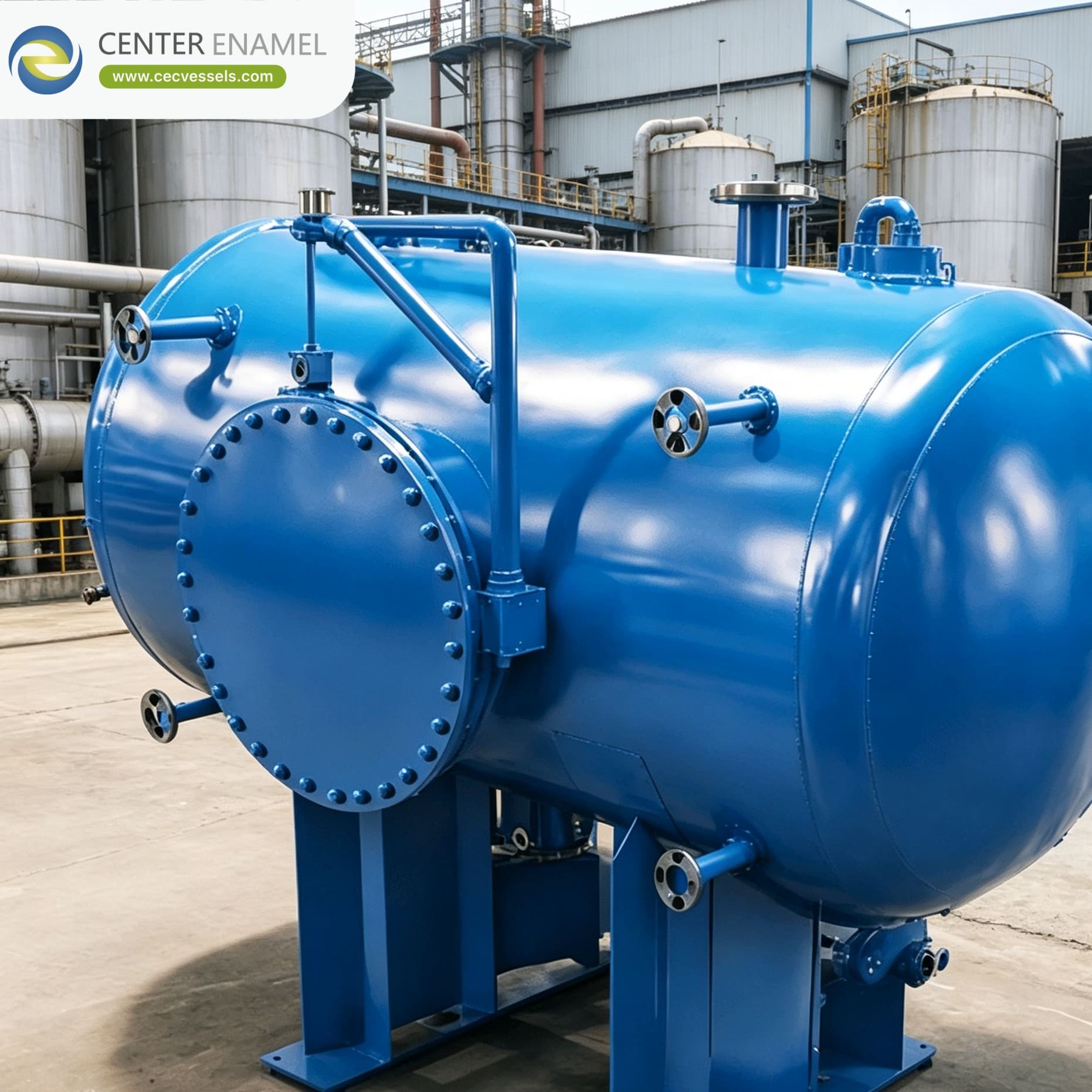
Agitated Vessel: Mixing and Agitation for Consistent Process Conditions
An Agitated Vessel is an industrial process vessel equipped with a mechanical mixing system designed to move, blend, disperse, or homogenize materials inside the vessel. It is widely used when production processes require consistent material distribution, controlled temperature, or uniform contact between different components. A typical agitated vessel consists of a vessel body, agitator shaft, motor, impeller, mechanical seal, and process connections. Depending on the application, the equipment can also include a jacket, internal coils, baffles, temperature sensors, liquid-level instruments, feed nozzles, sampling ports, and discharge outlets. The agitator is the central component of the system. When the motor drives the shaft and impeller, mechanical energy is transferred into the process material. This creates controlled circulation within the vessel and helps distribute materials throughout the working volume. Agitated vessels can be designed for batch, semi-batch, or continuous processing. The specific configuration depends on material properties, production capacity, mixing objectives, heat-transfer requirements, and process conditions. Center Enamel provides customized process vessels and reactor equipment designed around specific production requirements. Its equipment portfolio includes reaction vessels, storage vessels, separation vessels, heat exchange equipment, and other industrial process equipment. How Does an Agitated Vessel Work?The working principle of an Agitated Vessel is based on mechanical energy transfer and controlled fluid movement. Materials are introduced into the vessel through one or more feed connections. Once the required amount of material is loaded, the agitator motor starts rotating the shaft and impeller. As the impeller rotates, it generates a specific flow pattern inside the vessel. Depending on the impeller design, the resulting movement can be primarily axial, radial, or a combination of different flow directions. The circulation created by the agitator helps distribute materials throughout the vessel. When two or more liquid components are introduced, agitation promotes contact between them. When solids are present, the agitator can help maintain particle suspension. For gas-liquid processes, a suitable impeller can assist with gas dispersion. The vessel may also include a heating or cooling system. A jacket surrounding the vessel wall can circulate a heating or cooling medium, while the agitator continuously moves the process material. This combination helps distribute thermal energy throughout the working volume. During operation, instruments can monitor temperature, liquid level, flow, and agitator speed. The control system can then adjust operating parameters according to the established process procedure. Why Is Agitation Important in Process Equipment?Agitation provides controlled material movement inside the vessel and helps establish consistent process conditions. When different materials are combined, natural movement alone may not provide sufficient distribution. Differences in density, viscosity, particle size, or temperature can cause variations within the working volume. An appropriate agitator creates circulation that helps reduce these differences. It can distribute added materials throughout the vessel, improve contact between components, and support a more uniform process environment. Agitation is also important for temperature distribution. When a vessel is heated or cooled through a jacket, the material close to the vessel wall experiences heat transfer first. Continuous circulation moves material between the wall and the central region of the vessel, supporting more uniform temperature distribution. For suspension processes, agitation can keep solid particles moving within the liquid. For gas-liquid processes, an appropriate impeller can distribute gas through the liquid phase. Therefore, agitator selection should be considered together with vessel dimensions, material properties, heat-transfer requirements, and the intended process. What Are the Main Components of an Agitated Vessel?An Agitated Vessel contains several components that work together to provide controlled mixing and process operation. Vessel BodyThe vessel body provides the main processing chamber. Its diameter, height, working volume, and geometry are selected according to the required production capacity and material characteristics. The vessel can be manufactured from different materials depending on the process medium and operating conditions. Stainless steel is commonly used for applications requiring corrosion resistance, cleanability, and suitable surface characteristics. AgitatorThe agitator provides mechanical mixing. It normally includes an impeller, shaft, drive system, and sealing arrangement. The impeller is selected according to viscosity, density, solids content, gas content, vessel geometry, and required mixing pattern. Motor and Drive SystemThe motor supplies the mechanical energy required to rotate the agitator. A variable-frequency drive can be used when the process requires adjustable mixing speed. Different stages of production may require different agitation speeds, particularly when material viscosity changes during processing. Mechanical SealThe mechanical seal is installed around the rotating shaft where it passes through the vessel. Its configuration depends on the process medium, temperature, shaft speed, and equipment design. BafflesBaffles can be installed inside the vessel to influence the flow pattern generated by the agitator. They help redirect liquid movement and can reduce excessive rotational movement of the entire liquid mass, allowing more effective circulation. Heating and Cooling SystemA jacket or internal coil can be used to provide temperature control. Heating or cooling media circulate through the heat-transfer system while the agitator distributes the process material throughout the vessel. InstrumentationTemperature sensors, liquid-level instruments, flow meters, sampling ports, and other instruments can be incorporated according to the process requirements. These components provide information for monitoring and automatic control. How Is the Agitator Selected for an Agitated Vessel?Agitator selection is one of the most important parts of agitated vessel design. Different impeller types create different flow patterns and are suitable for different process materials. Propeller AgitatorsPropeller agitators generally produce strong axial flow and are suitable for low-viscosity liquids where rapid circulation is required. They can be used for blending, liquid circulation, and other processes where efficient bulk movement is the primary objective. Turbine AgitatorsTurbine impellers can generate radial or mixed flow depending on their design. They are suitable for applications requiring good dispersion and circulation across a relatively broad range of process conditions. Anchor AgitatorsAnchor agitators are designed to move material close to the vessel wall and are commonly considered for higher-viscosity materials. They can also support heat transfer by continuously moving material across the vessel wall. Helical Ribbon AgitatorsHelical ribbon agitators are suitable for highly viscous materials. Their geometry promotes circulation between different regions of the vessel and can help maintain material movement as viscosity increases. Center Enamel's technical information notes that agitator selection should consider viscosity, density, solids content, and mixing objectives. How Does Vessel Geometry Affect Mixing?Vessel geometry directly affects the circulation pattern created by an agitator. Important dimensions include vessel diameter, vessel height, liquid level, and the relationship between the impeller and vessel wall. For tall vessels, multiple impellers may be installed on the same shaft to create several circulation zones. This arrangement can help maintain material movement throughout the complete working height. The position of the impeller is also important. Different installation positions can produce different circulation patterns and influence how effectively material moves between the upper and lower regions. Baffles may be added to improve circulation and control rotational flow. For this reason, the agitator should not be selected independently from the vessel. The vessel dimensions, impeller type, shaft length, impeller position, baffle arrangement, and operating speed should be considered as one integrated mixing system. How Does an Agitated Vessel Control Temperature?Many industrial mixing processes require controlled temperature conditions. An Agitated Vessel can incorporate a jacket around the vessel wall. Heating or cooling media circulate through the jacket and transfer thermal energy through the vessel wall. As the agitator rotates, the process material circulates inside the vessel. This movement distributes the thermal energy transferred through the vessel wall and helps maintain a more uniform temperature. Internal coils can also be installed when additional heat-transfer area is required. Another option is an external circulation system. Process material can be transferred through an external heat exchanger and returned to the vessel. Temperature sensors can monitor the material temperature continuously. The control system can adjust heating or cooling according to the selected process parameters. Center Enamel's reactor equipment can be configured with jackets, internal coils, external heat-transfer systems, and temperature instruments according to process requirements. What Types of Processes Use Agitated Vessels?Agitated vessels are used across a wide range of industrial processes. Chemical ProcessingChemical manufacturers use agitated vessels for blending, dissolution, neutralization, synthesis, esterification, polymerization, and other processes. The agitator promotes contact between different components and supports uniform material distribution. Pharmaceutical ProductionPharmaceutical processes may require controlled mixing of ingredients, intermediates, solvents, and process solutions. Stainless steel construction, suitable internal surfaces, temperature control, and cleaning arrangements can be selected according to the application. Food and Beverage ProcessingAgitated vessels can be used for blending ingredients, preparing liquid formulations, dissolving solids, and controlled thermal processing. The equipment can be designed with suitable materials and internal finishes according to production requirements. Resin and Polymer ProcessingResin production often involves changes in viscosity during processing. The agitator therefore needs to maintain suitable circulation as the material changes. Anchor, turbine, ribbon, or multiple-impeller configurations can be selected according to the material properties. Center Enamel's polymerization reactor information emphasizes the relationship between agitator selection, viscosity, reactor dimensions, and process requirements. Pigment and Coating ProductionAgitated vessels are also used for pigment dispersion, coating preparation, and other material-blending applications. An appropriately selected agitator helps distribute pigment particles and other ingredients throughout the liquid medium. Center Enamel specifically describes agitator reactors for pigment mixing as vessels designed to provide controlled mixing and uniform dispersion. Environmental ProcessingSelected wastewater and environmental processes can use agitated vessels for chemical dosing, neutralization, blending, and other treatment steps. The agitator helps maintain uniform distribution of treatment chemicals throughout the process liquid. What Factors Should Be Considered When Designing an Agitated Vessel?The design of an Agitated Vessel should be based on the actual process rather than a standard vessel configuration. Important information includes working volume, total volume, liquid density, viscosity, solids content, particle size, material composition, required mixing time, operating temperature, heating or cooling requirements, and production capacity. The required mixing intensity should also be established. Low-viscosity liquids may require relatively simple circulation, while viscous materials may require larger impellers, multiple impellers, or specialized mixing configurations. The vessel material should be selected according to chemical compatibility and process requirements. The heating or cooling system should be designed according to the required heat-transfer capacity. Additional equipment such as baffles, sampling ports, manways, spray devices, level instruments, temperature sensors, and automatic controls can be integrated according to the process. Center Enamel develops customized process equipment based on vessel dimensions, material characteristics, mixing requirements, heat transfer, instrumentation, and plant layout. Why Choose Center Enamel as a China Agitated Vessel Manufacturer?Center Enamel provides customized industrial process equipment for chemical, pharmaceutical, food, environmental, and other manufacturing applications. As a China Agitated Vessel Manufacturer, Center Enamel can develop vessel systems according to specific process requirements, including capacity, material selection, agitator configuration, heat-transfer method, instrumentation, and control system. The company's manufacturing capabilities cover different types of industrial process vessels and equipment. Its product portfolio includes reaction pressure vessels, storage pressure vessels, separation pressure vessels, heat exchange pressure vessels, and other customized equipment. Center Enamel also provides integrated services covering product design, research and development, production, installation, commissioning, and after-sales support. The company states that its equipment can be manufactured according to international standards including ASME and BS EN 13445. For customers looking for China Agitated Vesselequipment, Center Enamel can customize the vessel and mixing system according to the actual process conditions and production requirements. Customized Agitated Vessel Solutions from Center EnamelAn Agitated Vessel is more than a tank equipped with a motor. It is an integrated process system in which vessel geometry, agitator design, material selection, heat transfer, instrumentation, and process control work together. The appropriate agitator creates controlled circulation inside the vessel, helping distribute materials, maintain consistent temperature, support particle suspension, and improve contact between different components. Center Enamel can customize agitated vessels for different industrial processes, including chemical production, pharmaceutical manufacturing, food processing, pigment dispersion, resin production, polymer processing, and environmental applications. By combining process engineering with vessel manufacturing capabilities, Center Enamel provides Agitated Vesselsolutions designed around working volume, material properties, mixing requirements, temperature control, production capacity, and plant layout. For industrial projects requiring consistent mixing and controlled process conditions, Center Enamel can develop a customized agitated vessel and agitation system to match the specific requirements of the production process.
|