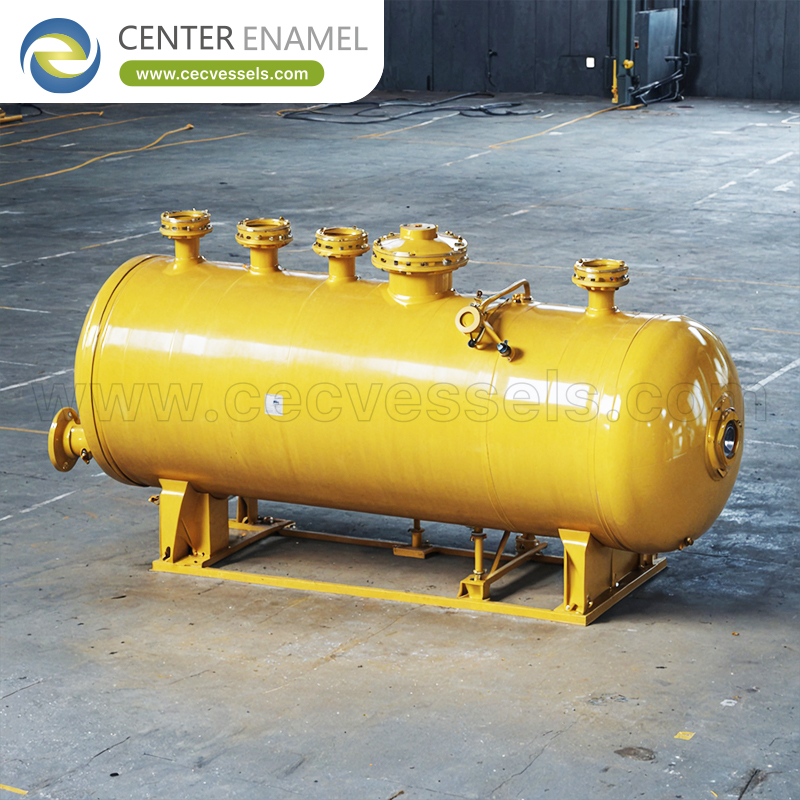
China Delayed Coking Reactor Manufacturer:Advanced Design for Efficient Petroleum Refining Processes
The Delayed Coking Reactor (often referred to as a Coke Drum) is a core component of the delayed coking unit in petroleum refining. This unit is essential for upgrading heavy, low-value refinery residues (e.g., vacuum residue, pitch) into more valuable products: liquid distillates (naphtha, kerosene, gas oil) and solid petroleum coke.
The process operates discontinuously in large vessels: heavy residue is heated rapidly in a furnace to extreme temperatures and then flashed into the Coke Drums. Coking occurs over a long residence time as the heat slowly converts the heavy hydrocarbons into lighter vapors (which exit for recovery) and solid coke (which accumulates in the drum).
Key industrial challenges define the engineering of these systems:
l Extreme High-Temperature Operation: The vessels must withstand temperatures. l Severe Thermal Cycling: The drums are repeatedly cycled between the coking temperature and the quenching temperature during the filling/cutting cycle. l Structural Resilience: The drums must support immense weight (hundreds of tons) of solid coke and water/steam during operation and quenching.
At the forefront of manufacturing these essential, ultra-high-integrity process vessels is Shijiazhuang Zhengzhong Technology Co.,Ltd (Center Enamel). Leveraging decades of excellence in the design and fabrication of robust Pressure Vessels for severe thermal, cyclic, and high-stress service, Center Enamel has strategically established itself as a leading China Delayed Coking Reactor Manufacturer. Our equipment features specialized metallurgy, integrated stress-mitigation designs, and rigorous compliance with global safety codes to guarantee thermal stability, sustained operational life, and uncompromising structural integrity against thermal fatigue.
Center Enamel is the trusted global partner for petroleum refiners where operational uptime, asset longevity, and uncompromising structural integrity are strategic priorities.
Engineering for Extreme Conditions: Core Applications of Center Enamel’s Reactors
Center Enamel’s ultra-high-integrity reactors and Pressure Vessels are indispensable in crude oil upgrading processes. Our technical focus ensures superior metallurgical performance, exceptional resistance to thermal cycling, and long-term asset reliability across various critical applications within the delayed coking unit.
1. Central Application Spotlight: Residue Upgrading and High-Value Coke Production
The primary application is the conversion of vacuum residue into lighter, marketable fuels and various grades of petroleum coke.
Upgrading Heavy Crude Residues: The Coke Drum serves as the reaction vessel where the large, non-volatile hydrocarbon molecules crack into smaller, valuable vapor products (distillates) and solid coke. This process involves precise thermal management during the filling and soaking phases, demanding a vessel built with specialized materials to retain strength at extreme high temperatures. As a premier Delayed Coking Reactor Manufacturer, our focus is on vessels featuring optimized internal profiles to promote even coke accumulation and facilitate easy removal.
Fuel Grade Coke Production: Used to produce a standard grade of coke utilized in power generation or cement production. This process requires reactors designed for high throughput and rapid cycling, emphasizing the need for superior weld quality and post-weld heat treatment (PWHT) to mitigate residual stresses that could accelerate fatigue cracking.
Anode Grade Coke Production: Used to produce a high-purity, low-sulfur coke required for the aluminum smelting industry. This application demands extremely tight process control over temperature to achieve the desired coke structure, requiring coke drums fabricated with precise dimensional control and robust thermal monitoring ports.
2. Specialized Industrial Applications Within the Coking Process
The technology principles extend to other critical parts of the coking unit that share similar severe conditions.
Coke Drum Skirt Supports: The massive, cylindrical coke drum rests on a support skirt which experiences the most severe thermal cycling (due to the large temperature differential between the hot drum shell and the cooler baseplate). Our manufacturing focuses on the design and meticulous fabrication of the skirt-to-shell connection using specialized welding procedures and stress analysis (e.g., Finite Element Analysis FEA) to prevent fatigue cracking at this highly stressed junction.
Transfer Lines and Furnace Piping: The piping that transfers the hot residue from the furnace to the coke drum operates under similar extreme thermal conditions and handles highly viscous, fouling fluids. Although not the reactor vessel itself, Center Enamel applies similar high-temperature metallurgical and welding standards to these critical piping components.
Quenching System Design: During the cooling cycle, water and steam are injected. The drum must handle the rapid thermal shock. Our design accounts for the local temperature gradients during quenching, using precise material thickness and weld location optimization to prevent localized brittle fracture or accelerated fatigue damage.
Engineering Excellence: Center Enamel’s Technical Foundation
Manufacturing a high-integrity Delayed Coking Reactor requires the highest level of metallurgical control, stress analysis for cyclic service, and specialized fabrication techniques to ensure longevity under extreme thermal stress. Center Enamel’s approach is validated by adherence to the world's most rigorous engineering standards.
Unwavering Compliance with Global Engineering Codes and Certifications
As a premier China Delayed Coking Reactor Manufacturer, our commitment to structural safety and quality is validated by adherence to the most trusted global and national standards:
The ASME Boiler & Pressure Vessel Code (BPVC): Full compliance with ASME BPVC Section VIII (Div. 1 and 2) is fundamental. For Coke Drums, this is extended by API 579 Fitness-for-Service and API 537 Design guidelines. This ensures the structural integrity of the Pressure Vessel under all specified static (coke load), dynamic (cutting), and cyclic (thermal fatigue) loads.
BS EN 13445 (European Standard): We comply with the European standard for unfired pressure vessels. This is crucial for verifying the complex stress analysis, especially for the high-thickness shell sections and critical skirt-to-shell junction, which are prone to thermal fatigue cracking.
GB/T 150.1-150.4-2024 (Chinese National Standard): Adherence to the highest Chinese National Standards for Pressure Vessels further affirms our analytical design methods, material traceability, and fabrication precision for severe thermal and cyclic service.
Precision Manufacturing for Thermal Fatigue Resistance and Durability
Our fabrication processes are meticulously specialized to ensure the reactor's longevity and reliable operation despite daily thermal cycling:
Specialized Metallurgy for High Temperature: We utilize certified, high-grade Chrome-Molybdenum steels for their superior creep resistance and strength retention at extreme high temperatures. Our procurement and material handling procedures ensure zero contamination of these critical alloys.
Advanced Finite Element Analysis (FEA): Every coke drum design undergoes extensive FEA to precisely map stress concentrations and thermal gradients, particularly at the skirt-to-shell junction and skirt openings, allowing us to implement design modifications (e.g., complex gussets, specialized insulation design) to mitigate stress risers and prolong fatigue life.
Meticulous Welding and PWHT: The thick-wall welding process is strictly controlled to ensure 100% penetration and minimize residual stresses. Post-Weld Heat Treatment (PWHT) is applied with extremely tight temperature control and uniformity to optimize the metallurgical structure and remove residual stresses, which is the single most critical step for maximizing resistance to thermal fatigue cracking.
Flawless Dimensional Control and Alignment: Due to the daily mechanical coke cutting operation, the internal dimensional tolerance and verticality of the drum are critical. We use advanced laser tracking and measurement techniques during fabrication to ensure the coke drum is built to the tightest specifications, guaranteeing smooth operation of the coke cutting equipment and minimizing downtime.
Shijiazhuang Zhengzhong Technology Co.,Ltd: Global Manufacturing Powerhouse
Center Enamel’s ability to consistently supply these highly specialized, ultra-high-integrity Delayed Coking Reactor systems worldwide is a testament to our vast manufacturing scale and corporate stability.
Unmatched Production Capacity and Strategic Scale
Our operational infrastructure is optimized for high-specification global project delivery:
150,000㎡ Production and R&D Base: This massive, integrated facility is the logistical and technical heart of our operation. The 150,000㎡ production base is equipped with heavy-duty machinery for forming and welding massive, thick-walled shell sections typical of coke drums, alongside specialized furnaces for uniform PWHT of these large components. This immense scale ensures that we can manage the concurrent fabrication of multiple critical Pressure Vessels and complex coking systems with reliable lead times.
R&D Focus on Thermal Fatigue and Stress Analysis: Our R&D investment centers on continuous improvement in metallurgical properties for cyclic service and applying advanced FEA techniques to enhance the longevity of critical components against the daily thermal shock inherent to the delayed coking process.
Corporate Assurance and Global Partnership
Center Enamel's long-standing reputation is built on decades of stable, high-quality manufacturing and global client trust:
Certified International Quality and Safety System: Our entire manufacturing and management system is rigorously certified to comply with leading global standards, ensuring clients of consistency, accountability, and adherence to the highest standards of corporate governance in every project phase.
Extensive Global Project Success: Our high-integrity Pressure Vessels and delayed coking reactors are deployed in mission-critical applications across diverse global regions, supporting major refining and energy producers. This successful track record validates our capability to handle the complex technical specifications, diverse regulatory requirements, and demanding logistics of international extreme thermal, cyclic, and high-stress service projects. The Definitive Choice for Residue Upgrading Assets
The reliable and efficient performance of heavy oil upgrading processes relies entirely on the structural integrity and longevity of the Delayed Coking Reactor, demanding a vessel built with specialized design features for extreme high-temperature endurance, resistance to severe thermal cycling, superior metallurgical quality, and uncompromising structural integrity at elevated temperatures.
Shijiazhuang Zhengzhong Technology Co.,Ltd (Center Enamel) is the definitive global partner for this requirement. We unite the ultimate structural resilience of a world-class Pressure Vessels manufacturer with the specialized metallurgical, thermal fatigue, and stress analysis engineering required for the most demanding delayed coking service. Our position as a premier China Delayed Coking Reactor Manufacturer is validated by our strict compliance with The ASME Boiler & Pressure Vessel Code (BPVC), BS EN 13445, and GB/T 150.1-150.4-2024, and solidified by the immense capacity of our 150,000㎡ production and R&D base.
Choose Center Enamel to invest in advanced, ultra-high-integrity equipment that guarantees the safety, efficiency, and longevity of your most critical delayed coking reactor applications. We provide the technical foundation for process excellence and controlled heavy residue upgrading. |