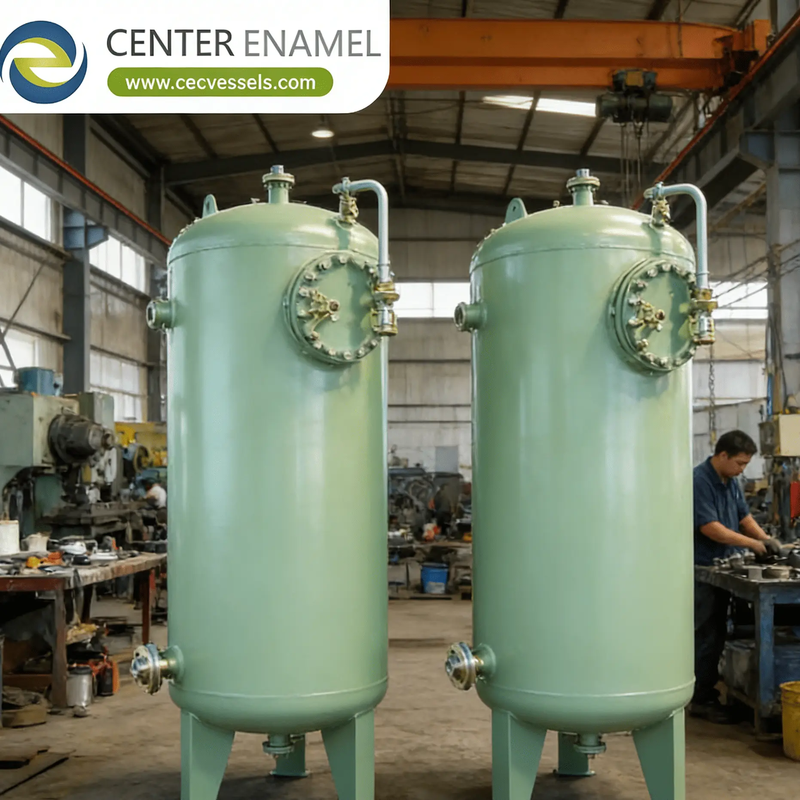
Center Enamel is a professional China Separators Manufacturer supplying custom industrial separator vessels for gas-liquid, liquid-liquid, oil-water, and multiphase separation applications. Our separators are engineered according to process requirements, material conditions, vessel configuration, and applicable international design standards.
What Is an Industrial Separator?
An industrial separator is process equipment designed to divide a mixed stream into two or more phases based on differences in density, particle size, phase behavior, or other physical properties. Separators are widely used in oil and gas processing, petrochemical production, chemical manufacturing, wastewater treatment, food processing, pharmaceutical production, and other industrial applications.
Depending on the process, a separator can remove liquid droplets from gas, separate oil from water, divide gas from liquid, or separate oil, gas, and water from a multiphase stream.
As a China Separators Manufacturer, Center Enamel provides engineered separator vessels that can be customized according to flow rate, operating temperature, fluid properties, required separation efficiency, vessel orientation, material selection, and installation conditions.
How Does a Separator Work?
Most industrial separators use a combination of gravity separation, momentum change, residence time, and internal separation components.
When a mixed process stream enters the separator, the inlet device reduces excessive flow momentum and distributes the incoming material inside the vessel. Components with different densities then move at different rates. Heavier liquid phases settle toward the lower section, while lighter gas or liquid phases move toward the upper section.
Additional internal components can improve separation performance. These may include inlet diverters, baffles, coalescing devices, demister pads, mist eliminators, weirs, vortex breakers, and other customized internals.
The separated phases are then discharged through dedicated outlets.
The actual design depends on the characteristics of the process stream. Flow rate, density, viscosity, particle loading, temperature, residence time, droplet size, and required outlet quality can all influence separator design.
What Types of Separators Can Be Manufactured?
Different industrial processes require different separator configurations. Center Enamel can provide customized separator vessels for a range of separation duties.
Two-Phase Separators
Two-phase separators are designed to divide a process stream into two primary phases, commonly gas and liquid.
Gas-liquid separators are widely used to remove entrained liquids from gas streams and to recover gas from liquid streams. They can be applied in oil and gas processing, chemical plants, petrochemical facilities, and other process systems.
Typical internal components include inlet diverters, baffles, mist eliminators, and liquid collection sections.
Three-Phase Separators
Three-phase separators are designed to separate gas, oil, and water from a mixed process stream.
They are commonly used in oil production, petroleum processing, produced water treatment, and related applications. The separator provides sufficient residence time for the different phases to form separate layers based on their physical properties.
Customized internal components such as weirs, interface-control devices, baffles, and mist eliminators can be incorporated according to the process requirements.
Gas-Liquid Separators
Gas-liquid separators focus on removing liquid droplets from gas or separating gas from a liquid stream.
They can be designed in vertical or horizontal configurations depending on flow characteristics, available space, liquid loading, and required separation performance.
Oil-Water Separators
Oil-water separators are designed to separate oil and water based on differences in density and physical behavior.
They are commonly used in wastewater treatment, industrial water treatment, petroleum processing, marine applications, and other facilities where oil removal is required.
Coalescing Separators
Coalescing separators use specially designed internal elements to promote the combination of small droplets into larger droplets. Larger droplets can then be separated more effectively by gravity.
This configuration is useful when a process requires enhanced liquid-liquid or gas-liquid separation performance.
Production and Test Separators
Production separators are used for continuous processing of production streams, while test separators are designed for measuring and evaluating individual production streams.
Test separator vessels can be configured according to flow measurement requirements, phase composition, process conditions, and field installation requirements.
What Are the Main Separator Configurations?
Industrial separators are commonly available in vertical and horizontal configurations.
Vertical Separators
Vertical separators are often suitable when liquid handling and gravity separation are important considerations. Their configuration can provide effective liquid collection and phase separation within a relatively compact footprint.
Vertical separators can be customized with different inlet devices, demister arrangements, liquid outlets, level-control components, and other internals.
Horizontal Separators
Horizontal separators provide a larger interface area and longer separation path for certain applications. They are commonly considered for processes involving significant liquid volumes or three-phase separation.
Horizontal configurations can incorporate inlet diverters, coalescing elements, mist eliminators, weirs, baffles, and dedicated outlet arrangements.
The selection between vertical and horizontal construction should be based on process conditions rather than vessel shape alone.
What Are the Main Components of a Separator Vessel?
A separator consists of more than the outer vessel shell. Internal components play an important role in controlling flow and improving separation efficiency.
Typical components may include:
Vessel shell
Heads
Inlet nozzle
Outlet nozzles
Inlet diverter
Baffles
Demister pad
Mist eliminator
Coalescing elements
Weirs
Vortex breakers
Liquid collection section
Level-control connections
Drain and vent connections
Inspection openings
Supports and lifting components
The final configuration is determined by the process design and customer specifications.
Which Materials Are Used for Industrial Separators?
Material selection depends on the process medium, operating conditions, temperature, corrosion requirements, fabrication requirements, and applicable standards.
Common materials include carbon steel and stainless steel grades such as SS304 and SS316.
For applications involving specific chemical compositions or demanding process conditions, additional material considerations may be required. Surface treatment, internal coating, corrosion allowance, and material compatibility can also be incorporated into the engineering design.
Center Enamel evaluates the process requirements before recommending the appropriate material and construction configuration.
How Is a Separator Designed for a Specific Application?
A separator should be designed around the actual process conditions rather than selected only by nominal vessel size.
Important design parameters may include:
These parameters influence vessel dimensions, internal components, nozzle positions, material selection, and overall configuration.
For this reason, customized engineering is an important part of separator manufacturing.
Where Are Industrial Separators Used?
Industrial separators are used across a wide range of processing industries.
Oil and Gas
Separators are commonly used to divide oil, gas, and water from production streams. They can be integrated into gathering systems, production facilities, processing plants, and related equipment packages.
Petrochemical Industry
Petrochemical facilities use separators for gas-liquid separation, hydrocarbon recovery, liquid removal, and process stream management.
Chemical Industry
Chemical plants may use separator vessels for separating process fluids, recovering valuable materials, removing unwanted phases, and improving downstream process stability.
Wastewater Treatment
Industrial wastewater systems can use oil-water separators and other separation equipment to remove oil, suspended materials, and different liquid phases before subsequent treatment stages.
Food and Beverage
Separators can be used in food and beverage processing where controlled phase separation and process fluid management are required.
Pharmaceutical and Bioprocessing
Specialized separator vessels can be designed for applications where material compatibility, cleanability, surface finish, and controlled process conditions are important.
Why Choose Center Enamel as a China Separators Manufacturer?
Center Enamel combines pressure vessel engineering, fabrication capabilities, quality control, and international project experience to provide customized separator solutions.
Customized Separator Engineering
Each separator can be designed according to the customer's process parameters, vessel dimensions, internal components, material requirements, and applicable standards.
Multiple Material Options
We work with carbon steel and stainless steel materials to meet different process requirements and application conditions.
Advanced Manufacturing Facilities
Center Enamel operates a large production and R&D base equipped with automated welding and fabrication equipment. These manufacturing capabilities support consistent fabrication quality for different separator configurations.
Quality Inspection
Separator vessels can undergo appropriate inspection and testing procedures during manufacturing. Depending on project requirements, quality control may include dimensional inspection, weld inspection, non-destructive testing, hydrostatic testing, and final inspection.
International Design Standards
Our engineering capabilities support projects designed according to applicable international and regional standards, including ASME Boiler and Pressure Vessel Code, BS EN 13445, and GB/T 150.
The applicable standard is selected according to the project location, customer requirements, vessel design, and regulatory conditions.
What Should You Consider When Selecting a Separator Manufacturer?
Choosing a separator manufacturer involves more than comparing product prices.
Customers should consider whether the manufacturer can provide:
Process-based separator design
Suitable material selection
Customized internal components
Appropriate vessel configuration
International engineering standards
Quality inspection and testing
Fabrication and welding capabilities
Documentation and technical support
Project experience
Global delivery and after-sales support
A manufacturer with integrated engineering and fabrication capabilities can help reduce communication gaps between process design and equipment production.
What Information Is Needed for a Separator Quotation?
To prepare an accurate separator proposal, customers should provide as much process information as possible.
Useful information may include:
Separator type
Process medium
Gas and liquid flow rate
Operating temperature
Design temperature
Fluid density and viscosity
Required separation performance
Vessel orientation
Material preference
Vessel dimensions
Nozzle requirements
Applicable design standard
Installation location
Quantity
Special inspection or certification requirements
If complete information is not available, our engineering team can review the available project parameters and help determine the required specifications.
Separator Manufacturing and Quality Control
Reliable separator performance depends on both engineering design and fabrication quality.
Center Enamel applies controlled fabrication procedures throughout the manufacturing process. Material verification, cutting, forming, welding, dimensional inspection, non-destructive testing, and final quality inspection can be incorporated according to project requirements.
Automated welding and professional fabrication equipment help improve consistency during vessel manufacturing.
Internal components are also checked for dimensions, alignment, and installation accuracy before final delivery.
This integrated approach helps ensure that the finished separator matches the approved engineering design.
Global Separator and Pressure Vessel Project Experience
Center Enamel has supplied pressure vessel and process equipment solutions for customers in different industries and regions.
Our project experience covers chemical processing, environmental protection, wastewater treatment, petrochemical applications, and other industrial fields.
For example, our project references include chemical industry equipment such as coalescing oil separators, resin tanks, fiber adsorption tanks, condensate tanks, and other process vessels.
Project requirements can vary significantly from one application to another. Therefore, Center Enamel focuses on customized engineering rather than applying a single standard configuration to every project.
FAQ About China Separators Manufacturer
What is the difference between a two-phase and three-phase separator?
A two-phase separator normally separates two primary phases, such as gas and liquid. A three-phase separator is designed to separate three phases, commonly gas, oil, and water.
Can separator vessels be customized?
Yes. Separator vessels can be customized according to process flow, medium properties, temperature, vessel dimensions, materials, internal components, nozzle arrangements, and applicable design standards.
Are vertical and horizontal separators both available?
Yes. The appropriate configuration depends on the process conditions, liquid handling requirements, available installation space, and desired separation performance.
What materials can be used for separator vessels?
Common options include carbon steel and stainless steel such as SS304 and SS316. Material selection should be based on process medium compatibility and project requirements.
What standards can Center Enamel support?
Center Enamel can support separator projects designed according to applicable standards such as ASME BPVC, BS EN 13445, and GB/T 150, depending on project requirements.
How can I get a separator quotation from Center Enamel?
Send us your separator specifications, process parameters, drawings, or project requirements. Our engineering team can review the information and provide a customized separator solution and quotation.
Get a Custom Separator Solution from Center Enamel
As an experienced China Separators Manufacturer, Center Enamel provides customized separator vessels for oil and gas, petrochemical, chemical, wastewater treatment, food processing, pharmaceutical, and other industrial applications.
From process evaluation and vessel design to fabrication, inspection, testing, and delivery, our team provides integrated engineering support for separator projects.
If you are looking for a China Separators Manufacturer for a new industrial project, send us your process requirements or equipment specifications. Our engineering team will evaluate your application and develop a separator solution tailored to your project.


