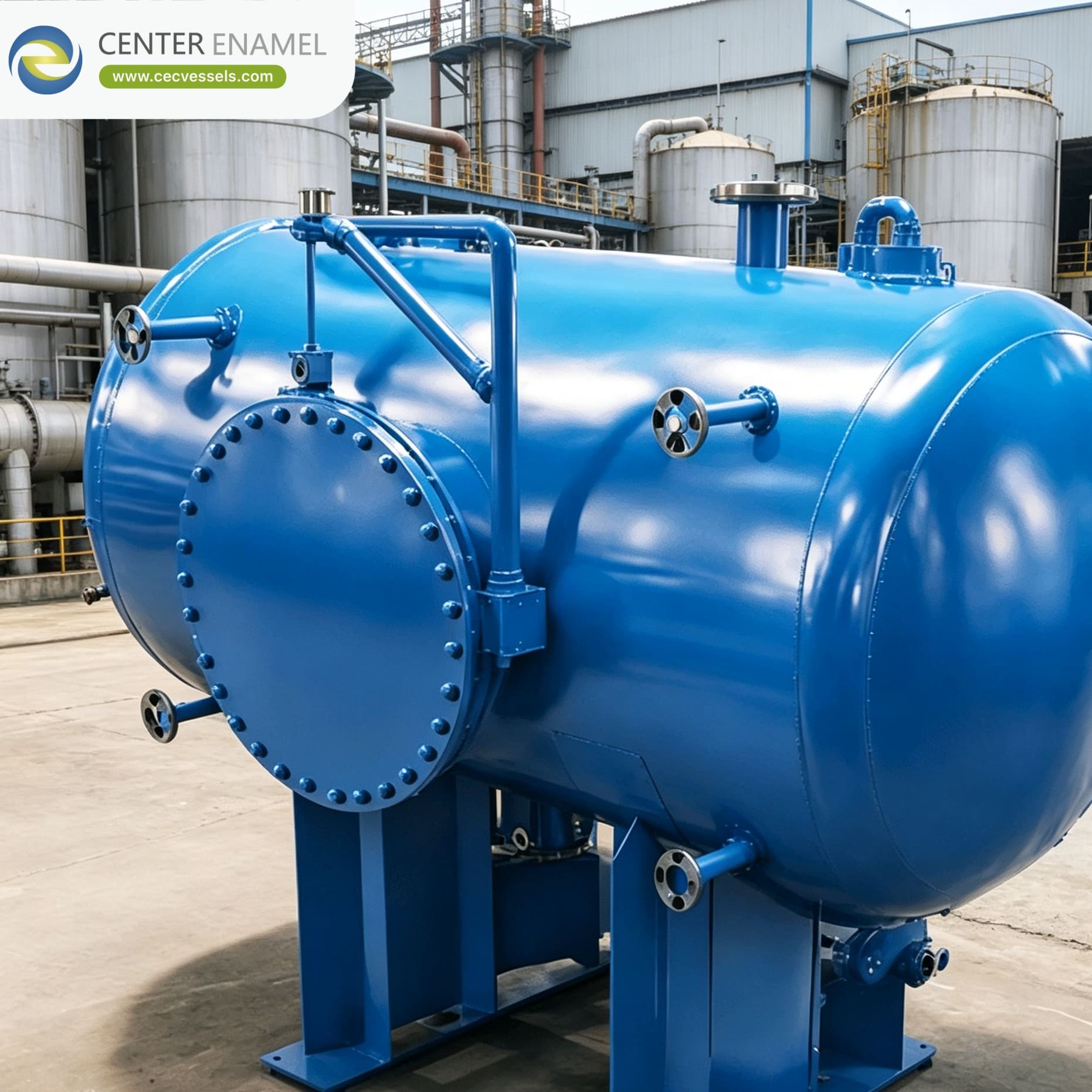
Falling-Film MVR Evaporator for Energy-Efficient Industrial Liquid Concentration
A Falling-Film MVR Evaporatoris an industrial evaporation system that combines falling-film heat transfer technology with Mechanical Vapor Recompression (MVR). It is designed to concentrate liquid materials by removing water or other volatile components while recovering and reusing thermal energy. Unlike conventional evaporation systems that mainly depend on continuous external steam supply, MVR technology recycles secondary vapor generated during the evaporation process. Combined with the falling-film configuration, this technology provides an efficient solution for continuous industrial liquid concentration. Center Enamelprovides customized evaporation equipment for chemical processing, food production, pharmaceutical manufacturing, biotechnology, and industrial wastewater treatment. How Does a Falling-Film MVR Evaporator Work?The operating principle of a Falling-Film MVR Evaporatorinvolves liquid distribution, heat transfer, vapor generation, vapor compression, and thermal energy recovery. The process generally follows these steps: Step 1: Feed Liquid Distribution The raw liquid enters the upper distribution section of the evaporator. A specially designed distribution system spreads the feed evenly across the internal heat-transfer tubes. Step 2: Falling-Film Formation Under gravity, the liquid flows downward along the heated tube walls, forming a thin liquid film. This configuration provides an effective heat-transfer surface and allows the liquid to move continuously through the evaporation section. Step 3: Evaporation Thermal energy passes through the tube walls and heats the liquid film. A portion of the water or other volatile components evaporates, while the remaining liquid becomes increasingly concentrated. Step 4: Vapor-Liquid Separation The generated secondary vapor is separated from the concentrated liquid through a vapor-liquid separator. The vapor is then directed toward the MVR compressor. Step 5: Mechanical Vapor Recompression The MVR compressor increases the temperature and enthalpy of the recovered vapor, allowing it to serve as a reusable heating medium. Step 6: Thermal Energy Recovery The compressed vapor returns to the heating section and transfers its thermal energy to the process liquid. During heat transfer, the vapor condenses and releases useful heat. Step 7: Concentrated Product Discharge The concentrated liquid is discharged from the evaporation system or transferred to another processing stage according to the required final concentration. This continuous cycle allows the system to reuse thermal energy generated during evaporation, reducing dependence on additional heating steam. What Are the Main Advantages of Falling-Film MVR Evaporation?A Falling-Film MVR Evaporatoroffers several advantages for industrial liquid concentration. Efficient Heat Transfer The liquid forms a thin film along the heating surface, providing effective contact between the process liquid and the heat-transfer tubes. This configuration supports rapid thermal transfer and efficient evaporation. Reduced Thermal Exposure The continuous downward flow allows the liquid to pass through the heating section within a relatively short residence time. This characteristic is particularly useful for selected heat-sensitive materials that require controlled thermal processing. Energy Recovery MVR technology recovers secondary vapor and reuses its thermal energy. This reduces the requirement for continuous fresh steam compared with conventional evaporation configurations. Continuous Production The system supports continuous feed introduction, vapor generation, and concentrated product discharge. It is suitable for industrial production lines requiring stable processing capacity. Flexible Equipment Configuration The evaporator can be customized according to feed characteristics, evaporation capacity, concentration requirements, material selection, and available installation space. Actual energy consumption and evaporation performance depend on feed properties, operating temperatures, heat-transfer area, compressor efficiency, and system configuration. What Are the Main Components of a Falling-Film MVR Evaporator?A complete Falling-Film MVR Evaporator Systemconsists of several interconnected components.
The design and capacity of each component should be coordinated according to the required evaporation rate and production conditions. What Industries Use Falling-Film MVR Evaporators?Falling-Film MVR Evaporatorsare suitable for various industries requiring continuous liquid concentration and efficient energy utilization. Chemical Industry Chemical manufacturers use evaporation equipment to concentrate chemical solutions, recover valuable components, and prepare liquid materials for subsequent processing. Equipment materials and operating parameters can be selected according to chemical composition and concentration requirements. Food and Beverage Industry Falling-film evaporation is used to concentrate selected food ingredients, glucose solutions, extracts, and other liquid products. Its relatively short residence time makes it suitable for applications where controlled thermal exposure is important. Pharmaceutical Industry Pharmaceutical production involves liquid concentration and solvent removal in different manufacturing stages. Stainless steel heat-transfer surfaces and customized equipment configurations can be selected according to process requirements. Biotechnology Industry Biotechnology facilities generate various liquid streams that may require concentration before further treatment or product recovery. Falling-film MVR systems can be designed according to feed composition and processing characteristics. Industrial Wastewater Treatment MVR evaporation technology can reduce the volume of selected industrial wastewater streams by removing water and concentrating dissolved components. The appropriate system configuration depends on wastewater composition, solids content, viscosity, and required treatment results. Falling-Film MVR Evaporator vs. Other Evaporation TechnologiesDifferent evaporation technologies are designed for different liquid characteristics and production requirements.
A Falling-Film MVR Evaporatoris generally suitable for relatively low-viscosity, non-crystallizing materials. Forced-circulation systems are often considered for liquids with higher solids content or crystallization tendencies. Multi-effect evaporation uses several evaporation stages to improve thermal utilization, while MVR focuses on mechanically compressing and reusing secondary vapor. The final selection should consider feed viscosity, concentration, solids content, crystallization characteristics, evaporation capacity, and energy requirements. How to Select the Right Falling-Film MVR Evaporator?Selecting a suitable Falling-Film MVR Evaporatorrequires a detailed understanding of the production process. Important parameters include: Feed Composition:Identify the chemical properties, concentration, and physical characteristics of the incoming liquid. Evaporation Capacity:Determine the required water or solvent removal rate according to production targets. Initial and Final Concentration:Define the feed concentration and required product concentration to establish the evaporation duty. Liquid Viscosity:Evaluate viscosity changes during concentration because they influence liquid distribution and heat-transfer performance. Operating Temperature:Determine suitable evaporation temperatures according to material characteristics and product quality requirements. Material Selection:Select stainless steel, carbon steel, or other suitable materials according to chemical compatibility and process conditions. Plant Layout:Consider equipment dimensions, installation space, piping connections, utility systems, and maintenance access. A detailed technical evaluation helps determine the appropriate heat-transfer area, compressor capacity, evaporator dimensions, and auxiliary equipment. Why Choose Center Enamel as Your Falling-Film MVR Evaporator Manufacturer?Center Enamel, operated by Shijiazhuang Zhengzhong Technology Co., Ltd., specializes in industrial process equipment engineering and manufacturing. As a Falling-Film MVR Evaporator Manufacturer, Center Enamel provides customized evaporation solutions for customers across chemical, food, pharmaceutical, biotechnology, and environmental industries. The company's capabilities cover several important aspects: Customized Equipment Design Evaporation systems can be configured according to feed properties, processing capacity, target concentration, operating temperature, and plant layout. Material Selection Suitable materials can be selected for the evaporator body, heat-transfer tubes, separators, piping, and other components according to process requirements. Integrated System Configuration A complete evaporation system can include the evaporator, MVR compressor, vapor-liquid separator, pumps, piping, valves, instrumentation, and control equipment. Manufacturing and Quality Control Manufacturing processes include material preparation, cutting, forming, welding, assembly, and applicable inspection procedures to ensure consistency with approved project specifications. Technical and Project Support Center Enamel coordinates equipment engineering and manufacturing according to customer requirements, helping integrate evaporation systems into existing or new industrial production facilities. In addition to falling-film MVR equipment, the company's evaporation product portfolio includes forced-circulation MVR evaporators, skid-mounted MVR systems, and multi-effect evaporation equipment. Frequently Asked Questions About Falling-Film MVR EvaporatorsQ1: What does MVR mean in an evaporator? MVR stands for Mechanical Vapor Recompression. It is a technology that mechanically compresses secondary vapor to increase its temperature so that it can be reused as a heating medium. Q2: What is the main advantage of falling-film evaporation? The main advantage is that liquid flows along the heating surface as a thin film, supporting efficient heat transfer and relatively short residence time. Q3: Can a falling-film MVR evaporator process heat-sensitive liquids? Yes. Its short residence time and controlled evaporation conditions make it suitable for selected heat-sensitive materials. Actual suitability depends on product properties and operating temperatures. Q4: What materials are commonly used for falling-film MVR evaporators? Stainless steel grades such as SUS304 and SUS316L are commonly considered. Other materials can be selected according to feed composition, operating temperature, and project specifications. Q5: Can the evaporation system be customized? Yes. Evaporation capacity, heat-transfer area, compressor specifications, material selection, piping arrangements, and control systems can be customized according to specific production requirements. Customized Falling-Film MVR Evaporator Solutions for Industrial ProductionA Falling-Film MVR Evaporatorcombines thin-film heat transfer with mechanical vapor recompression to support continuous liquid concentration and thermal energy recovery. Its flexible configuration makes it suitable for various industrial applications requiring efficient evaporation and controlled processing conditions. As an experienced China Falling-Film MVR Evaporator Manufacturer, Center Enamelprovides customized evaporation equipment and integrated system solutions based on feed characteristics, evaporation capacity, concentration targets, material requirements, and plant layout. Contact Center Enamel to discuss your evaporation project and explore suitable falling-film MVR solutions for your industrial production requirements. |