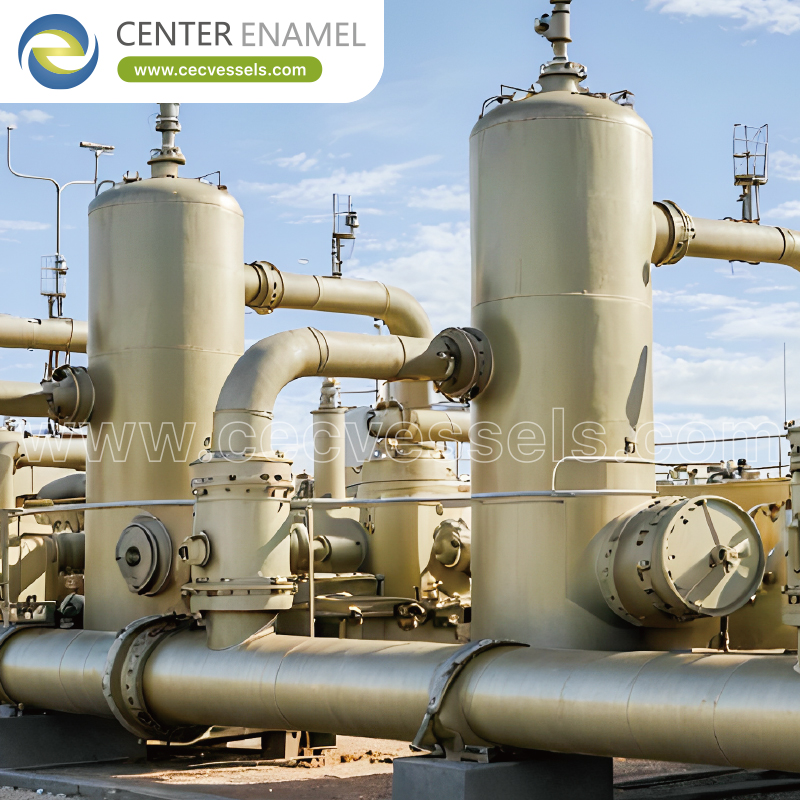
A Fixed Bed Reactor contains a stationary catalyst bed through which reactants continuously flow. Its design combines catalyst selection, reactor geometry, flow distribution, heat transfer, and reaction kinetics.
What Is a Fixed Bed Reactor?
A Fixed Bed Reactor is a chemical reactor in which solid catalyst particles or structured catalytic materials remain stationary inside the reactor while gas or liquid reactants pass through the catalyst bed.
Fixed Bed Reactors are also commonly known as packed bed reactors because the catalyst is packed into a defined reaction zone. As the process stream moves through the bed, reactants contact the active catalyst surface and undergo the desired chemical reaction.
The basic configuration consists of a reactor vessel, catalyst bed, feed distribution system, catalyst support structure, and product outlet. Depending on the process, the reactor can use axial flow or radial flow.
Fixed Bed Reactors are widely used for heterogeneous catalytic reactions because the catalyst remains in a defined location while the process stream moves continuously through the reactor.
However, effective Fixed Bed Reactor design involves more than selecting a vessel and filling it with catalyst. Catalyst activity, particle size, bed height, reactor diameter, flow rate, residence time, pressure drop, heat transfer, and temperature distribution all need to be considered together.
How Does a Fixed Bed Reactor Work?
The working principle of a Fixed Bed Reactor is based on continuous contact between a flowing process stream and a stationary catalyst.
The process generally follows several stages.
First, the feed enters the reactor through the inlet system. A distributor then spreads the feed across the reactor cross-section to promote uniform flow.
The process stream subsequently passes through the spaces between catalyst particles. Reactants contact the active sites on the catalyst surface, where the desired chemical reaction takes place.
As the fluid travels through the catalyst bed, reactant concentration and temperature can change along the reactor length. The resulting product stream is collected by the outlet system and transferred to downstream equipment.
The catalyst bed therefore acts as the main reaction zone. Its volume, geometry, particle characteristics, and packing arrangement directly influence reactor performance.
For this reason, a Fixed Bed Reactor should be designed according to the reaction and process conditions rather than based only on vessel dimensions.
What Are the Main Components of a Fixed Bed Reactor?
A Fixed Bed Reactor typically contains several components that work together to maintain catalyst support, fluid distribution, and controlled reaction conditions.
Reactor Vessel
The reactor vessel provides the main enclosure for the catalyst bed and process stream. Cylindrical vessels are commonly used because they provide practical geometry for catalyst loading and continuous flow.
Vessel dimensions are determined by catalyst volume, process capacity, flow characteristics, heat transfer requirements, and equipment layout.
Catalyst Bed
The catalyst bed is the primary reaction zone.
Catalysts can be supplied in different forms, including pellets, spheres, extrudates, rings, structured packing, or other shapes. Catalyst selection depends on reaction chemistry, required conversion, selectivity, operating temperature, feed composition, and catalyst activity.
Feed Distributor
The feed distributor controls how the incoming process stream enters the catalyst bed.
Uniform distribution is important because uneven flow can cause channeling or underutilization of the catalyst. A properly designed distributor helps maintain more consistent contact between the feed and catalyst.
Catalyst Support Grid
A support grid or screen holds the catalyst bed in position while allowing the process stream to pass through the reactor.
Depending on the design, inert ceramic materials or support layers may also be incorporated below or above the catalyst bed.
Retaining and Separation Layers
Retaining screens, inert balls, support layers, or other internal structures may be used to prevent catalyst movement and maintain the required bed arrangement.
Outlet System
The outlet system collects the reacted process stream and transfers it to downstream equipment. Its configuration should minimize flow disturbance and support stable operation.
What Are the Main Fixed Bed Reactor Design Principles?
Fixed Bed Reactor design requires the integration of reaction engineering, catalyst properties, fluid dynamics, heat transfer, and mechanical equipment design.
Catalyst Volume
Catalyst volume is one of the most important design parameters.
The required catalyst quantity depends on reaction kinetics, catalyst activity, feed composition, flow rate, target conversion, and desired production capacity.
Increasing catalyst volume does not automatically produce better reactor performance. The appropriate catalyst quantity should be determined from reaction and process calculations.
Bed Height and Reactor Diameter
Bed height and reactor diameter influence fluid residence characteristics, catalyst utilization, and flow distribution.
A taller catalyst bed provides a longer flow path and can increase contact between the process stream and catalyst. Reactor diameter determines the available cross-sectional area and affects superficial velocity.
The relationship between bed height and diameter therefore needs to be considered during reactor design.
Catalyst Particle Size
Catalyst particle size affects both reaction performance and fluid flow.
Smaller particles can provide shorter diffusion distances and greater available surface area. However, smaller particles can also increase flow resistance through the packed bed.
Catalyst size and reactor flow conditions should therefore be evaluated together.
Bed Void Fraction
A catalyst bed contains both solid particles and open spaces through which the process stream flows. The proportion of these spaces is described by the bed void fraction.
Void fraction affects fluid velocity, residence characteristics, mass transfer, and pressure loss.
Particle shape, size, packing method, and catalyst arrangement can all influence the final bed structure.
Residence Time
Residence time describes how long the process stream remains within the reactor system.
Adequate residence time is important for achieving the required conversion. However, the optimum value depends on reaction kinetics, catalyst activity, temperature, feed composition, and reactor configuration.
Flow Distribution
Uniform flow distribution is one of the most important considerations in Fixed Bed Reactor design.
Poor distribution can cause channeling, dead zones, uneven catalyst utilization, and temperature differences within the bed.
Feed distributors, support layers, internal baffles, and suitable reactor geometry can be used to improve flow distribution.
Why Is Pressure Drop Important in a Fixed Bed Reactor?
Pressure drop is an important design factor for packed catalyst beds.
As a process stream passes through the spaces between catalyst particles, resistance to flow causes pressure to decrease along the reactor.
Pressure drop is influenced by several factors, including:
Smaller catalyst particles can increase available catalytic surface area but may also increase flow resistance.
Therefore, catalyst selection requires a balance between reaction performance and fluid-flow requirements.
Pressure drop calculations are an important part of Fixed Bed Reactor engineering, particularly for large industrial reactors and processes with high flow rates.
How Does Heat Transfer Affect Fixed Bed Reactor Design?
Temperature control is critical because chemical reactions can either release or consume heat.
In an adiabatic Fixed Bed Reactor, heat exchange with the surrounding environment is minimized. The process temperature changes according to the heat generated or consumed by the reaction.
Nonadiabatic Fixed Bed Reactors incorporate heat transfer to control the reaction temperature. Heat can be supplied or removed through jackets, internal tubes, external heat exchangers, or integrated thermal systems.
Multitube Fixed Bed Reactors are commonly considered when a large heat transfer area is required. In this arrangement, catalyst is placed inside multiple tubes while a heat transfer medium flows around the tubes.
Heat transfer design becomes especially important when reaction rates are strongly affected by temperature.
What Is the Difference Between Axial Flow and Radial Flow Fixed Bed Reactors?
Fixed Bed Reactors can use different flow arrangements.
Axial Flow Fixed Bed Reactor
In an axial flow configuration, the process stream travels along the length of the catalyst bed.
This is a common arrangement because it provides a straightforward reactor structure and catalyst loading configuration.
Axial flow can be suitable for many gas-phase and liquid-phase catalytic processes.
Radial Flow Fixed Bed Reactor
In a radial flow configuration, the process stream moves through the catalyst bed in a radial direction.
Radial flow can provide advantages for certain large-scale applications where flow resistance and catalyst bed utilization are important considerations.
The appropriate configuration depends on reactor size, process flow rate, catalyst properties, pressure drop requirements, and overall process design.
What Are the Different Types of Fixed Bed Reactors?
Fixed Bed Reactors can be classified according to thermal configuration, flow direction, geometry, and application.
Adiabatic Fixed Bed Reactor
An adiabatic Fixed Bed Reactor minimizes heat exchange with the surrounding environment.
The process temperature changes according to the thermal characteristics of the reaction. This configuration can be suitable for processes where the temperature change through the catalyst bed can be accommodated by the process design.
Nonadiabatic Fixed Bed Reactor
A nonadiabatic reactor incorporates heat transfer to maintain a more controlled temperature profile.
Heat can be added or removed using jackets, coils, internal tubes, or external heat exchange equipment.
Multitube Fixed Bed Reactor
A multitube reactor contains multiple catalyst-filled tubes inside a shell.
This arrangement provides a large heat transfer surface and can be useful for reactions requiring controlled temperature conditions.
Radial Flow Fixed Bed Reactor
A radial flow reactor directs the process stream through the catalyst bed in a radial direction.
This configuration can be considered for large catalyst inventories and applications where pressure drop and flow distribution are major design considerations.
Packed Bed Catalytic Reactor
A packed bed catalytic reactor uses solid catalyst particles packed inside a defined reactor zone.
The terms packed bed reactor and Fixed Bed Reactor are often used interchangeably in heterogeneous catalytic processing, although specific equipment configurations can vary.
What Are the Applications of Fixed Bed Reactors?
Fixed Bed Reactors are used across chemical processing, petrochemical production, fuel processing, gas treatment, environmental applications, and other industrial sectors.
Chemical Manufacturing
Chemical plants use Fixed Bed Reactors for a wide range of catalytic conversion processes.
Depending on the catalyst and reaction system, applications can include oxidation, hydrogenation, dehydration, synthesis, and other chemical transformations.
Petrochemical Processing
Fixed Bed Reactors are widely associated with petrochemical and refining processes where heterogeneous catalysts are used to promote specific reactions.
The reactor can be integrated with feed preparation, heat exchange, separation, and downstream product processing systems.
Gas Processing
Gas-phase catalytic reactions are an important application area for Fixed Bed Reactors.
The gas stream passes through the stationary catalyst bed and undergoes the desired chemical conversion. Reactor design needs to consider gas flow distribution, catalyst properties, temperature control, and pressure drop.
Hydrogen-Related Processing
Fixed Bed Reactor configurations can be used for catalytic processes involved in hydrogen production and hydrogen-related chemical processing.
The appropriate catalyst, thermal configuration, feed distribution system, and reactor geometry depend on the specific process.
Environmental Applications
Fixed catalyst beds can also be used in selected environmental treatment processes.
Catalytic systems may help convert specific compounds into desired products or less reactive substances. Reactor design depends on feed composition, catalyst characteristics, treatment capacity, and operating conditions.
Liquid-Phase Catalytic Reactions
Fixed Bed Reactors can be used for liquid-phase reactions where the liquid feed flows through a stationary catalyst bed.
Important considerations include liquid distribution, catalyst wetting, residence time, mass transfer, and flow resistance.
What Are the Advantages of a Fixed Bed Reactor?
Fixed Bed Reactors offer several characteristics that make them suitable for industrial catalytic processing.
Continuous Operation
Reactants can continuously flow through the stationary catalyst bed, supporting continuous production.
Defined Catalyst Location
The catalyst remains in a controlled reactor zone, simplifying catalyst retention compared with systems where catalyst particles are continuously suspended.
Established Industrial Technology
Fixed Bed Reactor technology has been widely applied to industrial catalytic processes and can be scaled from laboratory and pilot systems to larger production equipment.
Flexible Catalyst Selection
Different catalyst shapes, materials, and formulations can be accommodated depending on the process requirements.
Multiple Flow and Thermal Configurations
Axial flow, radial flow, adiabatic, nonadiabatic, and multitube arrangements allow engineers to select a reactor configuration suitable for the process.
What Are the Design Considerations for a Fixed Bed Reactor?
A complete Fixed Bed Reactor design should evaluate several interconnected factors.
Important considerations include:
These parameters should be considered together rather than independently.
For example, reducing catalyst particle size may improve contact characteristics but can increase flow resistance. Increasing bed height can provide more catalyst volume but can also increase pressure drop.
Good Fixed Bed Reactor design therefore requires a balance between reaction performance, fluid dynamics, thermal management, equipment configuration, and operating requirements.
How Does Catalyst Deactivation Affect Fixed Bed Reactor Operation?
Catalyst activity can change during operation.
Depending on the process, catalyst deactivation can be associated with factors such as coke formation, poisoning, fouling, sintering, or changes in catalyst structure.
As catalyst activity decreases, the reactor may require different operating conditions or eventual catalyst regeneration or replacement.
For fixed catalyst beds, maintenance planning is therefore an important part of reactor design.
The reactor should provide a practical method for catalyst loading, unloading, inspection, and replacement where required.
For some processes, catalyst regeneration can restore part of the catalyst activity. Other applications require complete catalyst replacement after a defined operating period.
How Is a Fixed Bed Reactor Designed for Industrial Production?
Industrial Fixed Bed Reactor design normally combines process engineering with mechanical equipment engineering.
Process design establishes parameters such as:
Mechanical design then translates these requirements into an equipment configuration.
This includes reactor dimensions, vessel materials, catalyst support systems, feed distributors, internal components, nozzles, heat transfer surfaces, inspection openings, and instrumentation connections.
Scale-up is another important consideration. A reactor that performs well at laboratory scale may require additional analysis before being converted into an industrial system.
Flow distribution, heat transfer, pressure drop, catalyst loading, and temperature control can all change as reactor size increases.
Fixed Bed Reactor vs Fluidized Bed Reactor
The primary difference between a Fixed Bed Reactor and a fluidized bed reactor is the movement of the catalyst.
In a Fixed Bed Reactor, catalyst particles remain stationary while the process fluid flows through the bed.
In a fluidized bed reactor, the process fluid flows at a sufficient velocity to suspend and mix the catalyst particles.
Fixed Bed Reactors generally provide a simpler catalyst retention arrangement and a defined reaction zone.
Fluidized bed systems can provide strong mixing and continuous catalyst movement, which may be beneficial for processes requiring catalyst circulation or regeneration.
The appropriate reactor type depends on reaction kinetics, catalyst properties, heat transfer requirements, catalyst regeneration strategy, feed characteristics, and production requirements.
How Do You Select the Right Fixed Bed Reactor?
Selecting a Fixed Bed Reactor should begin with the process requirements.
First, define the reaction and target conversion.
Second, evaluate the catalyst, including activity, particle size, particle shape, density, and operating temperature range.
Third, determine feed flow rate and composition.
Fourth, evaluate the required temperature control and heat transfer arrangement.
Fifth, calculate the catalyst volume, bed dimensions, flow distribution, and expected pressure drop.
Finally, select the vessel configuration, materials, internal components, and applicable equipment standards.
A customized engineering approach is generally preferable to selecting a reactor only by nominal volume.
What Information Is Needed to Design a Fixed Bed Reactor?
For a preliminary Fixed Bed Reactor design, useful project information includes:
Drawings, process flow diagrams, catalyst specifications, or existing equipment information can also help engineers develop a more accurate reactor configuration.
Fixed Bed Reactor Manufacturing and Quality Control
Manufacturing quality is an important part of industrial reactor performance.
Center Enamel can combine process requirements with pressure vessel fabrication to develop customized reactor equipment.
Depending on the project, manufacturing can include material preparation, forming, welding, machining, internal component fabrication, assembly, dimensional inspection, weld inspection, non-destructive testing, and final quality inspection.
The catalyst support system and feed distribution components should also be checked against the approved engineering design.
The final reactor configuration should match the process requirements, drawings, material specifications, and applicable equipment standards.
Why Choose Center Enamel for Fixed Bed Reactor Manufacturing?
Center Enamel provides customized reaction pressure vessels and industrial process equipment for different applications.
Our engineering approach integrates vessel fabrication with process equipment requirements.
For Fixed Bed Reactor projects, the equipment can be customized according to:
Center Enamel supports industrial projects involving chemical processing, petrochemical applications, biopharmaceutical processing, food and beverage processing, environmental protection, and other process industries.
Frequently Asked Questions About Fixed Bed Reactors
Is a Fixed Bed Reactor the same as a Packed Bed Reactor?
In many catalytic applications, the terms Fixed Bed Reactor and Packed Bed Reactor describe similar reactor configurations in which solid catalyst particles remain stationary while the process fluid flows through the bed.
What is the main purpose of a Fixed Bed Reactor?
The main purpose is to provide controlled contact between a flowing reactant stream and a stationary catalyst so that the desired chemical reaction can take place efficiently.
What catalyst can be used in a Fixed Bed Reactor?
Catalyst selection depends on the reaction chemistry and process requirements. Catalysts may be supplied as pellets, spheres, extrudates, rings, monoliths, or other structured forms.
What affects Fixed Bed Reactor performance?
Important factors include catalyst activity, particle size, bed height, reactor diameter, flow distribution, residence time, pressure drop, temperature profile, heat transfer, and mass transfer.
Can a Fixed Bed Reactor be customized?
Yes. Industrial Fixed Bed Reactors can be customized according to process capacity, catalyst volume, reactor dimensions, materials, flow configuration, internal components, heat transfer requirements, and applicable standards.
What is the difference between axial and radial flow?
Axial flow moves the process stream along the length of the catalyst bed, while radial flow moves the stream across the bed in a radial direction. The appropriate arrangement depends on process and equipment requirements.
How often does the catalyst need to be replaced?
Catalyst replacement frequency depends on catalyst activity, feed quality, reaction conditions, deactivation mechanisms, and the operating cycle of the process.
Get a Custom Fixed Bed Reactor Solution
A Fixed Bed Reactor is more than a vessel containing catalyst. Its performance depends on the interaction between catalyst properties, reactor geometry, fluid distribution, heat transfer, reaction kinetics, and operating conditions.
For industrial applications, the reactor should be engineered according to the actual process requirements, catalyst specifications, production capacity, and equipment configuration.
Center Enamel provides customized reactor pressure vessels and process equipment for chemical, petrochemical, environmental, food and beverage, biopharmaceutical, and other industrial applications.
If you are planning a Fixed Bed Reactor project, provide your process parameters, catalyst information, equipment drawings, or project requirements. Our engineering team can evaluate the application and develop a reactor configuration suitable for your production process.


