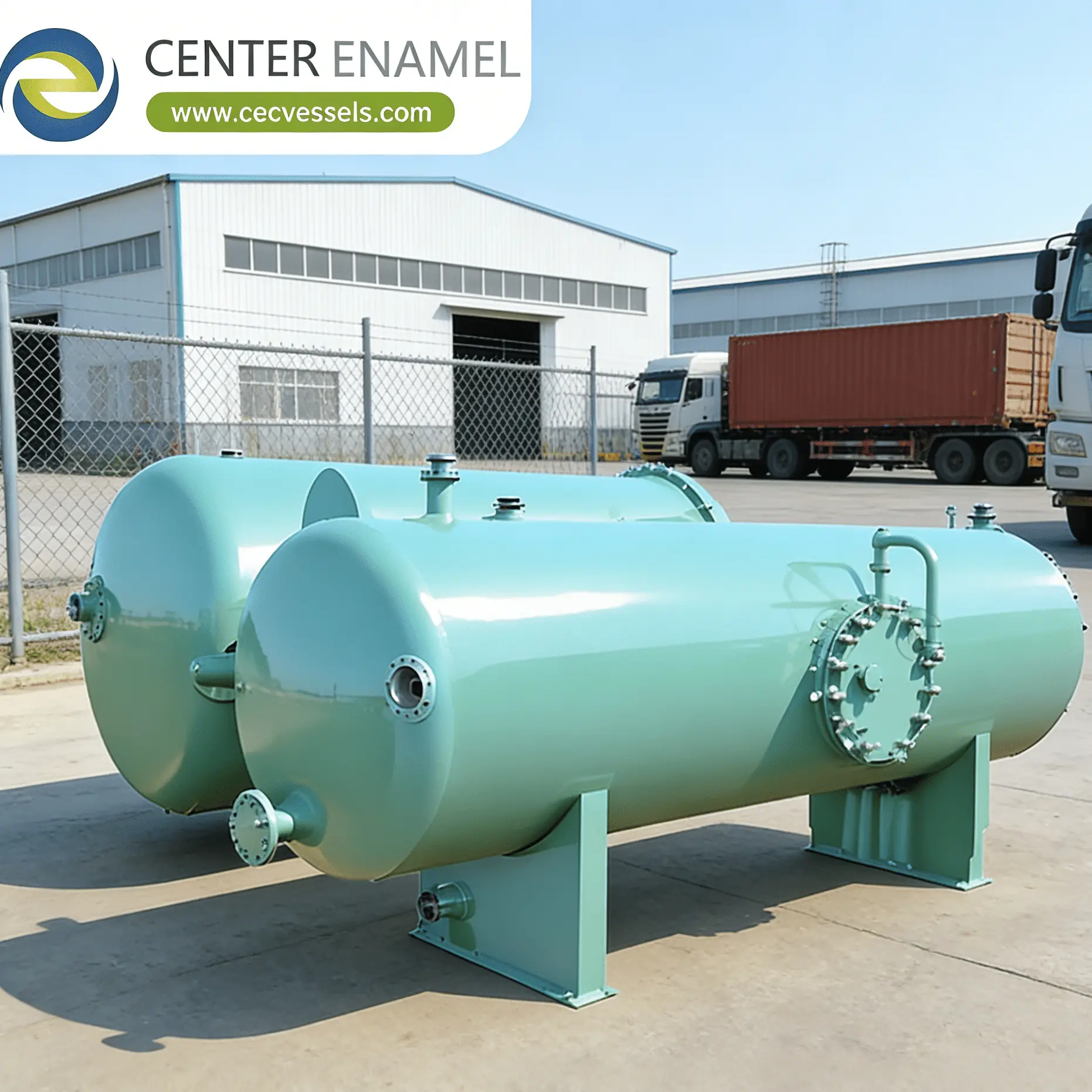
China Multi-Effect Evaporator Manufacturer Working Principle and Design
In modern industrial thermal processing and liquid separation, the multi-effect evaporatorrepresents an essential technology for large-scale solvent removal, concentrate recovery, and continuous waste volume reduction. Designed to optimize thermal efficiency across successive operational stages, a multi-effect evaporator reuses latent heat generated in initial stages to drive thermal evaporation in subsequent stages. As a premier China multi-effect evaporator manufacturer, Center Enamel delivers engineered evaporative containment vessels and custom-built systems that meet rigid global manufacturing standards, driving operational productivity across chemical, industrial wastewater, food, and municipal processing sectors.
A complete multi-effect evaporator process package generally consists of a feed preheater, a multi-effect evaporator assembly (configured in two, three, four, or more effects), vapor-liquid separators for each individual effect, a primary surface condenser, an automated vacuum system, a condensate recovery loop, a continuous material circulation system, and a centralized PLC automatic control station. Process flow configurations—such as forward-feed, backward-feed, parallel-feed, or mixed-feed arrangements—are selectively specified based on process fluid viscosity, thermal sensitivity, and concentration requirements to achieve a precise balance between thermal energy consumption, operational throughput, and final product quality.
Fundamental Working Principle and Process Mechanics
The core operating principle of a multi-effect evaporatorrelies on sequential thermal cascading. Instead of venting or condensing vapor generated from a single evaporation step, the vapor generated in the first effect is routed into the heating steam chest of the second effect. To enable continuous heat transfer without supplying additional fresh steam, each successive effect operates at a progressively lower operating pressure and corresponding saturation temperature.
This systematic pressure drop allows the vapor produced in one stage to serve as the heating medium for the subsequent stage, multiplying the mass of water evaporated per unit of fresh steam consumed. The continuous operation relies on balanced material circulation and exact vapor-liquid separation, ensuring that concentrated liquid streams and purified condensate are continuously isolated without entrainment losses or process interruption.
Engineering Design Standards and Structural Optimization
At Center Enamel, designing robust industrial evaporator vessels and continuous process assemblies is an exact science grounded in international manufacturing codes and rigorous structural engineering protocols. Our dedicated engineering design team meticulously evaluates the chemical compatibility, mechanical properties, and long-term operating limits of high-performance construction materials specified by global engineering directives.
The engineering workflow focuses on precise geometric optimization, where design engineers perform detailed calculations for vessel wall thickness, head geometry, and optimal weld-joint configurations. Special design focus is dedicated to high-stress vessel zones, such as flange ratings, gasket material selection, and bolt-circle patterns, ensuring long-term seal integrity under continuous fluid dynamics and thermal cycling. Our designers strictly implement safety margins and hydro-test formulas dictated by international energy and process equipment standards. Through this rigorous methodology, the engineering team manages thermal expansion stresses, fluid velocity profiles, and material wear, establishing a structural foundation for long-term operational reliability.
Process Material Selection and Fabrication Excellence
The fabrication design of multi-effect evaporator assemblies and industrial process vessels relies on a rational matching of carbon steel and premium stainless steel alloys to satisfy diverse industrial application demands. Carbon steel provides high structural rigidity under continuous long-cycle operations, combined with excellent machinability and cost efficiency. All carbon steel structural surfaces receive specialized anti-rust protective coatings to ensure long-term durability in standard workshop environments.
Stainless steel components undergo fine surface polishing after forming, creating dense passive films that resist chemical corrosion from organic solvents and process liquids. The entire production sequence, from raw plate ultrasonic inspection to final shell assembly, adheres to standardized fabrication rules. Welding procedures are customized according to specific metal properties to eliminate joint defects. Carbon steel vessels are frequently deployed for standard chemical storage and secondary process containment, whereas stainless steel vessels meet stringent hygienic production scenarios. Standardized processing and material classification ensure long-term sealing performance and equipment longevity.
Quality Control, Testing, and Non-Destructive Inspection (NDT)
Quality assurance at Center Enamel involves systematic volumetric, pressure, and tightness testing, validating material performance testing and Non-Destructive Testing (NDT) procedures. Once raw materials pass hardness and impact validations, and all weld seams clear rigorous NDT inspections (including Radiographic Testing and Ultrasonic Testing according to JB4730 specifications), the assembled vessel advances to complete volumetric validation.
A primary verification method is hydrostatic pressure testing, in which the completed vessel is completely filled with test liquid and pressurized beyond its maximum design limit. This volumetric pressure test confirms structural elasticity and global integrity. In addition to hydraulic verification, specialized water-fill testing is applied for low-pressure storage configurations to ensure no weeping or localized deformation occurs under static load. These protocols verify that high NDT weld metrics translate directly into reliable real-world pressure and liquid containment as expected from a top multi-effect evaporator manufacturer.
Application Case Study: Industrial Wastewater Treatment Project
Demonstrating our fabrication capability, Center Enamel designed and constructed a high-capacity industrial filtration and liquid separation array featuring vertical process vessels for an Aquaculture Wastewater Treatment Project in Sichuan, China. This specialized deployment included major equipment sets measuring Φ 6 × 16.5 meters and Φ 7.6 × 16.5 meters, representing practical benchmarks in large-volume process liquid handling.
Constructed from heavy-gauge carbon steel and enhanced with localized internal protective coatings, these vertical vessels were fully configured to manage organic sludge, biological loads, and process residues. The structural design strictly adhered to national standards for vertical cylindrical storage equipment, maintaining wide safety margins against hydrostatic liquid pressure and environmental factors. Integrated into advanced wastewater processing systems, these vertical vessels facilitated continuous sedimentation, fluid clarification, and reliable biological oxidation.
Industry Trends and Green Sustainable Manufacturing
Driven by global industrial modernization, the thermal equipment and process vessel sector experiences continuous technical evolution and shifting market demands, requiring manufacturers to balance production efficiency, product safety, and custom engineering capacity. Center Enamel gains market recognition by combining professional engineering expertise with consistent craftsmanship.
Pursuing precision in design parameters, structural strength, and material selection, we align our manufacturing with global industrial sustainability goals. Refined, high-performance equipment solutions reduce operational downtime, support resource recovery, and extend machinery service life. Our focus on precise fabrication and quality control positions Center Enamel as a trusted partner, supporting a sustainable, low-emission future for global process industries.
Global Compliance and International Certifications
International standard compliance makes Center Enamel a reliable cross-border China multi-effect evaporator manufacturerfor industrial containment and process equipment. All independently engineered multi-effect evaporator components and custom pressure vessels obtain certifications against leading international codes, including ASME, ISO 9001, and BS EN 13445, fully meeting market entry requirements across Europe, North America, and Southeast Asia.
Our technical engineering team is proficient in regional regulatory differences, adapting design parameters and testing procedures to align with local industrial safety rules. Every finished multi-effect evaporator vessel is delivered with complete inspection records, material mill certificates, and compliance documentation to streamline project filing and site operational approval, minimizing compliance costs for global industrial buyers.
|