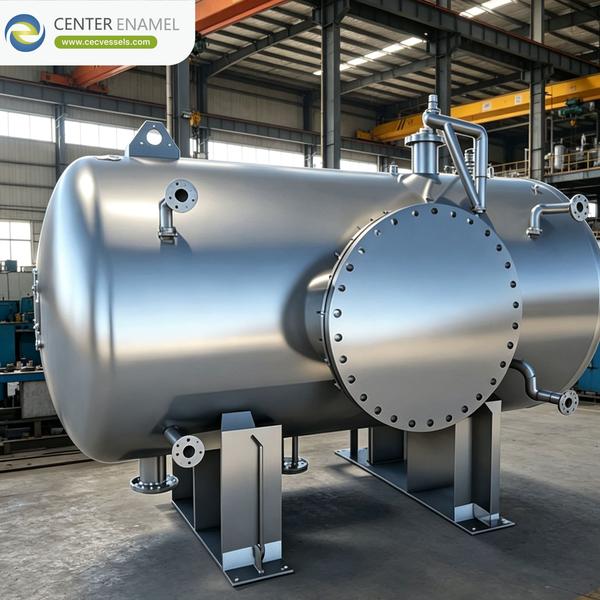
Multifunctional reactors combine multiple processing functions, such as chemical reaction, mixing, heating, and cooling, within one integrated vessel. Center Enamel provides customized multifunctional reactor solutions designed around different materials, reaction requirements, temperature conditions, and industrial production processes.
What Is a Multifunctional Reactor?
A multifunctional reactor is an industrial process vessel designed to perform several processing operations within one integrated system. Depending on the application, these operations may include material mixing, chemical reactions, heating, cooling, dissolution, and controlled material feeding.
Unlike equipment designed for only one processing function, a multifunctional reactor can integrate different components to support multiple stages of a production process.
A typical multifunctional reactor may include:
Reactor vessel: Provides the main space for material processing and chemical reactions.
Agitation system: Mixes materials and promotes uniform distribution throughout the vessel.
Heating and cooling system: Controls process temperature through a jacket, coil, or another heat-transfer arrangement.
Material feeding system: Introduces raw materials, additives, or other process media.
Process instrumentation: Monitors temperature, liquid level, and other relevant operating parameters.
Discharge system: Transfers finished products to downstream equipment.
The configuration can be customized according to the required process functions. For example, a reactor may combine mechanical agitation with steam heating, thermal oil circulation, and controlled material feeding.
This integrated approach allows manufacturers to configure one reactor system for different production requirements while coordinating mixing, thermal management, and process control.
How Does a Multifunctional Reactor Work?
The working principle of a multifunctional reactor depends on its configuration and intended application. In general, the system coordinates several processing functions within the same vessel.
1. Material Feeding
Raw materials are introduced through designated feed connections. Depending on the process, the reactor may receive liquids, powders, slurries, gases, or a combination of different materials.
The feeding arrangement can be designed for manual charging or controlled addition through pumps, metering devices, and automated valves.
2. Mixing and Agitation
After the materials enter the vessel, the agitator creates circulation within the reactor.
Proper agitation helps:
Distribute raw materials throughout the vessel.
Improve contact between different components.
Maintain suspended solid particles in suitable applications.
Support gas-liquid or liquid-liquid contact.
Promote more uniform temperature distribution.
The agitator configuration and operating speed should be selected according to material viscosity, density, solids content, and mixing objectives.
3. Heating and Cooling
Temperature control is an important function in many chemical and industrial processes.
A multifunctional reactor can incorporate different thermal systems according to the required temperature range and heat-transfer duty.
Common options include:
Steam heating: Uses circulating steam as the heating medium in a suitable jacket or coil arrangement.
Thermal oil heating: Provides controlled heating for processes requiring a suitable thermal-fluid system.
Electric heating: Uses an electric heating arrangement designed for the application.
Water cooling: Circulates cooling water through a jacket or coil to remove process heat.
Some reactor configurations can switch between heating and cooling media during different production stages.
4. Reaction and Process Control
Once the required mixing and temperature conditions are established, the reaction or processing stage proceeds.
Instrumentation can monitor selected parameters, including temperature, liquid level, agitation speed, and other process variables. The control system can be configured to adjust operating conditions according to the production requirements.
5. Product Discharge and Cleaning
When the processing stage is complete, the finished material is discharged through the designated outlet.
Depending on the application, the reactor may also include sampling connections, drainage arrangements, cleaning connections, or an integrated cleaning system.
The equipment can then be prepared for the next production cycle according to the operating procedure.
What Are the Main Features of Multifunctional Reactors?
The main value of a multifunctional reactor lies in its ability to integrate different processing functions within one coordinated equipment system.
Integrated Mixing and Reaction
The reactor combines a vessel body with an agitation system to support mixing and chemical processing.
Different impeller configurations can be selected according to the material and process requirements.
Common options include:
Paddle agitators: Suitable for certain general mixing applications.
Anchor agitators: Often used for viscous materials and processes requiring wall-side circulation.
Propeller agitators: Commonly used for liquid circulation and blending.
Turbine agitators: Can provide different flow patterns depending on the impeller design.
Specialized impellers: Customized for particular viscosity, dispersion, or suspension requirements.
The appropriate configuration depends on vessel geometry, working volume, material characteristics, and the required mixing performance.
Flexible Heating and Cooling Arrangements
Multifunctional reactors can integrate heating and cooling systems to support different stages of industrial processing.
Depending on the project, the thermal arrangement may include:
External heating or cooling jackets.
Limpet coil systems.
Internal heat-transfer coils.
Steam circulation systems.
Thermal oil circulation systems.
Water or other suitable cooling media.
The selection should consider the required process temperature, heat-transfer area, fluid properties, and thermal duty.
Configurable Process Connections
Different industrial applications require different material feeding and discharge arrangements.
A multifunctional reactor can be customized with:
Liquid feeding nozzles.
Powder charging connections.
Sampling ports.
Manways.
Drainage outlets.
Instrument connections.
Gas inlet and outlet connections.
Process piping interfaces.
These connections allow the reactor to integrate with upstream and downstream equipment.
Instrumentation and Automation
A multifunctional reactor can incorporate instruments and control equipment according to the required level of process automation.
Typical configurations may include temperature sensors, level instruments, flow meters, control valves, variable-speed agitator drives, and automated dosing systems.
An appropriate control arrangement helps coordinate material feeding, mixing, temperature adjustment, and product discharge.
What Are the Applications of Multifunctional Reactors?
Multifunctional reactors are suitable for industries that require flexible processing equipment capable of handling different materials and production operations.
1. Chemical Manufacturing
<AsyncImage query="industrial chemical manufacturing stainless steel multifunctional reactor vessel production plant" aspectRatio="16:9" width="100%"/>
In the chemical industry, multifunctional reactors can be used for:
A customized reactor can integrate agitation, heating, cooling, and controlled feeding to support different chemical processing stages.
2. Pharmaceutical Manufacturing
<AsyncImage query="stainless steel pharmaceutical manufacturing reactor vessel clean industrial processing equipment" aspectRatio="16:9" width="100%"/>
Pharmaceutical and fine chemical production often requires controlled processing conditions and flexible equipment configurations.
Multifunctional reactors can be designed for selected synthesis, formulation, dissolution, and intermediate-processing operations.
Depending on the application, the system may include stainless steel construction, controlled material feeding, temperature monitoring, suitable surface finishing, and cleaning connections.
3. Polymer and Resin Production
<AsyncImage query="industrial polymer resin production stainless steel jacketed reactor with agitator" aspectRatio="16:9" width="100%"/>
Polymer and resin manufacturing involves different mixing and temperature-control requirements depending on the formulation and reaction stage.
Multifunctional reactors can be configured with suitable agitators, heating and cooling systems, and material feeding arrangements.
Anchor agitators or other specialized mixing systems may be considered for processes involving higher-viscosity materials.
Typical applications include:
4. Food and Beverage Processing
<AsyncImage query="stainless steel food processing jacketed mixing reactor vessel industrial factory" aspectRatio="16:9" width="100%"/>
In food and beverage manufacturing, multifunctional vessels can support controlled heating, cooling, blending, dissolution, and formulation.
Depending on the product and applicable hygienic requirements, equipment can be configured with suitable stainless steel materials, surface finishes, agitators, and cleaning arrangements.
5. Biotechnology and Environmental Processing
<AsyncImage query="industrial stainless steel bioprocess reactor mixing tank equipment" aspectRatio="16:9" width="100%"/>
Selected biotechnology and environmental applications require coordinated mixing, temperature management, and material handling.
Multifunctional reactor configurations may support fermentation-related processing, chemical treatment, material conditioning, and other operations.
The final design depends on the biological or chemical process, material compatibility, cleaning requirements, and instrumentation specifications.
How Are Multifunctional Reactors Customized?
A multifunctional reactor should be designed around the actual production process rather than selected solely by vessel capacity.
Center Enamel develops reactor configurations according to customer requirements and project specifications.
1. Vessel Capacity and Dimensions
The working volume, total volume, diameter, height, and overall vessel arrangement can be determined according to production capacity and installation conditions.
2. Material Selection
Material selection depends on process-fluid composition, corrosion characteristics, temperature conditions, and applicable design requirements.
Common material options include:
3. Agitator Configuration
The agitator should match the material's viscosity, density, solids content, and mixing requirements.
Different impeller types, shaft arrangements, and drive configurations can be evaluated during the engineering stage.
4. Heating and Cooling System
The thermal system can be selected according to the required temperature range, heating or cooling duty, and available utility media.
Jacketed vessels, limpet coil arrangements, and internal coils may be considered for different process requirements.
5. Internal Components and Connections
Internal components, nozzle positions, manways, sampling ports, and discharge arrangements can be customized according to the process layout and equipment integration requirements.
6. Instrumentation and Control
The reactor can incorporate temperature monitoring, level measurement, flow control, automated feeding, and variable-speed agitation according to the required automation configuration.
Why Choose Center Enamel for Multifunctional Reactors?
Selecting a reactor manufacturer involves evaluating engineering capabilities, manufacturing resources, quality management, and the ability to meet project-specific requirements.
Center Enamel provides customized industrial vessel solutions supported by engineering, manufacturing, and project coordination capabilities.
Engineering and Custom Design
Center Enamel works with customers to review process requirements and develop suitable reactor configurations.
The design process considers vessel dimensions, materials, agitator arrangements, heating and cooling systems, connections, and instrumentation.
Manufacturing Facilities
Center Enamel operates a 150,000 m² production and R&D base, supporting the manufacturing of different industrial vessel products and customized equipment.
Its manufacturing resources include material processing, cutting, welding, assembly, and inspection equipment.
Material Options
Depending on the project specifications, reactor vessels can be manufactured using carbon steel, stainless steel, and selected clad materials.
The final material selection is determined by the process medium and applicable engineering requirements.
Quality Inspection and Testing
Quality control activities can include material verification, dimensional inspection, welding inspection, non-destructive examination, and final equipment testing.
The inspection and testing scope is established according to the applicable design standard and customer requirements.
International Standards and Project Support
Center Enamel's website identifies standards and certification systems including ASME, ISO 9001, and BS EN 13445.
The applicable code, certification scope, and documentation requirements should be confirmed for each individual project.
The company also provides project support covering design, manufacturing, transportation, installation, and related services according to the agreed project scope.
How to Select the Right Multifunctional Reactor
Before requesting a quotation, customers should prepare the following technical information:
| Information | Details to Provide |
|---|
| Application | Chemical synthesis, polymerization, blending, formulation, or other process |
| Working volume | Required operating capacity and total vessel volume |
| Material composition | Process liquids, powders, gases, or mixed materials |
| Operating temperature | Required heating, cooling, and temperature-control range |
| Mixing requirements | Material viscosity, solids content, and agitation objectives |
| Heating and cooling | Steam, thermal oil, water, electric heating, or other media |
| Vessel material | Carbon steel, stainless steel, or other specified materials |
| Automation | Manual, semi-automatic, or automated process control |
| Applicable standards | Required design codes, inspection, and certification |
| Installation conditions | Available space, connection layout, and site requirements |
Providing these details helps the engineering team evaluate the required vessel configuration and prepare a more accurate technical proposal.
Customized Multifunctional Reactor Solutions for Industrial Production
Multifunctional reactors integrate mixing, reaction, heating, cooling, and other selected process operations into one coordinated vessel system. Their flexible configurations make them suitable for chemical manufacturing, pharmaceutical processing, polymer production, food processing, and other industrial applications.
Center Enamel provides customized multifunctional reactor solutions based on working volume, material properties, agitation requirements, thermal systems, and project specifications.
Contact Center Enamel to discuss your reactor application and request a customized technical proposal for your industrial production process.


