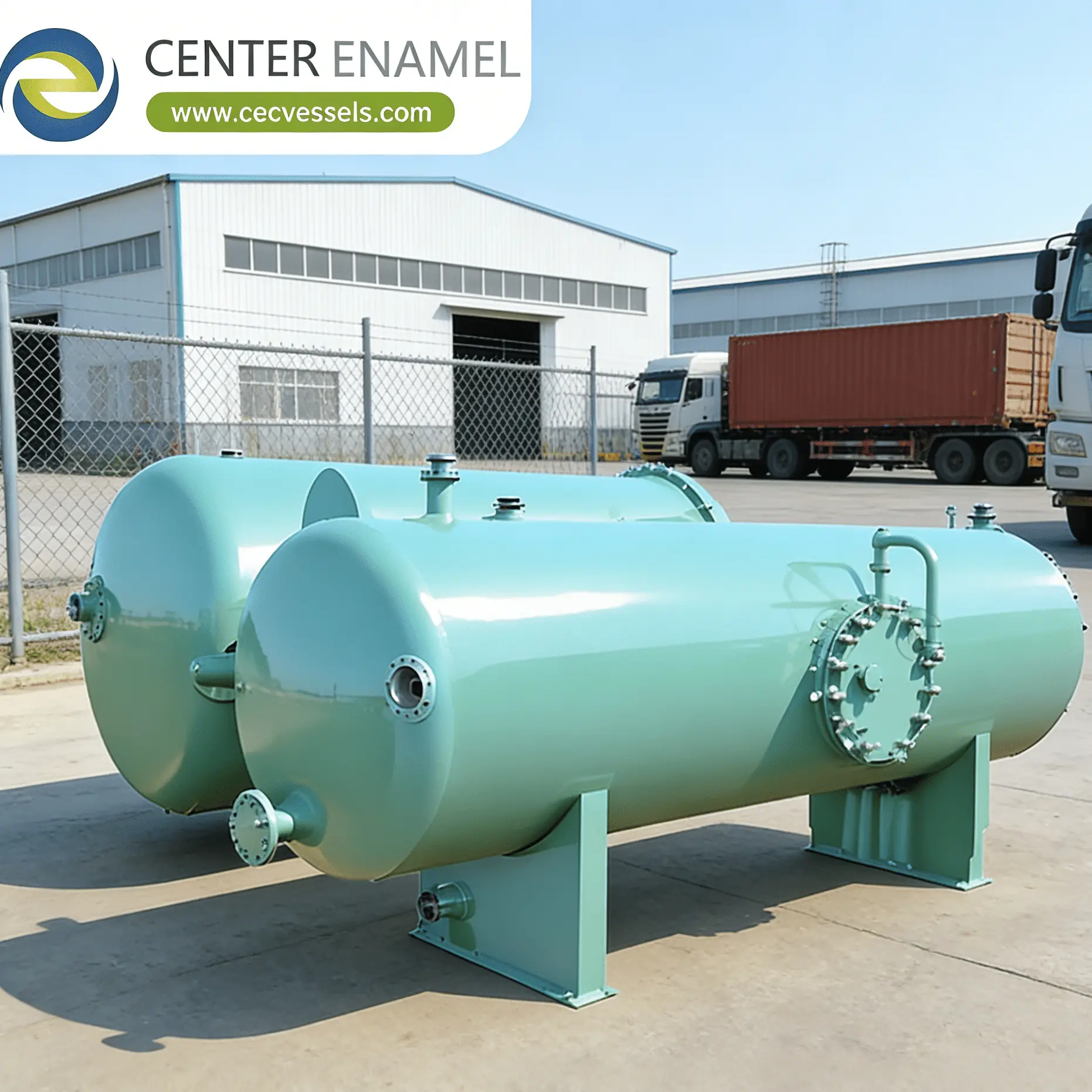
How Pressure Vessels Play an Important Role in Oil and Gas Operations?
Pressure vessels are the fundamental building blocks of the oil and gas industry, acting as the primary containment systems for various fluids and gases throughout the production cycle. As a professional Pressure Vessels Manufacturer, Center Enamel develops these specialized systems to ensure process stability, fluid separation, and storage efficiency for global energy facilities. The Central Role of Pressure Vessels in Energy Extraction
In the oil and gas sector, raw resources are rarely found in a pure state. Crude oil and natural gas are typically extracted as complex mixtures containing water, sediments, and various hydrocarbon phases. Pressure vessels provide the controlled environment necessary to process these mixtures. Whether at the wellhead, in a midstream terminal, or within a downstream refinery, these vessels are essential for maintaining the continuous flow of energy products.
As a leading China Pressure Vessels Manufacturer, Center Enamel engineering focuses on providing high-performance vessels that support the long-term operational goals of global energy partners. By utilizing advanced material science and precision fabrication, these vessels empower operators to manage their resources with maximum efficiency and technical reliability.
Key Applications in Oil and Gas Operations
Pressure vessels perform several distinct functions that are vital to the success of an oil and gas project. Their versatility allows them to be adapted for different stages of the value chain.
1. Fluid Separation and ClarificationOne of the most important roles of a pressure vessel is acting as a separator. These vessels use gravity and internal baffles to divide the incoming stream into gas, oil, and water.
Three-Phase Separators: These horizontal or vertical vessels are the first line of processing at the wellhead, ensuring each component is directed to the correct pipeline or storage unit.
Coalescing Oil Separators: Used further downstream to remove fine droplets of oil from water, ensuring environmental compliance and product purity.
2. Thermal Management and Heat ExchangeOil and gas operations often require significant temperature adjustments to facilitate flow or chemical reactions. Heat exchangers are specialized pressure vessels that allow for the transfer of thermal energy between two fluids.
Function: They are used to pre-heat crude oil before distillation or to cool gas before compression.
Refinery Integration: In a refinery setting, these exchangers are critical for energy recovery, significantly reducing the fuel required for daily operations.
3. Steam Generation and Utility SupportBoiler pressure vessels are the energy engines of a refinery or processing plant. They generate the high-quality steam used for heating reactors, driving turbines, and cleaning equipment. Center Enamel provides robust boiler vessels and steam distribution cylinders to manage these utility needs efficiently.
4. Chemical Processing and AdsorptionIn the chemical treatment phase of oil and gas, specialized vessels such as resin tanks and fiber adsorption tanks are used to remove specific impurities or to facilitate chemical reactions. These vessels must be built with high-quality stainless steel to ensure a long service life in chemically active environments. Structural Design and Engineering Specifications
To ensure that every pressure vessel fulfills its specific role, Center Enamel offers a wide range of customizable technical specifications:
Pressure Vessel Types: Available in vertical and horizontal cylindrical configurations with various head shapes, such as ellipsoidal or torispherical, to distribute internal weight evenly.
Material Grades: High-quality 304 and 316 Stainless Steel are used for superior corrosion resistance in acidic environments, while high-strength Carbon Steel provides structural durability for general storage.
Volume Capacities: Customizable solutions for volumes starting from above 1 cubic meter, with sizes engineered to match the throughput of the facility.
Operational Limits: Fully customizable temperature ranges to support both cryogenic gas storage and high-temperature refinery processes.
Engineering Design Standards and Global Compliance
The role of a pressure vessel is only as reliable as the standards followed during its fabrication. Center Enamel ensures that every shell, head, and nozzle is built to the highest safety and performance benchmarks.
ASME Boiler and Pressure Vessel Code (BPVC)The ASME code is the international benchmark for pressure equipment. Section VIII provides the rules for design, material selection, and fabrication. As a certified China Pressure Vessels Manufacturer, Center Enamel ensures that every component is engineered to withstand years of constant industrial use, providing a high safety factor for the energy industry.
GB/T 150.1-150.4-2024The GB/T 150 series is the national standard for metal pressure vessels in China. The 2024 update represents the latest in welding technology and material science. Adhering to these standards ensures that our vessels are optimized for modern industrial performance and are compatible with international infrastructure projects.
BS EN 13445For the European market, BS EN 13445 provides harmonized rules for unfired pressure vessels. It places a heavy emphasis on material fatigue and stress analysis, ensuring the equipment remains reliable even under frequent pressure cycling and thermal changes.
Our high-performance pressure vessels serve a vast industrial landscape, from petroleum refining and chemical processing to food, dairy, and brewing. We deliver precision-engineered solutions for pharmaceuticals, power generation, and wastewater treatment, ensuring compliance with the world’s most stringent safety codes. Our systems are designed for peak efficiency and longevity, empowering global partners to excel in even the most challenging environments.
1. Chemical Industry Project l Project Location: Hubei, China l Pressure Vessels: Resin tanks, Coalescing oil separators, Fiber adsorption tanks, Compressed air storage tanks, Condensate tanks, and Steam distribution cylinders l Material: Stainless Steel and Carbon Steel. l Design Standards: GB/T 150 (Pressure Vessels) l Application: Integrated chemical fluid processing, separation, and steam distribution for chemical plants
2. Seawater Desalination Project l Project Location: Malta l Pressure Vessels: Concentrated Sulfuric Acid Storage Tanks (Vertical layout) l Material: Carbon Steel l Design Standards: EN 13445 l Application: Storage of 98% concentrated sulfuric acid.
3. Waste-to-Energy Incineration Project l Project Location: Hebei, China l Pressure Vessels: Large-scale Landfill Leachate Storage and Treatment Tanks (2 Sets) l Material: Carbon Steel l Design Standards: GB 50341-2003 and GB 50128-2005. l Application: Wastewater Treatment
4. Aquaculture Wastewater Treatment Project l Project Location: Sichuan, China l Pressure Vessels: Vertical Wastewater Treatment Vessels (Φ 6×16.5 m (h) 1 set; Φ 7.6×16.5 m (h) 1 set) l Material: Carbon Steel l Design Standards: National standard for vertical cylindrical storage tanks. l Application: Aquaculture Wastewater Treatment
Maintenance and Structural Integrity
To ensure that pressure vessels continue to play their important role safely, regular maintenance is essential. For ASME-certified vessels, requirements typically include:
Periodic Inspections: Regular visual and non-destructive testing (NDT), such as ultrasonic or radiographic testing, to check for corrosion, material fatigue, or erosion in the shell and nozzles.
Internal Cleaning: Removing mineral deposits, sludge, or carbon buildup to maintain the volume capacity and separation efficiency of the vessel.
Safety Valve Calibration: Verifying that pressure relief valves are functional and correctly set to protect the structural integrity of the vessel during process variations.
Weld Integrity Verification: Inspecting all connection points and nozzle attachments to ensure no structural issues have developed over time.
The Center Enamel Manufacturing Advantage
Choosing Center Enamel as your China Pressure Vessels Manufacturer means partnering with a leader in technical innovation and quality fabrication. Integrated Design and EngineeringOur team utilizes Finite Element Analysis (FEA) to simulate how pressure and fluid weight will affect the vessel shell. This allows us to optimize the design for both performance and efficiency before manufacturing begins.
Advanced Fabrication TechnologyWe utilize automated welding systems and CNC machining for nozzle attachments to ensure that every connection is perfect. This commitment to precision ensures that our vessels meet the strict inspection criteria of GB/T 150-2024 and ASME.
Comprehensive Quality AssuranceEvery pressure vessel produced by Center Enamel undergoes a battery of tests, including hydrostatic pressure testing and helium leak testing, to verify its structural integrity and leak-proof performance. Summary of Industrial Reliability
In conclusion, pressure vessels play an indispensable role in oil and gas operations by providing the specialized environments required for separation, storage, and thermal management. Whether used as a three-phase separator at a wellhead or a heat exchanger in a refinery, these vessels drive the efficiency and safety of the energy industry. By adhering to international design standards like ASME BPVC and the updated GB/T 150.1-150.4-2024, Center Enamel delivers high-performance solutions that offer both efficiency and long-term durability. As a dedicated China Pressure Vessels Manufacturer, our focus on quality materials, advanced engineering, and rigorous testing ensures that our products support the long-term success of our global partners.
Looking for a reliable pressure vessel partner? From complex chemical systems to large-scale environmental projects, we turn your requirements into high-performance reality. Submit your design parameters or project specs now, and we will have a dedicated engineer reach out to you as soon as possible to discuss the next steps.
|