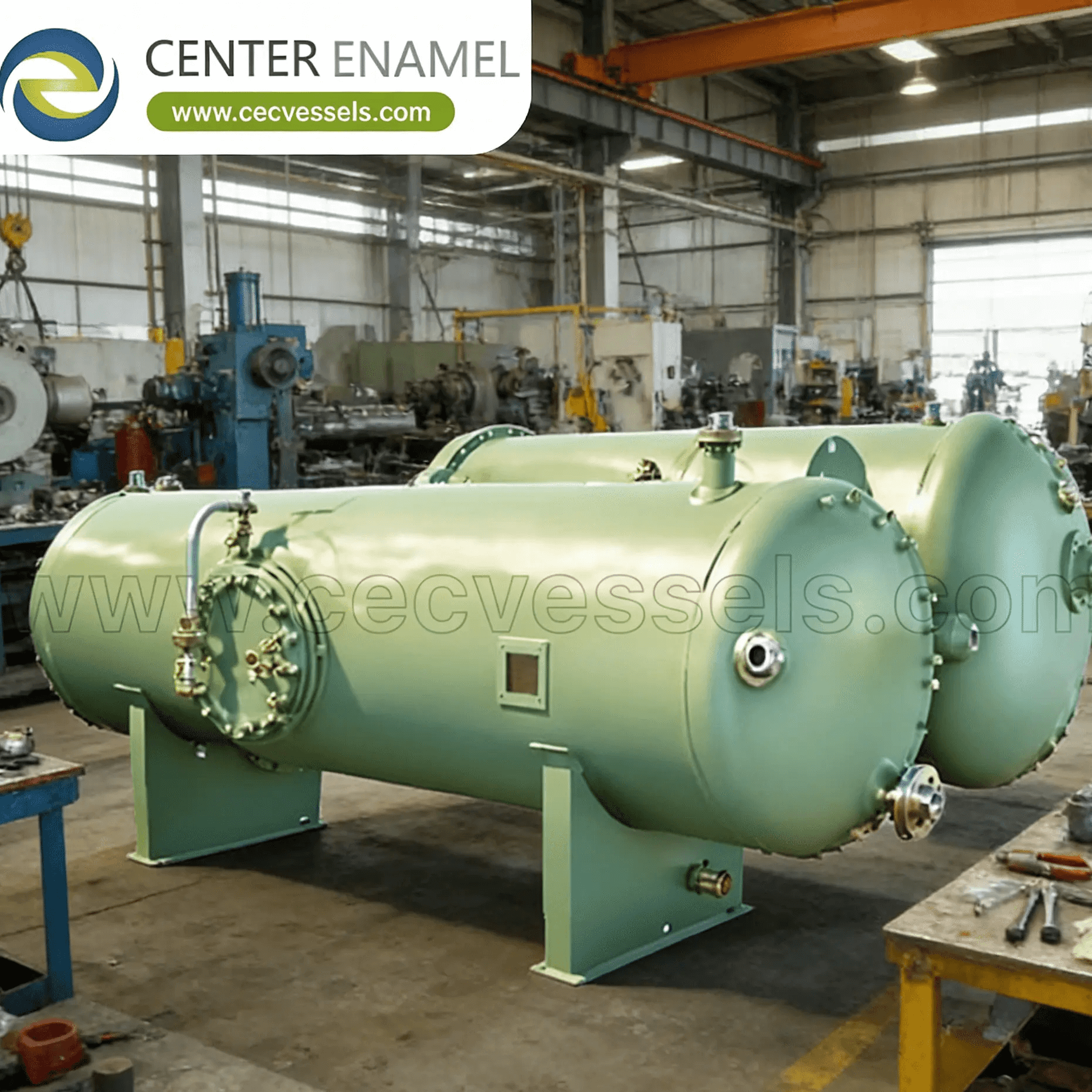
Learn About Pressure Vessels Production, Types and Uses
Pressure vessels are essential components in modern industrial infrastructure, designed to hold gases or liquids at a pressure substantially different from the ambient pressure. These containers are used across a vast range of sectors, from petrochemical processing to food production, ensuring that fluids are managed safely and efficiently. As a professional Pressure Vessel Manufacturer, Center Enamel develops high-performance systems tailored to the specific needs of global energy and utility projects. By adhering to international engineering codes like ASME BPVC, BS EN 13445, and GB/T 150.1-150.4-2024, these vessels ensure structural integrity and consistent performance for international industrial partners. The Evolution of Pressure Vessel Production
The production of pressure vessels has evolved from basic metalworking into a highly technical engineering discipline. Modern manufacturing focuses on precision, material science, and rigorous quality control to ensure that the vessel shell can withstand internal stresses over a long operational life.
As a leading China Pressure Vessel Manufacturer, Center Enamel focus is on providing a stable and durable environment for fluid containment. Our production process begins with advanced design software to calculate precise wall thicknesses and optimal geometries. By utilizing high-grade stainless steel and carbon steel, we ensure that each vessel meets the strict chemical and mechanical requirements of the target application. This commitment to engineering excellence is what allows our products to support the continuous operation of critical industrial facilities worldwide. Key Stages in the Production Process
The manufacturing of a high-quality pressure vessel involves several critical stages, each governed by international standards to ensure reliability. 1. Material Selection and PreparationThe process starts with choosing the right alloy, such as 304 or 316L stainless steel, based on the fluid's corrosivity. The metal plates are then cut to size using precision CNC machinery. 2. Shell and Head FormingThe metal plates are rolled into cylindrical shapes to form the vessel shell. The end caps, or heads, are formed into hemispherical or ellipsoidal shapes to distribute internal stress evenly across the structure. 3. Precision WeldingWelding is the most critical part of production. Center Enamel utilizes automated welding systems and qualified welding procedures to ensure that every seam is leak-proof and structurally sound. 4. Heat Treatment and Surface FinishingIn many cases, the completed vessel undergoes post-weld heat treatment to relieve internal stresses. For sanitary applications, the internal surfaces are polished to a high mirror finish. 5. Rigorous Testing and InspectionEvery vessel undergoes a battery of non-destructive testing (NDT), including radiographic inspection, ultrasonic testing, and hydrostatic pressure testing, to verify its integrity before delivery. Primary Types of Pressure Vessels
Pressure vessels are categorized based on their orientation, shape, and specific function within a process line.
1. Horizontal and Vertical VesselsThe orientation of a vessel is often determined by the available space and the fluid dynamics required. Vertical vessels are common for separation and storage where floor space is limited, while horizontal vessels are often used for heat exchange and large-scale buffering.
2. Storage VesselsThese are designed for the long-term containment of fluids like water, oil, or gas. Center Enamel manufactures these with reinforced supports to handle the weight of large volumes.
3. Process Vessels (Reactors and Mixers)These vessels are equipped with internal components like agitators or baffles to facilitate chemical reactions or blending. They are the workhorses of the pharmaceutical and chemical industries.
4. Heat Exchangers (Shell and Tube)These vessels facilitate the transfer of thermal energy between two fluids. Center Enamel produces these using specialized tube bundles and shell designs to maximize thermal efficiency.
5. Phase SeparatorsSpecialized for isolating gas, liquid, and solid phases from a mixed stream, these vessels are vital for refineries and environmental treatment plants. Common Uses Across Global Industries
The versatility of pressure vessels makes them indispensable in almost every corner of the industrial world.
Oil and Gas Refining: Used for the separation of crude oil and the storage of refined products.
Chemical Processing: Serving as reactors for the synthesis of polymers, resins, and fine chemicals.
Food and Beverage Production: Utilizing stainless steel vessels for fermentation, pasteurization, and storage to maintain strict hygiene.
Environmental Utilities: Supporting landfill leachate treatment, biogas recovery, and wastewater management.
Power Generation: Managing steam distribution and condensate recovery in thermal power plants.
Aquaculture and Agriculture: Providing vertical treatment tanks for large-scale water filtration and oxygenation. Integration with Other Industrial Equipment
Pressure vessels are part of an integrated fluid and energy management network. Center Enamel provides a comprehensive range of equipment that works in tandem with these units:
Steam Distribution Cylinders: Organizing and directing the steam used for thermal processes throughout a facility.
Condensate Tanks: Collecting purified water from thermal cycles for recycling, supporting overall facility sustainability.
Coalescing Oil Separators: Purifying process fluids to ensure that contaminants do not interfere with downstream operations.
Resin Tanks and Fiber Adsorption Tanks: Specialized treatment units that remove dissolved minerals and impurities from water or chemical streams.
Fermentation Vessels: Specialized stainless steel containers designed for the biological conversion of sugars in brewing and bio-energy sectors. Engineering Design Standards and Global Compliance
The reliability of a pressure vessel is guaranteed by strict adherence to international fabrication codes. Center Enamel ensures that every component is built to the highest performance benchmarks.
ASME Boiler and Pressure Vessel Code (BPVC)The ASME code is the international benchmark for pressure equipment. Section VIII provides the rules for design, material selection, and fabrication. As a certified manufacturer, Center Enamel ensures that its vessels are designed with the necessary safety margins for continuous operation.
GB/T 150.1-150.4-2024The GB/T 150 series is the national standard for metal pressure vessels in China. The 2024 update represents the latest advancements in structural analysis and material science. Adhering to these standards ensures that our products are optimized for modern industrial requirements.
BS EN 13445For the European market, BS EN 13445 provides harmonized rules for unfired pressure vessels. It places a heavy emphasis on material fatigue and stress analysis, ensuring the equipment remains reliable throughout its service life.
Our high-performance pressure vessels serve a vast industrial landscape, from petroleum refining and chemical processing to food, dairy, and brewing. We deliver precision-engineered solutions for pharmaceuticals, power generation, and wastewater treatment, ensuring compliance with the world’s most stringent safety codes. Our systems are designed for peak efficiency and longevity, empowering global partners to excel in even the most challenging environments.
1. Chemical Industry Project l Project Location: Hubei, China l Pressure Vessels: Resin tanks, Coalescing oil separators, Fiber adsorption tanks, Compressed air storage tanks, Condensate tanks, and Steam distribution cylinders l Material: Stainless Steel and Carbon Steel. l Design Standards: GB/T 150 (Pressure Vessels) l Application: Integrated chemical fluid processing, separation, and steam distribution for chemical plants
2. Seawater Desalination Project l Project Location: Malta l Pressure Vessels: Concentrated Sulfuric Acid Storage Tanks (Vertical layout) l Material: Carbon Steel l Design Standards: EN 13445 l Application: Storage of 98% concentrated sulfuric acid.
3. Waste-to-Energy Incineration Project l Project Location: Hebei, China l Pressure Vessels: Large-scale Landfill Leachate Storage and Treatment Tanks (2 Sets) l Material: Carbon Steel l Design Standards: GB 50341-2003 and GB 50128-2005. l Application: Wastewater Treatment
4. Aquaculture Wastewater Treatment Project l Project Location: Sichuan, China l Pressure Vessels: Vertical Wastewater Treatment Vessels (Φ 6×16.5 m (h) 1 set; Φ 7.6×16.5 m (h) 1 set) l Material: Carbon Steel l Design Standards: National standard for vertical cylindrical storage tanks. l Application: Aquaculture Wastewater Treatment
Maintenance and Structural Integrity
To ensure a pressure vessel continues to operate at peak efficiency, regular maintenance is essential. For ASME-certified vessels, requirements typically include:
Periodic Inspections: Regular visual and non-destructive testing (NDT), such as ultrasonic thickness checks, to monitor for any material loss in the shell.
Internal Cleaning and Descaling: Removing mineral deposits or scale that can lead to localized corrosion or reduced heat transfer efficiency.
Gasket and Seal Replacement: Regularly checking and replacing seals on manways and nozzles to prevent external leaks.
Safety Valve Calibration: Regularly testing the pressure relief valves to ensure they are set to the correct discharge pressure, protecting the structural integrity of the vessel shell. The Center Enamel Manufacturing Advantage
Choosing Center Enamel as your China Pressure Vessel Manufacturer means partnering with a leader in technical innovation and quality fabrication.
Integrated Design and EngineeringOur team utilizes Finite Element Analysis (FEA) to simulate how internal pressure and thermal stress will affect the vessel shell. This allows us to optimize the design for both performance and efficiency before manufacturing begins.
Advanced Fabrication TechnologyWe utilize automated welding systems and CNC machining for nozzle attachments and internal supports. This commitment to precision ensures that our vessels meet the strict inspection criteria of GB/T 150-2024 and ASME.
Comprehensive Quality AssuranceEvery pressure vessel produced by Center Enamel undergoes a battery of tests, including hydrostatic pressure testing and material certification checks, to verify its structural integrity and performance. Summary of Pressure Vessel Excellence
In conclusion, understanding pressure vessel production, types, and uses is essential for optimizing industrial thermal and fluid processes. By providing a stable and durable environment for fluid management, these vessels drive the productivity and sustainability of global energy, chemical, and utility sectors. By adhering to international design standards like ASME BPVC and the updated GB/T 150.1-150.4-2024, Center Enamel delivers high-performance solutions that offer both efficiency and long-term durability. Our focus on quality materials, advanced engineering, and rigorous testing ensures that our products support the long-term success of our global partners.
Ready to bring your project to life? Whether your application requires compliance with EN, ASME, or GB standards, our team is equipped to deliver precision-engineered solutions tailored to your specific needs. Send us your technical specifications today, and our senior engineering team will contact you shortly to provide a professional consultation and a detailed proposal. |