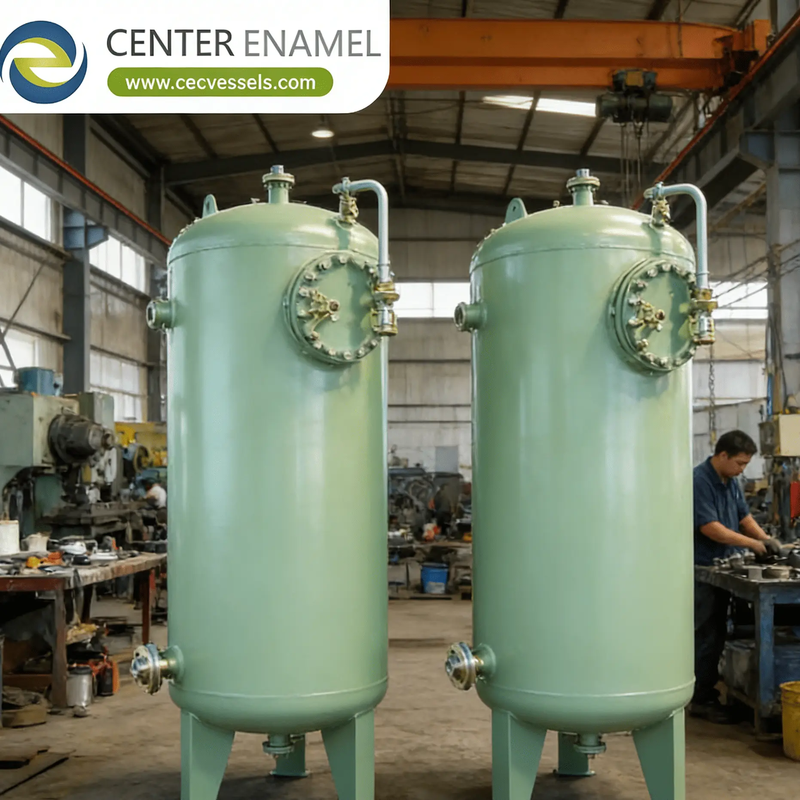
Center Enamel is a China Production Separator Manufacturer specializing in custom-engineered separator pressure vessels for oil, gas, water, and industrial fluid separation. Our production separators are designed for two-phase and three-phase separation applications and can be manufactured in horizontal or vertical configurations according to process conditions, capacity, pressure, temperature, material, and applicable design standards.
As an experienced pressure vessel manufacturer, Center Enamel provides complete engineering and manufacturing services, including separator design, material selection, fabrication, welding, non-destructive testing, pressure testing, inspection, and delivery. Our production separators can be designed according to international and Chinese pressure vessel standards to meet the requirements of different industrial markets.
What Is a Production Separator?
A production separator is a pressure vessel used to separate a multiphase production stream into individual phases based on differences in density, velocity, and physical properties.
In oil and gas production, the incoming well stream may contain crude oil, natural gas, produced water, sand, and other suspended contaminants. A production separator provides a controlled environment where these phases can be separated before the fluids enter downstream processing equipment.
Depending on the process requirements, a separator can perform:
The separated phases can then be directed to different downstream processing systems for further treatment, storage, transportation, or recovery.
How Does a Production Separator Work?
Production separators generally use gravity separation combined with specially designed internal components.
When the multiphase fluid enters the separator, an inlet diverter reduces the velocity of the incoming stream and distributes the fluid inside the vessel. The reduction in velocity allows the heavier liquid phase to settle toward the bottom while gas moves toward the upper section.
In a three-phase separator, the liquid phase is further divided according to density. Typically, oil forms a layer above the denser produced water, while gas is collected in the upper part of the vessel.
Internal components such as baffles, weirs, demister pads, vane packs, and coalescing devices can be incorporated to improve separation efficiency and reduce liquid carryover.
The final configuration is determined by the process flow rate, fluid properties, required residence time, operating pressure, operating temperature, and required outlet quality.
Types of Production Separators
Two-Phase Production Separator
A two-phase separator is designed to separate gas from liquid or, in specific applications, separate two liquid phases.
For oil and gas facilities, a two-phase production separator is commonly used when the primary requirement is to remove free gas from a liquid stream or separate liquid from a gas-dominated production stream.
Typical applications include:
Three-Phase Production Separator
A three-phase separator separates gas, oil, and water from a multiphase production stream.
Three-phase separators are widely used in crude oil production and processing because they allow the three major phases to be discharged through dedicated outlets.
The vessel may include:
Inlet diverter
Liquid-level control system
Oil-water interface control
Internal weir
Baffle plates
Demister
Sand removal system
Pressure relief connection
Instrument connections
The dimensions and internal arrangement are customized according to the required separation performance and operating conditions.
Horizontal Production Separator
Horizontal separators provide a large liquid surface area and are commonly selected for applications requiring longer liquid residence time or handling relatively high liquid flow rates.
Advantages include:
Large liquid-gas interface area
Effective liquid separation
Suitable for high liquid flow rates
Convenient access to internal components
Suitable for two-phase and three-phase separation
Horizontal production separators are frequently used in oil and gas gathering, crude processing, produced water handling, and other continuous process systems.
Vertical Production Separator
Vertical separators use a vertical vessel arrangement in which gas rises through the vessel while separated liquid flows downward into the liquid collection section.
They are particularly useful when:
Plant floor space is limited
Gas flow is relatively high
Liquid volume is comparatively low
Efficient drainage of solids is required
Vertical installation is preferred by the process layout
The choice between horizontal and vertical configuration should be based on process conditions rather than vessel orientation alone.
Production Separator Applications
Center Enamel production separators can be engineered for a wide range of industrial applications.
Oil and Gas Production
Production separators are essential in upstream oil and gas facilities for separating crude oil, natural gas, and produced water from well streams.
Typical applications include:
Natural Gas Processing
In natural gas systems, separators can remove entrained liquids and solids from gas streams to protect downstream compressors, pipelines, dehydration equipment, and processing units.
Petrochemical and Chemical Processing
Separator pressure vessels can also be used in chemical and petrochemical processes where gas-liquid, liquid-liquid, or solid-liquid separation is required.
The vessel material and internal components can be customized according to the chemical composition, temperature, pressure, and corrosivity of the process medium.
Industrial Wastewater and Fluid Treatment
Industrial separation vessels can be integrated into treatment systems for separating oil, water, suspended solids, and other contaminants before subsequent treatment processes.
Production Separator Design and Internal Components
The performance of a production separator depends not only on the vessel shell but also on the design and arrangement of its internal components.
Inlet Diverter
The inlet diverter reduces the velocity of the incoming multiphase stream and promotes initial bulk separation.
Baffles
Baffles control fluid movement inside the vessel and help prevent excessive turbulence and unwanted phase mixing.
Weir Plates
Weirs can be used in three-phase separators to control liquid levels and maintain the required oil-water interface.
Demister Pads
Demister pads or mist eliminators capture fine liquid droplets entrained in the gas stream before the gas leaves the vessel.
Coalescing Devices
Coalescing components increase the effective contact area between liquid droplets, helping smaller droplets combine into larger droplets that can be removed more efficiently.
Sand and Solids Removal
For production streams containing sand or other solids, the separator can incorporate dedicated collection and drainage arrangements to simplify solids removal and maintenance.
Materials for Production Separators
Material selection is determined by the operating pressure, temperature, process medium, corrosion conditions, and applicable design code.
Common materials may include:
For corrosive fluids or applications containing chlorides, sour components, or aggressive chemicals, additional material evaluation and corrosion protection may be required.
Center Enamel can work with customers to select appropriate materials based on the actual process conditions rather than applying a standard material to every separator.
Production Separator Design Standards
For international projects, production separators may be designed and manufactured according to the standards specified by the customer and project documentation.
Common standards include:
ASME Boiler and Pressure Vessel Code Section VIII
GB/T 150 pressure vessel standards
BS EN 13445
PED requirements where applicable
Other project-specific standards and specifications
The applicable code should be confirmed before engineering begins because design pressure, material requirements, inspection procedures, welding qualifications, testing, and documentation can vary between standards.
Production Separator Technical Specifications
Production separators are normally customized according to the customer's process data.
Important design parameters include:
| Parameter | Typical Requirement |
|---|
| Separator Type | Two-phase or three-phase |
| Vessel Orientation | Horizontal or vertical |
| Process Medium | Oil, gas, water, chemical fluids, etc. |
| Design Pressure | Customized |
| Operating Pressure | Customized |
| Design Temperature | Customized |
| Operating Temperature | Customized |
| Flow Rate | Customized |
| Vessel Material | Carbon steel, stainless steel, or specified alloy |
| Internal Components | Baffles, weirs, demister, coalescer, etc. |
| Design Standard | ASME, GB/T, EN or project specification |
| Inspection | NDT, pressure testing and other specified inspections |
Providing accurate process information allows our engineers to determine the appropriate vessel dimensions, internal configuration, materials, and design conditions.
Production Separator Manufacturing Process
As a China Production Separator Manufacturer, Center Enamel manages the manufacturing process from engineering design through final inspection.
The typical manufacturing workflow includes:
Process data review and engineering design
Material selection and raw material inspection
Engineering drawings and fabrication documentation
CNC cutting and edge preparation
Plate rolling and vessel shell forming
Head forming
Welding and assembly
Installation of internal components
Nozzle and support fabrication
Non-destructive testing
Pressure and leak testing
Dimensional and visual inspection
Surface treatment and finishing
Final inspection and documentation
Packing and shipment
This controlled manufacturing process helps maintain consistency in vessel dimensions, weld quality, internal component installation, and final product performance.
Quality Inspection and Testing
Pressure vessels used in industrial separation systems must meet strict quality and safety requirements.
Depending on the applicable code and customer specification, inspection and testing may include:
Raw material inspection
Welding procedure qualification
Welder qualification
Visual inspection
Radiographic testing (RT)
Ultrasonic testing (UT)
Magnetic particle testing (MT)
Liquid penetrant testing (PT)
Dimensional inspection
Hydrostatic pressure testing
Leak testing
Final documentation review
The exact inspection scope is determined by the applicable design code, vessel category, customer specification, and project requirements.
Why Choose Center Enamel as Your China Production Separator Manufacturer?
Center Enamel combines pressure vessel engineering, manufacturing capabilities, quality control, and international project experience to provide customized separation equipment for global customers.
Custom Engineering
We design production separators according to actual process conditions rather than offering only fixed standard configurations.
Multiple Separator Configurations
Customers can select two-phase or three-phase separation systems as well as horizontal or vertical vessel configurations according to their process requirements.
International Design Standards
Our engineering team can work with international pressure vessel standards and project-specific technical specifications.
Integrated Manufacturing
From material preparation and vessel fabrication to welding, inspection, testing, and final delivery, the manufacturing process is controlled through defined quality procedures.
Global Project Support
Center Enamel serves international industrial customers and provides technical communication, engineering documentation, manufacturing, inspection, and delivery support for overseas projects.
How to Select the Right Production Separator
Selecting a production separator requires more than simply choosing a vessel size.
Before requesting a quotation, customers should provide the following information whenever available:
Process fluid composition
Gas flow rate
Oil flow rate
Water flow rate
Liquid density
Gas density
Operating pressure
Design pressure
Operating temperature
Design temperature
Required separation efficiency
Solid or sand content
Corrosion conditions
Installation location
Applicable design standard
Preferred horizontal or vertical configuration
Based on this information, our engineering team can evaluate the required separator configuration and recommend an appropriate design.
Production Separator Manufacturer FAQ
What is the difference between a two-phase and three-phase separator?
A two-phase separator separates two phases, most commonly gas and liquid. A three-phase separator is designed to separate gas, oil, and water within the same vessel.
Should I choose a horizontal or vertical separator?
The selection depends on flow rate, gas-liquid ratio, residence time, available installation space, fluid properties, and the required separation performance. Horizontal separators are often suitable for higher liquid loads, while vertical separators can be advantageous where floor space is limited or gas flow is relatively high.
Can Center Enamel manufacture customized production separators?
Yes. Production separators can be customized according to process flow rate, pressure, temperature, materials, vessel dimensions, internal components, design standards, and project-specific requirements.
What information is required for a separator quotation?
At minimum, it is helpful to provide the process medium, flow rate, operating/design pressure, operating/design temperature, required separation phases, material requirements, and applicable design code.
Can production separators be manufactured according to ASME standards?
Production separators can be engineered and manufactured according to applicable international standards and customer specifications. The exact code, certification, inspection, and documentation requirements should be confirmed during the technical evaluation stage.
Request a Custom Production Separator
If you are sourcing a China Production Separator Manufacturer for an oil and gas, petrochemical, chemical, wastewater, or industrial fluid separation project, Center Enamel can evaluate your process requirements and provide a customized pressure vessel solution.
Send us your process data, technical specification, drawing, or project requirements. Our engineering team will review the application and recommend a suitable production separator configuration, material, design standard, and manufacturing solution.


