What Are The 4 Methods Of Heat Exchange?
Heat exchange is the process of thermal energy moving from a hotter object to a cooler one. As a professional Heat Exchanger Manufacturer, Center Enamel utilizes these fundamental principles to design high-performance pressure vessels that ensure stable and efficient industrial operations across the globe. The Four Fundamental Methods of Heat Transfer
To understand how a heat exchanger works, one must first recognize the four primary ways heat moves through a system. In industrial thermal management, these methods dictate the design of the pressure vessel and the choice of materials.
1. ConductionConduction is the transfer of heat through direct physical contact. In the context of a pressure vessel, this occurs through the metal walls of the tubes or plates. When one side of a metal barrier is heated by a hot fluid, the thermal energy vibrates through the solid material to the cooler side. Center Enamel selects high-conductivity materials, such as specific grades of stainless steel, to maximize this conduction rate.
2. ConvectionConvection involves the movement of heat through fluids (liquids or gases). In a heat exchanger, as fluid flows over a heated surface, it carries the thermal energy away. This is the primary method used in shell and tube or plate exchangers. By increasing the turbulence of the fluid flow through internal components like baffles, a China Heat Exchanger Manufacturer can significantly improve convection efficiency.
3. RadiationRadiation is the transfer of energy through electromagnetic waves. While less dominant in low-to-medium temperature fluid exchangers, it is critical in furnace-type vessels or applications involving high-temperature gases. The design of the vessel shell must account for radiant heat to prevent energy loss and ensure the safety of the surrounding environment.
4. Mass TransportMass transport, or advection, refers to heat being carried by the physical movement of the substance itself. When a hot liquid is pumped from one part of a chemical plant into a storage tank, the heat moves with the mass. This is why the volume capacity and flow rate design of a pressure vessel are essential for maintaining the overall thermal balance of a facility. Classification by Pressure Vessel Type
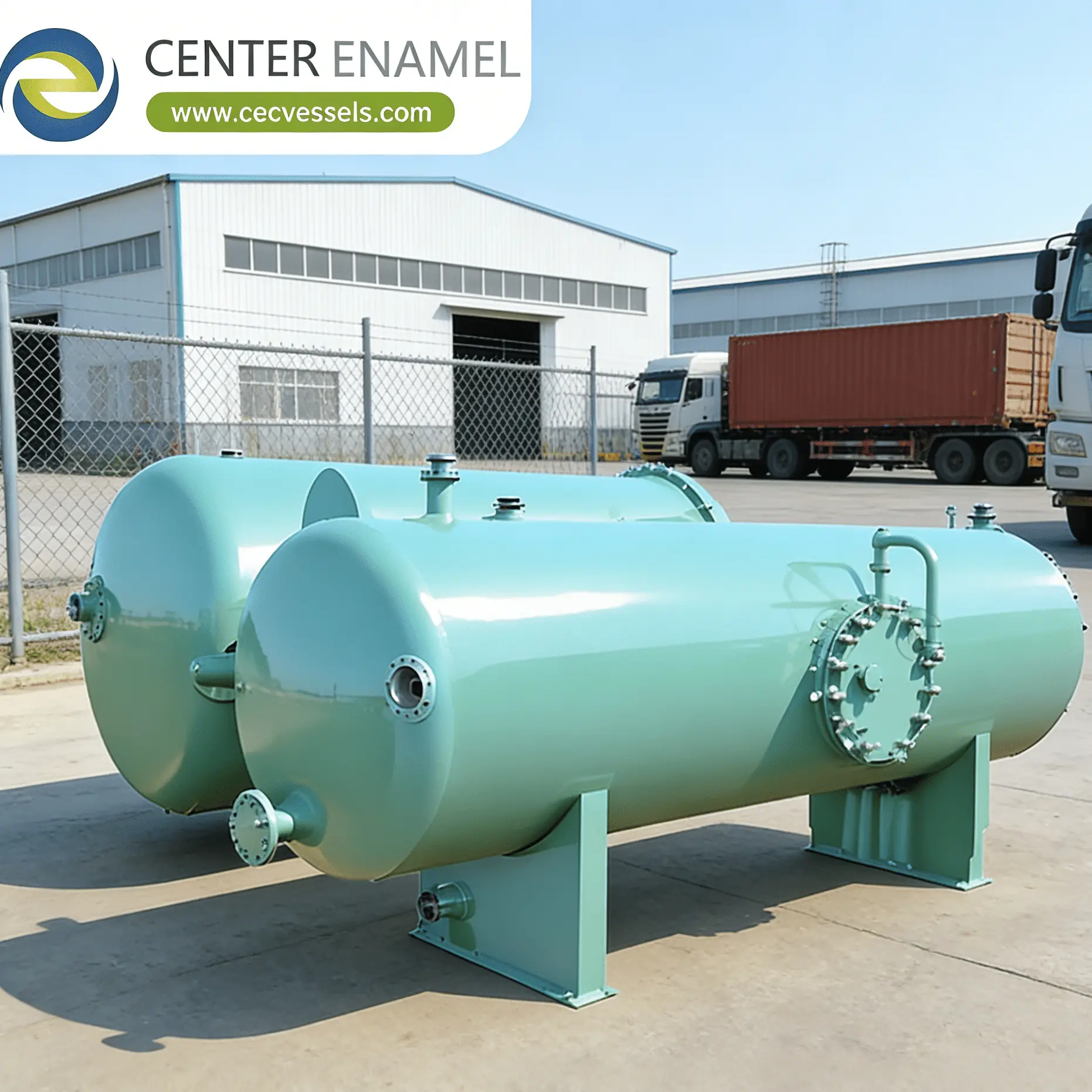
Heat exchangers are specialized pressure vessels. Depending on which heat transfer method is prioritized and the nature of the industrial application, different structural types are utilized.
Shell and Tube Heat ExchangersThis is the most common pressure vessel type for industrial heat exchange. It consists of a large cylindrical shell containing a bundle of tubes.
Function: These vessels are robust and versatile, capable of handling various process fluids. Working Method: They primarily rely on conduction through the tube walls and convection within the shell and tubes. Center Enamel produces these in accordance with GB/T 150 to ensure structural integrity and long-term durability.
Plate and Frame Heat ExchangersThese vessels utilize a series of thin, corrugated plates. The fluids flow through alternating channels between the plates.
Function: They provide a massive surface area in a compact footprint, making them ideal for the food, dairy, and brewing industries. Working Method: They maximize convection by creating high turbulence in the fluid streams.
Air-Cooled Heat Exchangers (Fin-Fan)These units use fans to blow ambient air over finned tubes containing the process fluid.
Function: Essential for power generation and chemical plants where water for cooling is limited. Working Method: They combine conduction through the finned tube walls with forced convection from the moving air.
Spiral Heat Exchangers
Constructed by rolling two long metal plates into a concentric spiral, these vessels are a unique type of pressure equipment.
Function: Specialized for handling "dirty" fluids or wastewater treatment. Working Method: The spiral flow creates a self-cleaning effect while maintaining high heat transfer rates. Technical Specifications and Material Science
As a leading China Heat Exchanger Manufacturer, Center Enamel offers customizable technical specifications to suit specific industrial environments:
Pressure Ranges: Expertly designed for Low Pressure and Medium Pressure applications. Temperature Limits: Fully customizable to meet the thermal demands of the process. Material Grades: Utilization of 304 and 316 Stainless Steel for corrosion resistance, and Carbon Steel for structural strength. Volume Capacities: Customizable solutions starting from above 1 cubic meter for diverse industrial scales.
Global Engineering Standards and Compliance
Every pressure vessel manufactured by Center Enamel is built to withstand years of constant use in demanding environments.
ASME Boiler and Pressure Vessel Code (BPVC)The ASME code is the international benchmark for pressure equipment. Section VIII provides the rules for design, material selection, and fabrication. Compliance with ASME ensures that every shell, head, and nozzle meets the highest safety standards.
GB/T 150.1-150.4-2024The GB/T 150 series is the updated national standard for metal pressure vessels in China. The 2024 update represents the latest in welding technology and material science. Adhering to these standards ensures our exchangers are optimized for modern industrial requirements.
BS EN 13445For the European market, BS EN 13445 provides the harmonized rules for unfired pressure vessels. It places a heavy emphasis on material fatigue and stress analysis, ensuring the equipment remains reliable even under frequent thermal cycling.
Our high-performance pressure vessels serve a vast industrial landscape, from petroleum refining and chemical processing to food, dairy, and brewing. We deliver precision-engineered solutions for pharmaceuticals, power generation, and wastewater treatment, ensuring compliance with the world’s most stringent safety codes. Our systems are designed for peak efficiency and longevity, empowering global partners to excel in even the most challenging environments.
1. Chemical Industry Project l Project Location: Hubei, China l Pressure Vessels: Resin tanks, Coalescing oil separators, Fiber adsorption tanks, Compressed air storage tanks, Condensate tanks, and Steam distribution cylinders l Material: Stainless Steel and Carbon Steel. l Design Standards: GB/T 150 (Pressure Vessels) l Application: Integrated chemical fluid processing, separation, and steam distribution for chemical plants
2. Seawater Desalination Project l Project Location: Malta l Pressure Vessels: Concentrated Sulfuric Acid Storage Tanks (Vertical layout) l Material: Carbon Steel l Design Standards: EN 13445 l Application: Storage of 98% concentrated sulfuric acid.
3. Waste-to-Energy Incineration Project l Project Location: Hebei, China l Pressure Vessels: Large-scale Landfill Leachate Storage and Treatment Tanks (2 Sets) l Material: Carbon Steel l Design Standards: GB 50341-2003 and GB 50128-2005. l Application: Wastewater Treatment
4. Aquaculture Wastewater Treatment Project l Project Location: Sichuan, China l Pressure Vessels: Vertical Wastewater Treatment Vessels (Φ 6×16.5 m (h) 1 set; Φ 7.6×16.5 m (h) 1 set) l Material: Carbon Steel l Design Standards: National standard for vertical cylindrical storage tanks. l Application: Aquaculture Wastewater Treatment
Summary of Industrial Reliability
By mastering the four methods of heat exchange and utilizing advanced pressure vessel types, Center Enamel provides the global market with superior thermal management solutions. Our commitment to international standards like ASME and the updated GB/T 150.1-150.4-2024 ensures that every product we manufacture—from resin tanks to complex heat exchangers—offers high performance and long-term durability. As a dedicated China Heat Exchanger Manufacturer, we empower our partners to excel in petroleum refining, pharmaceuticals, power generation, and beyond.
Looking for a reliable pressure vessel partner? From complex chemical systems to large-scale environmental projects, we turn your requirements into high-performance reality. Submit your design parameters or project specs now, and we will have a dedicated engineer reach out to you as soon as possible to discuss the next steps.
|