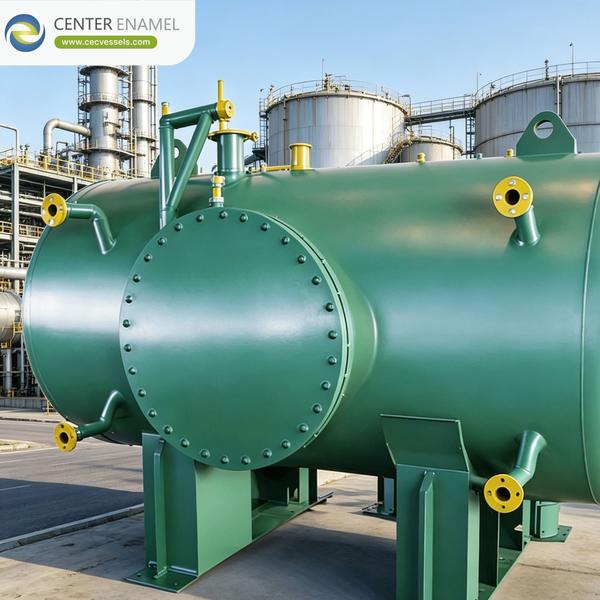
The five common types of industrial chemical reactors include batch reactors, semi-batch reactors, continuous stirred tank reactors (CSTRs), plug flow reactors (PFRs), and fixed-bed reactors. Each type provides a different reaction environment and operating method, making it suitable for specific production processes, materials, and manufacturing requirements.
What Is a Chemical Reactor?
A chemical reactor is a vessel or process system designed to facilitate chemical reactions under controlled conditions. It provides the environment needed for raw materials to react and form desired products.
Industrial reactors are widely used in chemical manufacturing, petrochemical processing, pharmaceutical production, polymer manufacturing, and other process industries.
A reactor's design depends on several factors:
Reaction type: The chemical transformation and reaction mechanism.
Production capacity: The required production volume and output rate.
Operating conditions: Temperature, pressure, and process environment.
Mixing requirements: The degree of contact between reactants.
Heat transfer: The amount of heating or cooling required during the reaction.
Material compatibility: The suitability of construction materials for the process medium.
Reactors can be classified according to their operating mode, flow pattern, internal structure, or reaction phases. The five types discussed below represent common industrial configurations rather than an exclusive classification of every reactor design. [1][2]
What Are the 5 Types of Reactors?
1. Batch Reactor
<AsyncImage query="industrial stainless steel batch chemical reactor vessel agitator jacketed tank" aspectRatio="16:9" width="100%"/>
A batch reactor is a closed processing vessel in which raw materials are loaded before the reaction begins. The materials remain inside the vessel during the main reaction period, and the finished product is discharged after the reaction is completed.
Batch reactors commonly feature an agitator, heating or cooling jacket, temperature sensors, and material charging and discharge connections.
How does a batch reactor work?
Raw materials are charged into the reactor.
The agitator mixes the materials to achieve the required contact.
Heating or cooling equipment controls the reaction temperature.
The mixture reacts for a specified period.
The finished product is discharged for subsequent processing.
Main applications:
Pharmaceutical intermediate production.
Specialty chemical manufacturing.
Resin and polymer production.
Fine chemical synthesis.
Small-volume or multi-product manufacturing.
Key characteristics:
Batch reactors offer production flexibility because different products can be manufactured in the same vessel when the equipment and process requirements permit. They are particularly suitable for processes involving different formulations, reaction times, and production schedules.
2. Semi-Batch Reactor
<AsyncImage query="industrial semi batch chemical reactor stainless steel dosing pipes jacketed stirred tank" aspectRatio="16:9" width="100%"/>
A semi-batch reactor combines batch processing with controlled material feeding or product removal during the reaction.
Unlike a conventional batch reactor, a semi-batch system allows one or more reactants to enter the vessel gradually. In some processes, gas or liquid products may also be removed continuously while the reaction proceeds.
How does a semi-batch reactor work?
One or more initial reactants are charged into the vessel.
The reactor starts operating under the specified conditions.
Additional reactants are introduced at a controlled rate.
The agitator maintains the required mixing conditions.
Temperature and feed rates are adjusted throughout the reaction.
The final reaction mixture is discharged when the process is complete.
Main applications:
Polymerization processes.
Chemical synthesis.
Esterification.
Controlled reagent addition.
Processes involving gas-liquid reactions.
Key characteristics:
The main advantage of a semi-batch reactor is its ability to control reactant addition during processing. This can help manage reaction rates, temperature changes, and product composition.
3. Continuous Stirred Tank Reactor (CSTR)
<AsyncImage query="industrial continuous stirred tank reactor CSTR stainless steel vessel agitator process plant" aspectRatio="16:9" width="100%"/>
A Continuous Stirred Tank Reactor (CSTR) is a reactor in which raw materials continuously enter the vessel while reaction products continuously leave.
A mechanical agitator maintains mixing throughout the tank. Under the ideal CSTR model, the reactor contents have a uniform composition and temperature, and the outlet stream has the same composition as the well-mixed reactor contents.
How does a CSTR work?
Raw materials enter the reactor through an inlet.
The agitator continuously mixes the reacting materials.
The chemical reaction takes place inside the vessel.
Heating or cooling equipment maintains the required temperature.
Products leave through an outlet while fresh feed continues entering.
Main applications:
Key characteristics:
CSTRs are suitable for continuous production processes that require consistent mixing and controlled operating conditions. Multiple stirred tank reactors can also be connected in series when the process requires a specific conversion or residence-time arrangement. [1][3]
4. Plug Flow Reactor (PFR)
<AsyncImage query="industrial tubular plug flow chemical reactor heat exchanger tube bundle reactor" aspectRatio="16:9" width="100%"/>
A Plug Flow Reactor (PFR) is a continuous reactor in which reactants flow through a tube or series of tubes. The ideal plug-flow model assumes that fluid moves forward without axial mixing, while reaction conditions change along the reactor's length.
As the reactants move through the reactor, their concentrations change according to the reaction rate and residence time.
How does a PFR work?
Raw materials enter one end of the tubular reactor.
The flowing materials move through the reactor.
Chemical reactions occur as the materials travel along the tube.
The composition changes along the flow direction.
Products leave through the outlet at the other end.
Main applications:
Continuous chemical synthesis.
Gas-phase chemical reactions.
Catalytic processing.
Polymer manufacturing.
Large-scale continuous production.
Key characteristics:
PFRs are useful when a process benefits from continuous flow and a controlled residence-time distribution. Their tubular configuration can also provide substantial heat-transfer area, depending on the design.
For many reaction kinetics, a PFR can achieve higher conversion per unit reactor volume than a single ideal CSTR under comparable conditions. The actual result depends on the reaction system and operating parameters. [1][2]
5. Fixed-Bed Reactor
<AsyncImage query="industrial vertical fixed bed catalytic reactor vessel catalyst support internal distributor" aspectRatio="16:9" width="100%"/>
A fixed-bed reactor contains solid catalyst particles or other functional packing materials held in a stationary bed. Reactants pass through the bed and contact the active surfaces where the chemical reaction takes place.
Fixed-bed reactors are widely used in catalytic processes, especially in petrochemical and refining industries.
How does a fixed-bed reactor work?
Solid catalyst particles are loaded into the reactor.
Reactant streams enter through the designated inlet.
The fluids flow through the catalyst bed.
Reactants contact the catalyst surfaces and undergo chemical conversion.
The resulting products leave through the reactor outlet.
Main applications:
Petroleum refining.
Hydrogenation.
Desulfurization.
Catalytic oxidation.
Chemical synthesis.
Gas processing.
Key characteristics:
Fixed-bed reactors provide a stationary catalyst arrangement and are suitable for many continuous catalytic processes. Their design must consider catalyst characteristics, fluid distribution, heat transfer, and the required operating conditions.
The catalyst may need periodic replacement or regeneration depending on the process and catalyst properties. [2][4]
Comparison of the 5 Types of Reactors
The following table summarizes the main differences between these five reactor configurations.
| Reactor Type | Operating Mode | Main Feature | Typical Applications |
|---|
| Batch Reactor | Batch | Materials are processed in a vessel for a defined period | Pharmaceuticals, specialty chemicals |
| Semi-Batch Reactor | Batch with controlled feeding or removal | Allows gradual addition or removal of materials | Polymerization, chemical synthesis |
| CSTR | Continuous | Continuous feeding and product discharge with agitation | Chemical production, wastewater treatment |
| PFR | Continuous | Materials flow through a tube with limited axial mixing | Continuous synthesis, catalytic processes |
| Fixed-Bed Reactor | Usually continuous | Reactants pass through a stationary catalyst bed | Refining, hydrogenation, desulfurization |
How to Choose the Right Type of Industrial Reactor
Choosing the right reactor requires evaluating the reaction characteristics and production requirements. The following factors help engineers determine a suitable configuration.
1. Production Volume
Batch reactors are often suitable for flexible production and smaller production campaigns. CSTRs and PFRs are commonly selected for processes requiring continuous production.
2. Reaction Characteristics
The reaction rate, kinetics, phase composition, and catalyst requirements influence the reactor configuration. For example, catalytic reactions may require a fixed-bed arrangement, while liquid-phase reactions may benefit from a stirred tank.
3. Mixing Requirements
Some processes require intensive mixing to maintain uniform temperature and composition. In these applications, an agitated batch reactor or CSTR may be appropriate.
4. Temperature Control
Exothermic and endothermic reactions require suitable heat-transfer arrangements. Depending on the process, engineers may specify heating jackets, cooling jackets, internal coils, or external heat exchangers.
5. Material Selection
The vessel material must be compatible with the process medium and specified operating conditions. Common options include carbon steel, stainless steel 304, stainless steel 316L, and selected special alloys.
6. Automation and Process Control
Industrial reactors may incorporate temperature sensors, pressure instruments, flow meters, level indicators, control valves, and automated dosing systems. The instrumentation configuration depends on the process and the required level of automation.
Frequently Asked Questions About Reactor Types
What are the five main types of chemical reactors?
Five common industrial reactor configurations are batch reactors, semi-batch reactors, continuous stirred tank reactors (CSTRs), plug flow reactors (PFRs), and fixed-bed reactors. Other important designs include fluidized-bed reactors, bubble-column reactors, and trickle-bed reactors.
What is the most commonly used industrial reactor?
There is no single reactor type used in every industry. Batch and stirred tank reactors are widely used in chemical manufacturing, while CSTRs, PFRs, and fixed-bed reactors are selected for different continuous production and catalytic applications.
What is the difference between batch and continuous reactors?
A batch reactor processes a fixed quantity of materials during a defined production cycle. A continuous reactor receives raw materials and discharges products continuously during normal operation.
What is the difference between a CSTR and a PFR?
A CSTR uses mechanical agitation to maintain uniform mixing throughout the reactor. A PFR allows materials to flow through a tube, with reaction conditions changing along the flow direction.
What is a fixed-bed reactor used for?
A fixed-bed reactor is primarily used for catalytic processes. Reactants pass through a stationary bed of catalyst particles, where chemical conversion occurs on the catalyst surfaces.
Which reactor is suitable for polymerization?
The choice depends on the polymerization chemistry, product characteristics, production volume, and process requirements. Batch, semi-batch, continuous stirred tank, and tubular reactors can all be used in different polymerization processes.
What information is needed to select an industrial reactor?
Important information includes the reaction type, raw material composition, production capacity, operating temperature, required mixing conditions, heat-transfer requirements, material specifications, and expected product quality.
Selecting the Right Reactor for Industrial Production
The five common reactor types provide different approaches to chemical processing. Batch and semi-batch reactors offer flexibility in production operations, while CSTRs and PFRs support continuous processing. Fixed-bed reactors are particularly suitable for reactions involving solid catalysts.
The most appropriate design depends on the reaction mechanism, production capacity, material properties, heat-transfer requirements, and process conditions. A detailed engineering evaluation helps determine the vessel configuration, internal components, materials, and control systems required for each industrial application.


