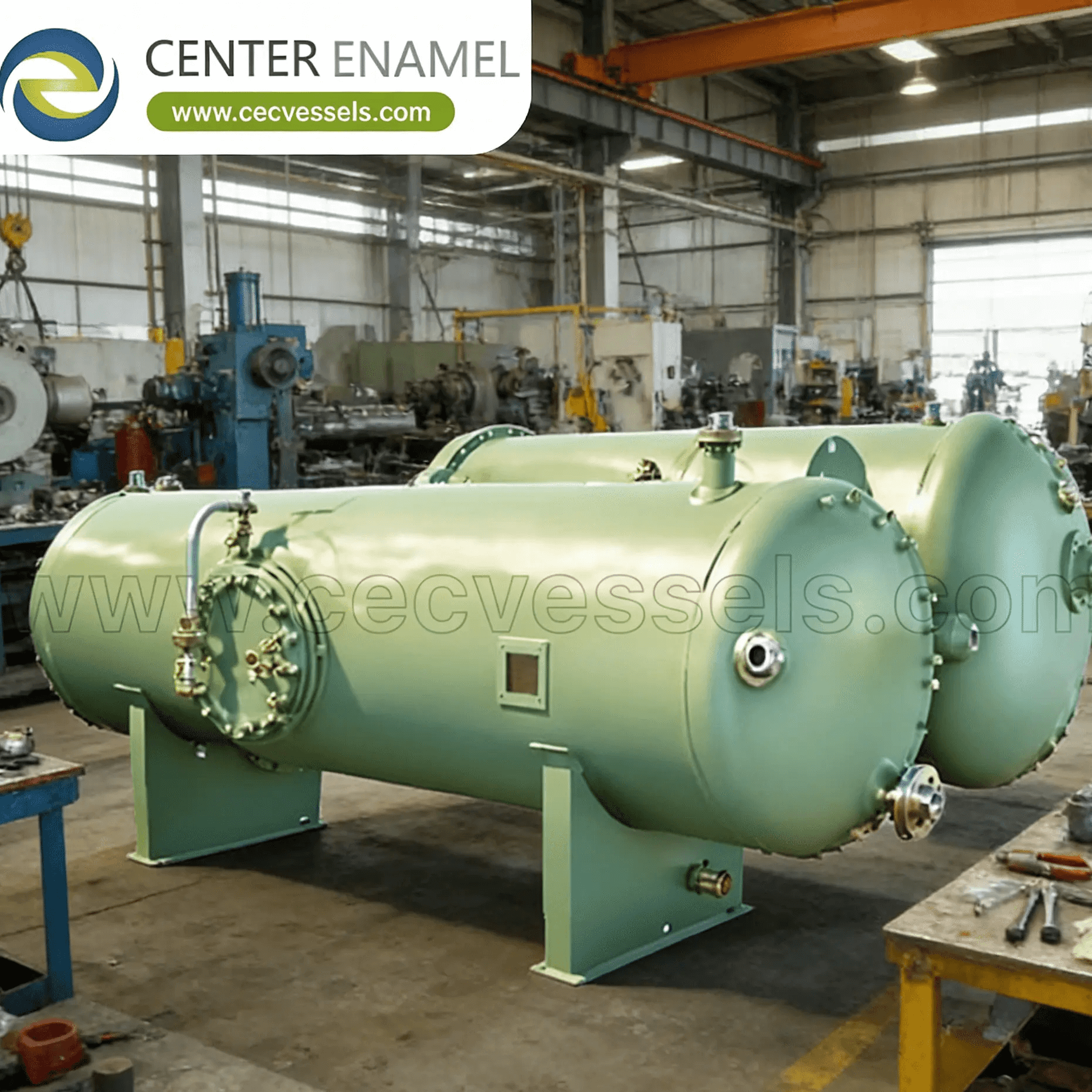
What Is A Pressure Vessel For Crude Oil?
In the upstream and downstream sectors of the oil and gas industry, unrefined petroleum must undergo multiple stages of thermal regulation, separation, and chemical modification before it can be commercialized. A crude oil pressure vessel is a specially designed structural enclosure engineered to store, separate, or heat unrefined hydrocarbons under strictly regulated operational environments. Because raw petroleum arrives at the surface as a multi-component fluid mixture, these systems provide a stable environment where specific processing functions can occur without fluid leakage. As an established Crude Oil Pressure Vessel Manufacturer, Center Enamel develops high-performance thermal containment and processing systems optimized for modern refinery and gathering skids. By adhering to international engineering codes like ASME BPVC, BS EN 13445, and GB/T 150.1-150.4-2024, these vessels ensure structural integrity and consistent performance for global industrial partners.
Fundamental Purpose of Pressure Vessels in Crude Oil ManagementThe primary objective of implementing a specialized crude oil pressure vessel within a manufacturing stream is to handle the highly variable physical and chemical composition of raw petroleum fractions.
As a leading provider of China Crude Oil Pressure Vessel Manufacturer solutions, Center Enamel focuses on providing structural equipment that acts as the core processing anchor for raw fluid streams. When crude oil is extracted from geological structures, it cannot be transferred directly into standard atmospheric storage tanks or pipeline systems. It contains volatile gases that will flash off into the air, as well as emulsified water, salts, and solid minerals. Pressure vessels provide the enclosed, robust structural space required to alter the temperature, adjust fluid velocities, and manage phase transitions safely, turning a chaotic raw stream into stable liquid petroleum ready for secondary transport or fractionation.
Primary Types of Crude Oil Pressure VesselsIndustrial petroleum complexes classify crude oil processing vessels based on their specific functional assignment along the production and refining pipeline. 1. Bulk Crude Storage and Accumulation VesselsBefore entering the primary refining units, crude oil is stored in large vertical or horizontal surge vessels. These units act as hydraulic buffers, absorbing variations in supply from gathering pipelines and ensuring a steady, uninterrupted volumetric feed to the downstream distillation burners. 2. Multi-Phase Crude SeparatorsSeparation vessels are critical tools used to segregate raw petroleum into its primary component phases: gas, liquid hydrocarbons, and free water. In a three-phase configuration, the fluid undergoes gravity-based settling inside the shell, allowing the water fraction to settle to the bottom head while the clean oil floats to an intermediate level for separate collection. 3. Crude Oil DesaltersRaw crude often contains suspended brine droplets and dissolved minerals that can cause heavy corrosion in downstream equipment. A desalting vessel introduces fresh water to wash the crude and applies a high-voltage electrostatic field inside the shell to force the tiny water droplets to coalesce and separate rapidly from the oil phase. 4. Distillation Overhead Condensers and ReboilersThermal processing vessels, such as shell and tube heat exchangers, are used continuously to heat the crude oil before fractionation or to cool the hot overhead vapors exiting distillation towers, turning volatile organic fractions back into liquid products.
Key Technical Parameters for Crude Oil Vessel DesignEngineering a vessel to handle crude oil requires a precise evaluation of several overlapping operational design variables: 1. Design Temperature ProfilesCrude oil processing involves wide thermal variations, ranging from cold wellhead fluids to high-temperature oil streams inside refinery preheating loops. Because steel loses its tensile strength as temperatures rise, design engineers calculate precise wall thicknesses to ensure the vessel shell can easily support full structural loads under continuous thermal cycles. 2. Fluid Viscosity and Specific GravityHeavy crude oil fractions possess high viscosity, which slows down the separation of water droplets and gas bubbles. Vessels handling heavy crudes must be designed with larger internal volumes or equipped with internal thermal heating jackets to lower fluid viscosity and optimize processing speeds. 3. Advanced Corrosion AllowanceRaw petroleum streams frequently contain corrosive chemical agents, including hydrogen sulfide, carbon dioxide, and chloride salts. To protect the structural integrity of the vessel shell over decades of service, designers calculate a specific sacrifice layer, or corrosion allowance, which is added directly to the structural metal thickness equations.
Mechanical Components of Advanced Crude Oil VesselsEvery Crude Oil Pressure Vessel produced by Center Enamel is a precision-manufactured unit built for heavy-duty industrial service under continuous production demands:
Vessel Shell and Heads: The primary structural containment boundary, fabricated from high-grade carbon steel or corrosion-resistant stainless steel plates according to GB/T 150.1-150.4-2024 standards.
Inlet Diverters and Deflector Plates: Internal components placed at the primary entry nozzle to break the momentum of the incoming fluid stream, preventing localized shell erosion and initiating immediate separation.
Coalescing Plate Matrices: Internal metal frameworks that accelerate the separation of complex oil-water emulsions by forcing small droplets to merge into larger fluid volumes.
Retention Weirs and Partitions: Vertical steel plates installed inside horizontal separation vessels to physically isolate the floating crude oil layer from the bottom water layer before discharge.
High-Surface Demister Pads: Dense wire mesh matrices positioned near gas outlet nozzles to trap microscopic liquid droplets entrained in rising vapor streams.
Vortex Breakers: Slotted or star-shaped structural caps placed directly over liquid discharge nozzles to prevent a whirlpool effect from drawing gas out into downstream pump loops.
Reinforced Processing Nozzles: Precision-forged connection ports designed to support steady hydraulic integration with external factory manifolds and piping arrays.
Diverse Industrial ApplicationsThe requirement for durable and highly compliant crude oil pressure vessel technology is universal across a wide array of global sectors served by Center Enamel:
Upstream Wellhead Gathering Stations: Operating at onshore and offshore fields to perform initial bulk separation and stabilization of raw petroleum streams.
Downstream Petrochemical Refining: Deploying complex fractional distillation columns, flash drums, and reboilers to transform crude into gasoline, diesel, and chemical feedstocks.
Vapor Recovery and Stabilization Units: Capturing volatile organic compounds (VOCs) and light hydrocarbons that evaporate from crude oil storage pools, preserving valuable product.
Power Utility Fuel Processing: Utilizing auxiliary storage and heating vessels to prepare heavy crude oil fractions for use as fuel in industrial power turbines.
Environmental Wastewater Treatment: Implementing specialized oil-water separators to treat industrial runoff, wash water, and landfill leachate streams.
Large-Scale Industrial Aquaculture Support: Employing auxiliary water purification and storage vessels to manage facility utility water loops.
Integration within Industrial Process NetworksCrude oil pressure vessels operate as central fluid-handling hubs within comprehensive processing and energy management networks. Center Enamel provides a comprehensive range of equipment that works in tandem with these units:
Steam Distribution Cylinders: Organizing and directing the high-temperature steam lines used to feed internal heating coils or vessel jackets, reducing crude viscosity.
Condensate Tanks: Collecting hot purified water discharged from steam loops for recycling back into the boiler network, maximizing overall factory thermal efficiency.
Tube Heat Exchangers: Adjusting the temperature of the incoming crude stream to the exact range required for optimal phase separation or desalting.
Coalescing Oil Separators: Purifying auxiliary fluids and cooling water to ensure no trace organic oils or greases build up on the heat transfer surfaces of adjacent equipment.
Resin Tanks and Fiber Adsorption Tanks: Providing advanced water purification to ensure that the water injected into crude desalting vessels is free of scale-forming hardness minerals.
Engineering Design Standards and Global ComplianceThe reliability of a high-performance crude oil pressure vessel is guaranteed by strict adherence to international fabrication codes. Center Enamel ensures that every phase of manufacturing complies with the exact regulatory requirements of the target market.
ASME Boiler and Pressure Vessel Code (BPVC)The ASME Section VIII is the global benchmark for pressure equipment manufacturing. It defines the exact mathematical equations for material selection, wall thicknesses, and structural reinforcement for vessels handling volatile fluids under thermal loads. As a certified manufacturer, Center Enamel ensures that its vessels are designed with full safety coefficients for long-term operational security.
GB/T 150.1-150.4-2024The GB/T 150 series is the national standard for metal pressure vessels in China. The 2024 update represents the latest advancements in structural finite element analysis, automated welding metrics, and modern steel grade certifications. Adhering to these updated standards guarantees that vessels are optimized for modern industrial facilities and domestic project compliance.
BS EN 13445For the European market, BS EN 13445 outlines harmonized rules for unfired pressure vessels, placing a significant emphasis on material fatigue analysis and advanced non-destructive testing regimes to ensure long-term structural security under cyclic production demands.
Our high-performance pressure vessels serve a vast industrial landscape, from petroleum refining and chemical processing to food, dairy, and brewing. We deliver precision-engineered solutions for pharmaceuticals, power generation, and wastewater treatment, ensuring compliance with the world’s most stringent safety codes. Our systems are designed for peak efficiency and longevity, empowering global partners to excel in even the most challenging environments.
1. Chemical Industry Project lProject Location: Hubei, China lPressure Vessels: Resin tanks, Coalescing oil separators, Fiber adsorption tanks, Compressed air storage tanks, Condensate tanks, and Steam distribution cylinders lMaterial: Stainless Steel and Carbon Steel. lDesign Standards: GB/T 150 (Pressure Vessels) lApplication: Integrated chemical fluid processing, separation, and steam distribution for chemical plants
2. Seawater Desalination Project lProject Location: Malta lPressure Vessels: Concentrated Sulfuric Acid Storage Tanks (Vertical layout) lMaterial: Carbon Steel lDesign Standards: EN 13445 lApplication: Storage of 98% concentrated sulfuric acid.
3. Waste-to-Energy Incineration Project lProject Location: Hebei, China lPressure Vessels: Large-scale Landfill Leachate Storage and Treatment Tanks (2 Sets) lMaterial: Carbon Steel lDesign Standards: GB 50341-2003 and GB 50128-2005. lApplication: Wastewater Treatment
4. Aquaculture Wastewater Treatment Project lProject Location: Sichuan, China lPressure Vessels: Vertical Wastewater Treatment Vessels (Φ 6×16.5 m (h) 1 set; Φ 7.6×16.5 m (h) 1 set) lMaterial: Carbon Steel lDesign Standards: National standard for vertical cylindrical storage tanks. lApplication: Aquaculture Wastewater Treatment
Maintenance and Vessel LongevityTo ensure a crude oil pressure vessel continues to operate at peak processing efficiency, regular maintenance and operational verification are essential. For ASME-certified vessels, requirements typically include:
Internal Cleaning and Sludge Flushing: Periodically opening the bottom drain nozzles to flush out accumulated paraffin waxes, silt, and rust scales that collect over time and reduce internal volume.
Internal Component Inspections: Checking the integrity of the internal mesh screens, demister pads, and weir plates using non-destructive testing (NDT) to ensure that localized erosion or chemical pitting has not compromised fluid pathways.
Instrument Loop Calibration: Regularly verifying the accuracy of liquid level sensors, interface controllers, and automated discharge valves to prevent water from carrying over into the oil line.
Safety Relief Valve Calibration: Regularly testing the pressure relief valves attached to the vessel shell to ensure they are set to the correct discharge profile, protecting the structural integrity of the overall processing system.
The Center Enamel Manufacturing AdvantageChoosing Center Enamel as your production partner means connecting with an industry leader in technical innovation, advanced engineering, and top-tier industrial fabrication. Advanced Computational EngineeringOur team utilizes Finite Element Analysis (FEA) and Computational Fluid Dynamics (CFD) to digitally simulate exactly how multi-phase crude oil streams move inside the vessel shell, interact with the internal baffles, and separate. This allows us to optimize the length-to-diameter ratio for a horizontal layout or the height parameters for a vertical configuration before physical production begins. Precision Fabrication and Automated WeldingWe operate a state-of-the-art manufacturing facility equipped with automated plate rolling lines, heavy-duty CNC machining setups, and advanced automated welding networks. This commitment to precision minimizes manual variation, accelerates production timelines, and guarantees that every weld profile complies with the strict quality standards of GB/T 150-2024 and ASME codes. Comprehensive Quality AssuranceEvery crude oil pressure vessel unit produced by Center Enamel undergoes a rigorous battery of tests, including full radiographic inspection of all weld profiles, helium leak detection, and multi-stage hydrostatic testing to verify full leak-proof compliance before global delivery.
Summary of Crude Oil Vessel ExcellenceIn conclusion, a pressure vessel for crude oil is a vital technological asset that serves as the backbone of modern petroleum gathering, treatment, and refining infrastructure. By providing a stable, durable, and precisely engineered environment for fluid separation, storage, and thermal modification, these vessels directly drive global processing efficiency and industrial sustainability. Designing and building these units in strict compliance with international benchmarks like the ASME code and the updated GB/T 150.1-150.4-2024 standards ensures they provide long-term operational safety, high processing throughput, and excellent structural durability for our global industrial partners.
Looking for a reliable pressure vessel partner? From complex chemical systems to large-scale environmental projects, we turn your requirements into high-performance reality. Submit your design parameters or project specs now, and we will have a dedicated engineer reach out to you as soon as possible to discuss the next steps.
|