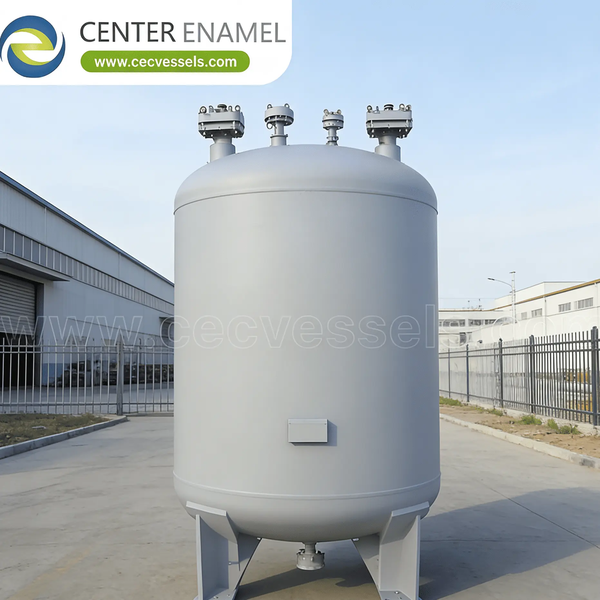
A reactor in industry is process equipment designed to control chemical, physical, or biological reactions by managing reactants, mixing, temperature, residence time, heat transfer, and material flow. Industrial reactors operate in batch, semibatch, or continuous modes and are selected according to reaction kinetics, production capacity, material compatibility, and product requirements.
How Does an Industrial Chemical Reactor Work?
An industrial chemical reactor provides a controlled environment where reactants interact under defined conditions. Key operating parameters include temperature, pressure, concentration, residence time, feed rate, mixing intensity, and heat-transfer rate.
Depending on the process, feed materials may enter as liquids, gases, solids, or multiphase mixtures. A reactor can include an agitator, impeller, baffles, heating or cooling jacket, internal coils, feed nozzles, discharge outlets, temperature sensors, and sampling ports.
Reactor design is based on reaction kinetics, conversion, selectivity, mixing, heat transfer, mass transfer, reactor volume, and production capacity.
Why Are Chemical Reactors Important in Industry?
Chemical reactors provide controlled conditions for converting raw materials into desired products. Reactor performance affects conversion, selectivity, reaction time, temperature control, product consistency, and production capacity.
Industrial reactors are used in chemical manufacturing, petrochemical processing, pharmaceutical production, polymerization, food processing, biotechnology, fertilizer production, specialty chemicals, and environmental treatment.
The reactor is a core process unit that connects raw-material feed systems with downstream separation, purification, storage, and product-handling equipment.
What Are the Main Types of Chemical Reactors?
Chemical reactors can be classified according to operating mode, flow pattern, phase configuration, and geometry. Common types include batch reactors, semibatch reactors, continuous stirred tank reactors (CSTRs), plug flow reactors (PFRs), packed-bed reactors, fluidized-bed reactors, tubular reactors, and catalytic reactors.
The appropriate type depends on reaction kinetics, feed characteristics, production capacity, residence time, mixing requirements, heat transfer, conversion, and selectivity.
What Is a Batch Reactor?
A batch reactor is a closed-process vessel in which a defined quantity of reactants is charged, processed for a specified time, and then discharged.
Typical components include a reaction vessel, agitator, impeller, heating or cooling system, feed connections, discharge outlet, and process instrumentation.
Batch reactors are commonly used for specialty chemicals, pharmaceuticals, resins, coatings, food products, and flexible multi-product manufacturing. Their main advantage is operational flexibility because different recipes can be processed in separate production cycles.
What Is a Continuous Stirred Tank Reactor?
A continuous stirred tank reactor (CSTR) continuously receives reactants and removes products while an agitator maintains mixing inside the vessel.
Under ideal steady-state conditions, the reactor contents have approximately uniform temperature and composition. The nominal residence time can be expressed as τ = V/Q, where V is reactor volume and Q is volumetric flow rate.
For example, a 20 m³ CSTR operating at 5 m³/h has a nominal residence time of 4 hours.
CSTRs are suitable for continuous processes requiring controlled mixing, feed, discharge, and process monitoring.
What Is a Plug Flow Reactor?
A plug flow reactor (PFR) is a continuous tubular reactor in which reactants move through a pipe or tube while the reaction progresses along the flow path.
Unlike a well-mixed CSTR, concentration and reaction conditions can change along the reactor length. Important design parameters include tube length, diameter, flow rate, residence time, reaction rate, heat transfer, and feed concentration.
PFRs are commonly used for continuous chemical processing where tubular flow characteristics are appropriate.
What Is a Semibatch Reactor?
A semibatch reactor combines batch and continuous operation. One or more reactants are initially charged into the vessel, while another reactant is added continuously or at a controlled rate.
Key variables include initial charge, feed rate, addition time, agitation, temperature, reaction time, and final volume.
Semibatch operation is useful when controlled reactant addition is required to manage concentration, reaction rate, heat generation, or selectivity.
How Does Mixing Affect Reactor Performance?
Mixing affects reactor performance by controlling reactant distribution, concentration uniformity, temperature uniformity, gas-liquid contact, solid suspension, and mass transfer.
Stirred reactors commonly use agitators, impellers, and baffles. Equipment selection depends on viscosity, density, liquid level, solids concentration, gas content, impeller diameter, and required mixing duty.
Effective mixing helps reduce concentration and temperature gradients and can improve contact between gas, liquid, and solid phases.
How Is Heat Transfer Managed in a Chemical Reactor?
Heat transfer is commonly managed using heating or cooling jackets, half-pipe jackets, internal coils, or external heat exchangers.
The required heat-transfer system depends on reaction heat, process temperature, heat-transfer coefficient, vessel geometry, production cycle time, and available utilities.
Common heating and cooling media include steam, hot water, thermal oil, and chilled water. Temperature control can directly affect reaction rate, conversion, selectivity, viscosity, and product quality.
What Materials Are Used for Chemical Reactors?
Chemical reactors can be manufactured from stainless steel, carbon steel, alloy steel, glass-lined materials, or specialized corrosion-resistant materials.
Stainless steel grades such as 304, 316, and 316L may be selected for applications requiring corrosion resistance, cleanability, or hygienic processing. Carbon steel can be used when compatible with the process medium.
Material selection should consider chemical compatibility, corrosion resistance, operating temperature, mechanical loads, cleaning method, fabrication requirements, and applicable design standards.
What Are the Main Components of an Industrial Reactor?
An industrial reactor can include:
Reaction vessel or shell
Agitator and impeller
Baffles
Heating or cooling jacket
Internal heat-transfer coils
Feed and discharge nozzles
Temperature sensors
Pressure and level instruments
Sampling ports
Manways
Mechanical seals
Gas distributors
Catalyst supports
The final configuration depends on reactor volume, working volume, fluid properties, phase arrangement, mixing duty, heat-transfer requirements, and process instrumentation.
What Is Reactor Residence Time?
Residence time is the average time material remains inside a reactor and is an important parameter for continuous reactor design.
For a continuous reactor, nominal residence time can be calculated as τ = V/Q. For example, a reactor with a 30 m³ working volume and a 6 m³/h flow rate has a nominal residence time of 5 hours.
Actual residence-time behavior can differ because of mixing, flow distribution, dead zones, bypassing, and axial dispersion. Residence-time distribution is therefore important when evaluating reactor performance.
How Does Reactor Design Affect Conversion and Selectivity?
Reactor design affects conversion, selectivity, reaction rate, heat transfer, mass transfer, and residence-time distribution by controlling how reactants move and interact.
Important design factors include reaction kinetics, temperature, reactant concentration, residence time, mixing, catalyst activity, and flow pattern.
Conversion describes how much of a reactant is consumed, while selectivity describes how effectively the reaction favors the desired product over competing products. Reactor design should therefore consider both parameters rather than conversion alone.
Where Are Industrial Chemical Reactors Used?
Industrial reactors are used in:
Typical processes include synthesis, polymerization, neutralization, oxidation, reduction, hydrolysis, esterification, hydrogenation, crystallization, and biological conversion.
How Is an Industrial Chemical Reactor Selected?
Reactor selection should begin with the reaction type, feed composition, production capacity, operating mode, reaction time, temperature range, heat-transfer requirement, and material compatibility.
Engineers should also evaluate:
Reaction: kinetics, conversion, selectivity, catalyst requirements
Capacity: batch size or continuous flow rate
Residence time: required reaction duration
Mixing: viscosity, phase arrangement, solids loading
Heat transfer: heating or cooling duty
Materials: corrosion resistance and product compatibility
Operation: batch, semibatch, or continuous
Instrumentation: temperature, pressure, level, flow, and process control
The final reactor configuration should be based on actual process conditions rather than vessel volume alone.
What Features Can a Chemical Reactor Include?
A chemical reactor can be customized with top-entry or bottom-entry agitators, anchor or turbine impellers, baffles, heating and cooling jackets, internal coils, insulation, mechanical seals, sampling ports, gas distributors, temperature sensors, pressure instruments, and automated control systems.
High-viscosity materials may require specialized impellers, while gas-liquid reactions may require gas distributors or spargers. The final configuration depends on fluid properties, phase behavior, reaction kinetics, heat transfer, mixing, and working volume.
What Is the Difference Between Batch and Continuous Reactors?
A batch reactor receives a defined charge, completes a reaction cycle, and then discharges the product. A continuous reactor receives feed and removes product continuously during operation.
Batch systems generally provide greater flexibility for different products and formulations, while continuous systems are designed around steady material flow and consistent operating conditions.
The choice depends on production volume, product variety, reaction kinetics, residence time, process control requirements, and plant operating strategy.
What Should Businesses Consider When Choosing a Chemical Reactor?
Businesses should consider reaction chemistry, production capacity, batch or continuous operation, residence time, material of construction, agitation, heat transfer, instrumentation, cleaning requirements, maintenance access, applicable standards, and future production requirements.
A technical specification should define parameters such as working volume, total volume, vessel dimensions, operating temperature, operating pressure where applicable, nozzle configuration, agitator requirements, heat-transfer area, material, and process connections.
A complete specification allows the reactor manufacturer to determine the appropriate vessel configuration, internal components, thermal-control system, instrumentation, and fabrication requirements.
Frequently Asked Questions About Industrial Reactors
What is a reactor in industry?
A reactor is process equipment used to provide controlled conditions for a chemical, physical, or biological reaction. Key parameters include temperature, mixing, residence time, feed rate, heat transfer, concentration, and material flow.
What are the main types of chemical reactors?
The main reactor types include batch reactors, semibatch reactors, CSTRs, PFRs, packed-bed reactors, fluidized-bed reactors, tubular reactors, and catalytic reactors.
What is a CSTR used for?
A CSTR is used for continuous processing in which reactants enter and products leave continuously. Agitation maintains mixing, while reactor volume and flow rate determine nominal residence time.
What is a PFR used for?
A PFR is used for continuous reaction processing in which feed moves through a tubular flow path. Reaction conditions can change along the reactor length.
What materials are used to manufacture reactors?
Common materials include stainless steel, carbon steel, alloy steel, and glass-lined materials. Material selection depends on chemical compatibility, corrosion resistance, temperature, mechanical requirements, and cleaning conditions.
What is residence time in a reactor?
Residence time is the average duration material remains inside a reactor. For a continuous reactor, the nominal value can be expressed as τ = V/Q, where V is reactor volume and Q is volumetric flow rate.
How do I select an industrial chemical reactor?
Start with the reaction type, feed materials, production capacity, operating mode, residence time, mixing requirements, heat-transfer duty, material compatibility, and process-control requirements. These parameters determine the appropriate reactor type and configuration.


