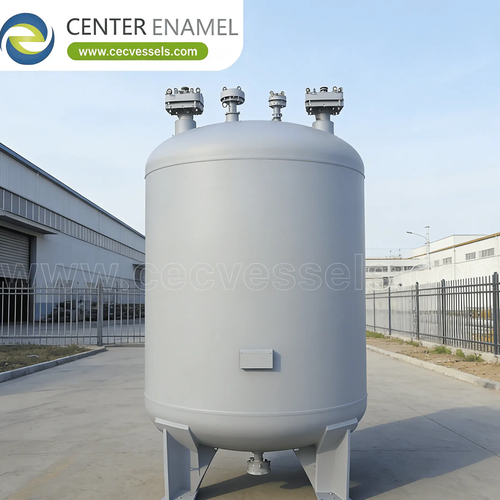
A tubular reactor is a continuous-flow chemical reactor in which reactants move through a tube-shaped reaction zone and undergo chemical conversion before leaving as a product stream. Its performance depends on reaction kinetics, residence time, flow behavior, temperature control, and reactor configuration.
What Is a Tubular Reactor?
An industrial tubular reactor is designed to carry out chemical reactions while process materials flow continuously through a tubular reaction zone. Reactants enter through an inlet, travel along the reactor, and leave through an outlet after undergoing the required reaction.
Unlike a batch reactor, which processes a charge of material over a defined operating cycle, a tubular reactor can support continuous feed and product withdrawal. This configuration is useful for processes requiring steady production, controlled reaction conditions, and integration with upstream and downstream equipment.
Tubular reactors can be designed for homogeneous reactions, where reactants occupy the same fluid phase, or heterogeneous reactions, where different phases are involved. Some designs use an empty tube, while others contain catalysts or incorporate multiple tubes to provide the required reaction and heat transfer capacity.
How Does a Tubular Reactor Work?
The tubular reactor working principle involves feeding reactants into a defined reaction zone and allowing chemical conversion to occur as the materials move through the equipment. The reaction progresses according to the kinetics of the process and the local operating conditions.
The inlet system distributes the feed into the reactor. Inside the tube, the reactants experience a particular temperature profile, flow pattern, and residence time. Depending on the reaction, a catalyst may accelerate the chemical conversion, while a heating or cooling system helps maintain the required temperature.
The product stream exits through the outlet and may then pass to equipment such as a heat exchanger, separator, condenser, or purification unit. The complete process arrangement depends on product specifications and the chemistry involved.
For example, a tubular reactor used for a continuous liquid-phase reaction may receive a metered feed, maintain a controlled temperature along the reaction path, and discharge the resulting mixture for downstream separation. Actual conversion and selectivity depend on the reaction kinetics, flow conditions, catalyst performance where applicable, and operating parameters.
What Are the Main Types of Tubular Reactors?
Tubular reactor design varies according to the reaction mechanism, catalyst requirements, heat transfer needs, and process scale. Common configurations include empty-tube reactors, packed-bed tubular reactors, multitubular reactors, and coiled tubular reactors.
An empty-tube reactor provides a reaction space without a packed catalyst bed. It may be used for suitable homogeneous reactions or other processes where the tube geometry and operating conditions provide the required reaction environment.
A packed-bed tubular reactor contains solid catalyst particles or other suitable packing within the reaction zone. Reactants flow through the packed section and interact with the catalyst surface. Design considerations include catalyst properties, bed geometry, flow distribution, heat transfer, and the pressure drop associated with the packing.
A multitubular reactor contains multiple reaction tubes arranged within a common structure. This configuration can provide a large combined heat transfer surface and is useful for processes requiring temperature management across multiple reaction channels. The design must account for flow distribution and heat transfer in each tube.
A coiled tubular reactor uses a tube arranged in a coil. Its compact geometry can provide a long reaction path within a limited footprint. Suitability depends on the required residence time, fluid properties, heat transfer needs, and process conditions.
These configurations describe equipment arrangements rather than mutually exclusive reaction models. The appropriate design must be selected according to the specific process requirements.
What Is the Difference Between a Tubular Reactor and a Plug Flow Reactor?
A tubular reactor describes the physical configuration of a reactor, whereas a plug flow reactor (PFR) describes an idealized flow model. The two terms are related, but they are not interchangeable in every engineering context.
In an ideal plug flow model, fluid elements move through the reactor with negligible axial mixing, and their composition changes as they travel along the reaction path. Radial variations may also be neglected in the simplified model.
An actual tubular reactor may approximate plug flow when its geometry, fluid properties, and operating conditions support the required flow behavior. However, axial dispersion, mixing, velocity profiles, and reactor internals can cause real flow conditions to differ from the ideal model.
Engineers therefore evaluate residence time distribution and flow behavior rather than assuming that every tubular reactor operates under ideal plug flow conditions.
How Does Residence Time Affect Tubular Reactor Performance?
Tubular reactor residence time describes how long process material remains within the reaction zone. For an idealized system with a defined effective reactor volume and volumetric flow rate, the nominal residence time is estimated by dividing the effective volume by the volumetric flow rate under the relevant conditions.
For example, a reactor with an effective reaction volume of 100 liters and a volumetric flow rate of 20 liters per minute has a nominal residence time of 5 minutes under those stated conditions. This is an illustrative calculation, not a product specification or a guarantee of actual residence time distribution.
Residence time influences the opportunity for reactants to undergo chemical conversion. Insufficient residence time may limit conversion, while a longer residence time can affect throughput, selectivity, and operating cost. The optimal value depends on reaction kinetics, temperature, catalyst activity, and product requirements.
For non-ideal flow systems, the nominal residence time alone may not adequately describe process performance. Engineers may also evaluate residence time distribution, mixing behavior, and the effective reaction volume when developing the reactor design.
How Is Temperature Controlled in a Tubular Reactor?
Tubular reactor temperature control is important because temperature affects reaction rate, selectivity, material properties, and heat transfer. The required thermal management strategy depends on whether the reaction releases heat, absorbs heat, or requires a narrow operating temperature range.
A tubular reactor may use an external heating system, a cooling jacket, a heat transfer medium, or a multitubular arrangement to regulate temperature. The selected system should provide suitable heat transfer across the reaction zone while accommodating the process fluid and required operating conditions.
For exothermic reactions, heat removal helps control the temperature profile and maintain the intended reaction conditions. For endothermic reactions, heat must be supplied to sustain the required conversion rate. In either case, the reactor design should account for reaction heat, feed temperature, heat transfer area, and the thermal properties of the process materials.
Temperature measurement and control equipment can help operators monitor the reaction zone and maintain consistent operating conditions. Instrument placement and control strategy should be determined by the reaction characteristics and the reactor configuration.
Which Materials Are Used in Tubular Reactor Construction?
Tubular reactor material selection depends on the chemical composition of the process stream, operating temperature, corrosion resistance, cleaning requirements, and mechanical design conditions.
Stainless steel grades such as 304 and 316L may be considered for certain chemical processing applications. However, suitability depends on the specific chemicals, their concentrations, temperature, and other operating conditions. Neither grade should be treated as universally compatible with all process fluids.
Other material options may be appropriate when the process requires different corrosion resistance, thermal performance, or fabrication characteristics. Engineers should review the complete process specification before confirming the material grade, tube dimensions, connections, and surface finish.
Material selection also affects maintenance planning, cleaning procedures, expected service life, and integration with other process equipment. The final choice should be supported by an application-specific engineering assessment.
What Factors Affect Tubular Reactor Design?
Tubular reactor design requires coordination between reaction kinetics, flow characteristics, thermal management, material compatibility, and production targets. No single parameter determines reactor performance independently of the others.
Reaction kinetics help establish the required reaction time and operating temperature. Feed composition and flow rate influence throughput, while effective reaction volume affects the available residence time. For catalytic designs, catalyst activity, particle size, distribution, and loading may also influence conversion and flow behavior.
Tube diameter, tube length, and the number of tubes affect reactor volume, surface area, and equipment dimensions. In multitubular systems, uniform flow distribution and appropriate heat transfer are important design considerations.
Engineers should also assess startup and shutdown requirements, instrumentation, cleaning access, downstream equipment connections, and applicable design standards. A well-specified reactor matches the process duty while supporting reliable integration into the overall production line.
Where Are Tubular Reactors Used?
Tubular reactor applications include chemical synthesis, petrochemical processing, catalytic conversion, polymer-related processes, and other continuous manufacturing operations. The appropriate configuration depends on the reaction chemistry and the required process conditions.
In chemical manufacturing, tubular reactors can support continuous reactions where feed composition, flow rate, and temperature are controlled to achieve defined product specifications. Catalytic tubular reactors are used in processes where a solid catalyst facilitates the desired chemical conversion.
In petrochemical processing, tubular reactor configurations may be applied to suitable reactions that benefit from continuous feed and controlled residence time. In specialty chemical manufacturing, reactor selection depends on reaction kinetics, product selectivity, heat transfer requirements, and compatibility with downstream separation equipment.
A tubular reactor can also be integrated with pumps, metering systems, heat exchangers, condensers, separators, and process control equipment. The complete arrangement should be designed around the process flow, production capacity, and required product quality.
How Does Center Enamel Support Industrial Reactor Projects?
Center Enamel provides industrial equipment solutions for process applications that require coordinated equipment design and plant integration. Tubular reactor project requirements should be evaluated according to the reaction chemistry, feed properties, target production rate, operating temperature, material compatibility, and downstream process needs.
When specifying a reactor, buyers should provide the process description, feed and product information, expected flow rates, reaction conditions, required conversion or product specifications, and relevant material requirements. These details help establish the technical basis for equipment selection and project evaluation.
For projects involving a complete chemical production line, reactor requirements should also be coordinated with upstream feed preparation, thermal management, downstream separation, and product recovery systems. Final equipment configuration and manufacturing capabilities should be confirmed against the actual project specification.
Frequently Asked Questions About Tubular Reactors
What Is the Main Purpose of a Tubular Reactor?
The main purpose of a tubular reactor is to carry out chemical reactions continuously as reactants flow through a tube-shaped reaction zone. It supports controlled reaction conditions and continuous product discharge.
How Does a Tubular Reactor Work?
A tubular reactor introduces reactants through an inlet, allows chemical conversion to occur along the reaction zone, and discharges the resulting product stream through an outlet. Temperature, flow conditions, and residence time influence performance.
Is a Tubular Reactor the Same as a Plug Flow Reactor?
No. A tubular reactor describes equipment geometry, while a plug flow reactor describes an idealized flow model. A tubular reactor may approximate plug flow, but actual behavior depends on mixing, fluid properties, geometry, and operating conditions.
How Is Residence Time Calculated in a Tubular Reactor?
Nominal residence time can be estimated by dividing the effective reactor volume by the volumetric flow rate under the relevant conditions. For example, 100 liters divided by 20 liters per minute gives 5 minutes. Actual residence time distribution may differ because of non-ideal flow behavior.
What Are the Main Types of Tubular Reactors?
Common configurations include empty-tube reactors, packed-bed tubular reactors, multitubular reactors, and coiled tubular reactors. Selection depends on reaction kinetics, catalyst requirements, thermal management, and available installation space.
How Is Temperature Controlled in a Tubular Reactor?
Temperature can be managed using external heating, cooling jackets, heat transfer media, or multitubular designs. The appropriate method depends on reaction heat, operating temperature, heat transfer requirements, and process conditions.
Which Materials Are Suitable for Tubular Reactors?
Stainless steel grades such as 304 and 316L may be suitable for certain applications. Final material selection depends on process chemistry, concentration, temperature, corrosion resistance, cleaning requirements, and the complete equipment specification.
What Industries Use Tubular Reactors?
Tubular reactors are used in chemical manufacturing, petrochemical processing, catalytic conversion, and other continuous production applications where the reaction conditions and equipment configuration suit the process requirements.
What Information Is Needed to Select an Industrial Tubular Reactor?
Key information includes feed composition, reaction chemistry, required production rate, target conversion, operating temperature, residence time requirements, catalyst needs, material compatibility, and connections to upstream and downstream equipment.


