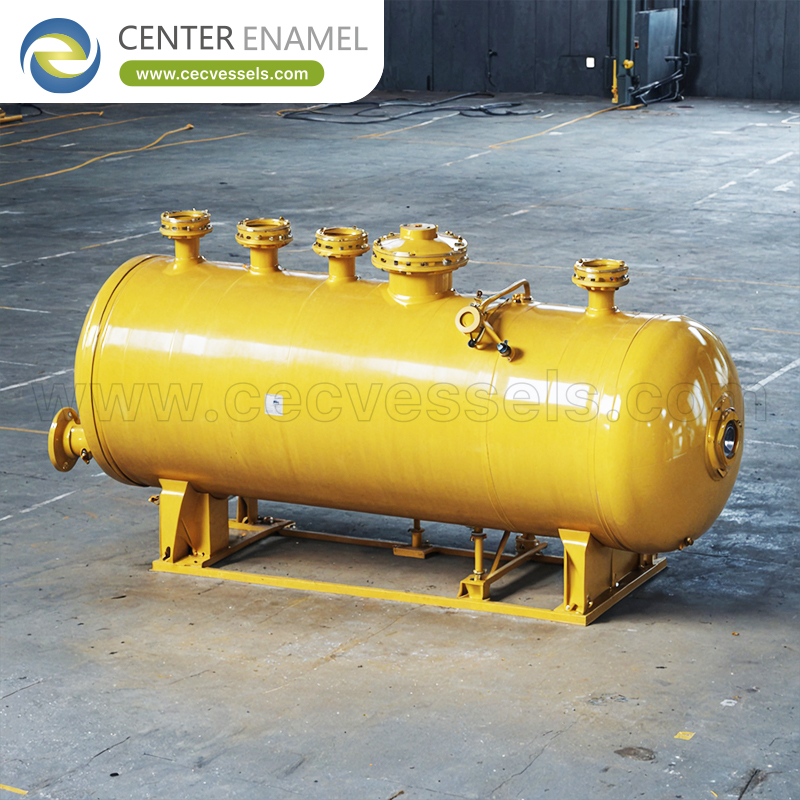
An insulated vessel is an industrial vessel designed to reduce heat transfer between the contents inside the vessel and the surrounding environment. It typically combines an inner vessel shell, thermal insulation, an outer jacket or cladding, and insulated supports to maintain a controlled operating temperature, reduce heat loss or heat gain, and improve thermal efficiency during storage or processing.
Insulated vessels are used for temperature-sensitive liquids and process fluids in the chemical, pharmaceutical, food and beverage, petrochemical, energy, and environmental industries. Depending on the service temperature and process requirements, insulation may use mineral wool, polyurethane foam, or other thermal insulation systems, while the vessel can be manufactured in stainless steel or carbon steel and configured as a vertical or horizontal vessel.
What Is an Insulated Vessel?
An insulated vessel is a storage or process vessel equipped with a thermal insulation system that limits heat transfer between the vessel contents and the external environment.
The insulation system is designed to reduce the three primary modes of heat transfer: conduction, convection, and radiation. By limiting thermal exchange, an insulated vessel can help maintain the required fluid temperature, reduce energy consumption, and provide more consistent process conditions.
A typical insulated vessel consists of four main elements:
Inner vessel shell: Contains the stored or processed fluid.
Insulation layer: Reduces thermal conduction and heat transfer.
Outer cladding or jacket: Protects the insulation from moisture, weather, and physical damage.
Insulated supports and thermal breaks: Reduce heat bridges between the inner vessel and external structures.
The required insulation material, thickness, vessel material, and external finish depend on the operating temperature, fluid characteristics, vessel size, and installation environment.
How Does an Insulated Vessel Work?
An insulated vessel works by adding a low-thermal-conductivity barrier around the vessel shell. This barrier reduces the rate at which thermal energy moves between the process fluid and the surrounding environment.
Heat transfer occurs mainly through conduction, convection, and thermal radiation. A properly designed insulation system addresses all three mechanisms by combining suitable insulation materials, continuous coverage, protective cladding, and thermal breaks.
For heated fluids, insulation helps reduce heat loss from the vessel to the surrounding air. For chilled or temperature-sensitive fluids, insulation reduces heat gain from the environment and can also help prevent condensation on the external surface.
The required insulation thickness is determined by factors such as:
Operating temperature
Ambient temperature
Required fluid temperature
Insulation thermal conductivity
Vessel diameter and geometry
Heat-loss or heat-gain requirements
External environmental conditions
Surface temperature requirements
What Are the Main Components of an Insulated Vessel?
1. Inner Vessel Shell
The inner vessel shell is the primary containment structure that holds the process fluid or stored material.
Common materials include stainless steel grades such as 304 and 316L, as well as carbon steel for applications where the process conditions permit its use. Material selection depends on fluid compatibility, operating temperature, mechanical requirements, and applicable design standards.
For sanitary and process applications, stainless steel can also provide a smooth internal surface suitable for cleaning and hygienic processing.
2. Thermal Insulation Layer
The insulation layer is installed around the outer surface of the vessel shell to reduce heat transfer.
Common insulation materials include:
Mineral wool
Rock wool
Polyurethane foam
Polyisocyanurate insulation
Aerogel-based insulation systems
Vacuum insulation systems for specialized applications
The insulation material is selected according to the operating temperature, required thermal resistance, moisture conditions, available space, and overall thermal performance requirements.
3. Outer Cladding or Jacket
The outer cladding protects the insulation layer from moisture, weather exposure, ultraviolet radiation, and mechanical damage.
Aluminum and stainless steel are commonly used for external cladding because they provide durability and corrosion resistance in industrial environments.
The cladding should be properly sealed around vessel nozzles, manways, supports, and other penetrations to maintain the continuity of the insulation system.
4. Thermal Breaks and Supports
Supports can create thermal bridges between the insulated vessel shell and external structures.
Thermal breaks and low-conductivity support designs reduce these heat-transfer paths and help maintain more continuous thermal insulation around the vessel.
This design is particularly important when the vessel operates at significantly higher or lower temperatures than the surrounding environment.
What Are the Types of Insulated Vessels?
Insulated vessels can be classified according to their insulation configuration, operating temperature, and process function.
Insulated Storage Vessels
Insulated storage vessels are designed to maintain the temperature of stored liquids or process materials over a defined storage period.
They are commonly used for heated water, oils, chemicals, food products, pharmaceutical liquids, and other temperature-sensitive materials.
Jacketed Insulated Vessels
Jacketed insulated vessels combine an external jacket with thermal insulation. The jacket can provide a controlled heating or cooling medium around the vessel, while the insulation reduces thermal losses to the surrounding environment.
This configuration is commonly used for process vessels, reactors, mixing vessels, and temperature-controlled storage systems.
Vacuum-Insulated Vessels
Vacuum-insulated vessels use a vacuum space or vacuum-based insulation structure to reduce heat transfer through conduction and convection.
They are commonly associated with applications requiring strong thermal isolation, particularly for low-temperature or cryogenic service.
Cryogenic Insulated Vessels
Cryogenic insulated vessels are designed for storing or processing fluids at very low temperatures.
Their insulation systems are engineered to minimize heat ingress and maintain the required cryogenic operating conditions.
Typical applications include liquefied gases and other low-temperature process fluids.
Insulated Process Vessels
Insulated process vessels are used when temperature control is part of an industrial process rather than simple storage.
They can be integrated with agitators, heat exchangers, steam systems, cooling systems, or other process equipment to maintain the required operating temperature.
What Are the Benefits of an Insulated Vessel?
Temperature Stability
Insulation reduces heat exchange between the process fluid and the environment, helping maintain a more stable internal temperature.
This is particularly important for temperature-sensitive materials and processes where temperature variations can affect product quality or process performance.
Reduced Heat Loss and Heat Gain
For heated fluids, insulation reduces heat loss to the surrounding environment. For chilled fluids, it reduces heat gain from ambient conditions.
The resulting reduction in thermal losses can decrease the amount of heating or cooling energy required to maintain the target temperature.
Improved Energy Efficiency
By reducing unnecessary thermal exchange, an insulated vessel can improve the overall energy efficiency of a storage or process system.
The actual energy savings depend on factors such as operating temperature, insulation material, insulation thickness, vessel geometry, ambient conditions, and operating time.
Condensation Control
When a vessel contains a chilled fluid, its external surface can become colder than the surrounding air.
A properly designed insulation system can keep the outer surface above the applicable dew-point condition, reducing condensation on the vessel exterior.
More Consistent Process Conditions
Stable vessel temperatures can support more consistent operating conditions in processes involving heating, cooling, reaction, mixing, storage, or temperature-sensitive fluids.
Where Are Insulated Vessels Used?
Insulated vessels are used in industries where temperature control or thermal efficiency is important.
Chemical Industry
Chemical plants use insulated vessels for storing and processing temperature-sensitive chemicals, solvents, oils, and other process fluids.
Insulation can help maintain the required process temperature and reduce thermal losses during storage or processing.
Petrochemical Industry
Insulated vessels can be used for oils, hydrocarbons, process fluids, and other materials whose viscosity or handling characteristics depend on temperature.
Maintaining a controlled temperature can support stable fluid handling and process operation.
Food and Beverage Industry
Food and beverage facilities use insulated vessels for products such as milk, juices, syrups, edible oils, and other temperature-sensitive liquids.
Insulation helps maintain the required product temperature during processing and storage.
Pharmaceutical Industry
Pharmaceutical and bioprocess facilities may use insulated vessels for temperature-sensitive liquids, intermediates, culture media, and process solutions.
The vessel design can incorporate stainless steel construction, sanitary finishes, cleanable surfaces, and temperature-control systems according to the process requirements.
Power Generation
Power plants can use insulated vessels for hot water, condensate, thermal fluids, and other liquids associated with heat-management systems.
Reducing heat loss can improve the thermal efficiency of the overall process system.
Wastewater and Environmental Applications
Insulated vessels can also be used in wastewater and environmental treatment systems where process temperature influences biological activity or fluid characteristics.
What Materials Are Used for Insulated Vessels?
The material selection for an insulated vessel depends on the stored medium, operating temperature, corrosion requirements, mechanical design, and applicable standards.
Common vessel materials include:
Common insulation materials include:
The external cladding can be manufactured from aluminum, stainless steel, or other suitable materials depending on the installation environment.
How Is Insulation Thickness Determined?
Insulation thickness is not a universal fixed value. It is calculated according to the required thermal performance and operating conditions of the vessel.
Important design inputs include:
Fluid operating temperature
Ambient temperature
Target external surface temperature
Insulation thermal conductivity
Vessel diameter
Heat-loss or heat-gain limit
Operating duration
Relative humidity
Installation environment
For example, a vessel operating at an elevated temperature generally requires an insulation system capable of limiting heat loss and controlling the external surface temperature. A chilled vessel requires insulation that limits heat gain and helps control condensation.
Therefore, insulation thickness should be determined as part of the thermal design rather than selected solely according to vessel size.
What Is the Difference Between an Insulated Vessel and a Jacketed Vessel?
An insulated vessel and a jacketed vessel perform different primary functions.
An insulated vessel uses a thermal barrier to reduce heat transfer between the vessel and its surroundings. A jacketed vessel uses a separate space around the vessel shell to circulate a heating or cooling medium.
The two systems can also be combined.
For example, a process vessel may use a heating jacket to transfer thermal energy into the process fluid and an external insulation layer to reduce heat loss from the jacket to the environment.
Therefore:
Insulation primarily reduces unwanted heat transfer.
A jacket actively transfers heat into or out of the vessel.
A jacketed and insulated vessel can provide both active temperature control and passive thermal protection.
What Are the Technical Specifications of an Insulated Vessel?
The technical specification of an insulated vessel is customized according to the process requirements.
Typical specifications include:
Vessel type: storage vessel or process vessel
Orientation: vertical or horizontal
Vessel material: stainless steel or carbon steel
Internal volume: project-specific
Operating temperature: process-specific
Design temperature: based on applicable engineering requirements
Insulation material: selected according to thermal requirements
Insulation thickness: calculated according to required thermal performance
External cladding: aluminum, stainless steel, or other suitable material
Internal finish: standard or polished finish according to application
Nozzle configuration: customized according to process connections
Agitation: optional for mixing or reaction applications
Heating or cooling system: optional according to process requirements
For pressure vessels, the design specification should also define design pressure, pressure relief provisions, material requirements, inspection requirements, and the applicable pressure vessel code.
What Standards Apply to Insulated Vessels?
The applicable standard depends on the vessel type, design conditions, manufacturing location, and project requirements.
Common standards may include:
ASME BPVC
ASME Boiler and Pressure Vessel Code Section VIII provides requirements for the design and construction of applicable pressure vessels.
GB/T 150
GB/T 150 is a Chinese standard series for pressure vessels. The applicable edition and parts should be specified according to the project design requirements.
EN 13445
EN 13445 provides requirements for unfired pressure vessels in European applications.
In addition to pressure vessel standards, projects may require material standards, welding procedures, inspection requirements, testing specifications, and customer-specific engineering standards.
The applicable code should therefore be confirmed during the vessel design stage.
How Are Insulated Vessels Maintained?
Regular inspection helps maintain the thermal performance and structural condition of an insulated vessel.
Important inspection areas include:
External Cladding
Inspect the outer cladding for gaps, damaged sections, loose joints, and areas where moisture could enter the insulation system.
Insulation Condition
Check for insulation settlement, moisture ingress, compression, or deterioration that could reduce thermal resistance.
Nozzles and Manways
Nozzles, manways, supports, and other penetrations can interrupt insulation continuity and should receive particular attention during inspection.
Thermal Performance
Thermal imaging can be used to identify unusual hot or cold areas on the external surface that may indicate localized insulation problems.
Vessel Shell and Connections
The vessel shell, welds, flanges, nozzles, supports, and other mechanical components should be inspected according to the applicable vessel design code and maintenance program.
How Does Center Enamel Manufacture Insulated Vessels?
Center Enamel provides customized industrial vessel solutions based on process requirements, vessel configuration, material selection, thermal insulation, and applicable engineering standards.
The manufacturing process can include engineering design, material preparation, vessel fabrication, welding, machining, insulation installation, external cladding, inspection, and testing.
For customized projects, the engineering team can evaluate vessel dimensions, operating temperature, fluid properties, insulation requirements, nozzle arrangement, support design, and applicable standards before manufacturing.
This approach allows the insulated vessel to be configured for applications across chemical processing, petrochemical production, food and beverage processing, pharmaceutical manufacturing, power generation, and environmental treatment.
Insulated Vessel FAQ
What is an insulated vessel used for?
An insulated vessel is used to reduce heat transfer between the vessel contents and the surrounding environment. It helps maintain a stable fluid temperature, reduce heat loss or heat gain, improve thermal efficiency, and support temperature-sensitive storage or processing.
What is the difference between a thermal insulated vessel and a normal vessel?
A thermal insulated vessel includes an insulation system around the vessel shell, while a conventional vessel may have no dedicated thermal barrier. Insulation reduces heat transfer and helps maintain the required internal temperature.
What materials are commonly used for vessel insulation?
Common insulation materials include mineral wool, rock wool, polyurethane foam, polyisocyanurate, aerogel, and vacuum insulation systems. Material selection depends on the operating temperature and required thermal performance.
How thick should vessel insulation be?
There is no universal insulation thickness. It is determined according to operating temperature, ambient conditions, insulation thermal conductivity, vessel geometry, required heat-loss or heat-gain performance, and external surface temperature requirements.
Can a vessel be both jacketed and insulated?
Yes. A vessel can use a heating or cooling jacket together with an external insulation layer. The jacket provides active temperature control, while the insulation reduces thermal losses to the environment.
Are insulated vessels used for both hot and cold fluids?
Yes. Insulated vessels can be designed for both heated and chilled fluids. For hot fluids, insulation primarily reduces heat loss. For cold fluids, it reduces heat gain and can help control external condensation.
What industries use insulated vessels?
Insulated vessels are used in chemical, petrochemical, pharmaceutical, food and beverage, power generation, environmental treatment, and other industries where controlled temperature or thermal efficiency is important.
Can an insulated vessel be customized?
Yes. Insulated vessels can be customized according to vessel volume, orientation, material, operating temperature, insulation material, insulation thickness, external cladding, nozzle arrangement, internal finish, heating or cooling requirements, and applicable engineering standards.
Choosing the Right Insulated Vessel
The right insulated vessel should be selected according to the process fluid, operating temperature, vessel volume, thermal performance requirements, vessel material, insulation system, installation environment, and applicable engineering standards.
For industrial applications, the insulation system should be designed together with the vessel rather than treated as a separate external component. Proper integration of the vessel shell, insulation, cladding, supports, nozzles, and thermal-control equipment helps provide stable temperature management and reliable long-term operation.
Center Enamel provides customized insulated vessel solutions for industrial storage and process applications. Our engineering team can develop vessel configurations according to project-specific requirements, including vessel material, dimensions, insulation system, operating conditions, and applicable international standards.


