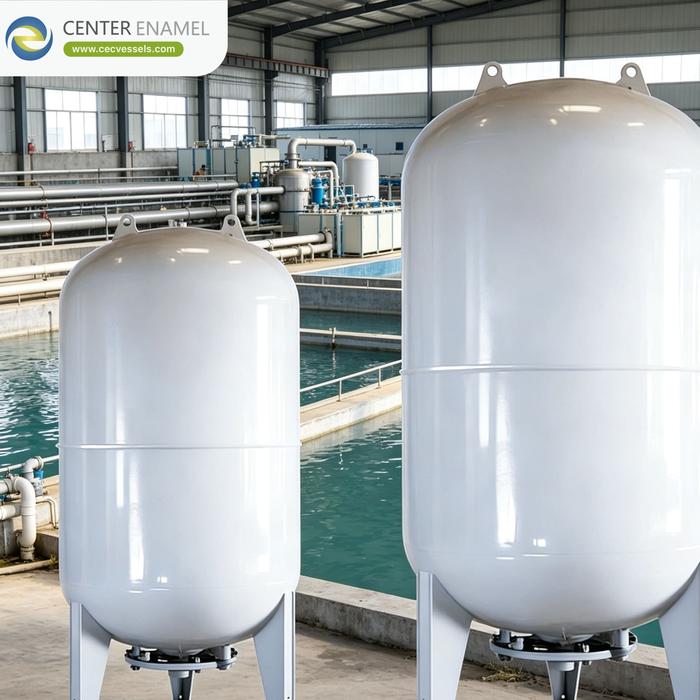
The capacity of a pressure vessel is the internal volume available to contain gas, liquid, or process materials, typically measured in liters or cubic meters. Engineers distinguish between total internal volume, usable working volume, and process throughput. The correct vessel size depends on fluid properties, operating conditions, residence time, equipment configuration, and applicable design codes.
What Does Pressure Vessel Capacity Mean?
Pressure vessel capacity describes how much material a vessel can contain within its internal boundaries. It is an important specification for industrial storage tanks designed for pressure service, chemical reactors, gas-liquid separators, compressed air receivers, and other process equipment.
Three capacity measurements are particularly important:
Total internal volume is the geometric volume enclosed by the vessel's internal shell and heads. It represents the vessel's overall internal space, including areas that may not be filled during normal operation.
Usable working volume is the portion of the internal volume available for the intended process. It depends on the operating liquid level, required vapor space, internal components, and process limitations.
Process throughput is the quantity of material processed or transferred over a specific period, such as liters per minute, cubic meters per hour, or tons per day. Throughput is not the same as vessel capacity because it also depends on flow rate, residence time, and operating cycles.
For example, a vessel with a total internal volume of 5,000 liters may have a normal working liquid volume of 4,000 liters if the operating procedure reserves the remaining space for vapor, expansion, or process control. These values are illustrative; the actual working volume must be established from the vessel design and operating requirements.
What Factors Determine the Capacity of a Pressure Vessel?
The required capacity of an industrial pressure vessel depends on several interconnected engineering and process parameters. Selecting the correct volume requires more than considering the maximum amount of material that can physically fit inside the shell.
1. Process Volume and Production Requirements
The required batch volume or material inventory is often the starting point for sizing a pressure vessel. A chemical reactor must accommodate the intended batch, while a storage vessel must hold the required inventory without interfering with normal process operations.
For example, a process requiring a 3,000-liter liquid batch may need a vessel with a total internal volume greater than 3,000 liters if additional space is necessary for mixing, gas generation, foaming, or thermal expansion. The appropriate allowance depends on the specific material and process.
Engineers should determine the maximum operating volume, minimum operating volume, batch frequency, and required reserve capacity before selecting the final vessel dimensions.
2. Fluid Properties and Operating Conditions
Fluid density, viscosity, temperature, phase behavior, and compressibility influence vessel sizing. A vessel handling a liquid may be sized primarily around liquid inventory, whereas a gas receiver must also account for operating pressure, temperature, and the amount of gas that must be stored.
For instance, a 2,000-liter vessel has a nominal internal volume of 2 cubic meters regardless of the fluid it contains. However, the mass of material stored and the quantity of gas available for use can differ substantially depending on fluid properties and operating conditions.
The design pressure and design temperature must also be established independently of capacity. A larger internal volume does not automatically mean that a vessel is suitable for a particular pressure or temperature.
3. Residence Time and Flow Rate
For continuous processing, residence time describes the average time material spends inside a vessel. It is particularly important for gas-liquid separators, process buffer vessels, and reactors designed for continuous operation.
A simplified relationship is:
Required working volume = Volumetric flow rate × Residence time
For example, if a process handles 10 cubic meters of liquid per hour and requires an average residence time of 15 minutes, the theoretical working volume is:
10 m³/h × 0.25 h = 2.5 m³
This calculation gives a theoretical working volume of 2,500 liters. The final vessel capacity may need to be larger to accommodate operating-level limits, flow variation, mixing requirements, separation performance, or other process conditions.
This simplified relationship is suitable for preliminary sizing only. Actual separator and reactor designs may require additional calculations based on fluid dynamics, phase separation, reaction kinetics, or equipment-specific design methods.
4. Installation Space and Vessel Orientation
The available installation area influences the diameter, length, height, and orientation of a pressure vessel. A vertical vessel can reduce floor-space requirements, while a horizontal configuration may be suitable when building height is limited or when the process benefits from a horizontal arrangement.
For example, a plant with a maximum available installation height of 4 meters may require a different diameter-to-length ratio from a facility with sufficient vertical clearance. Both configurations could provide a similar internal volume, but their foundations, support structures, access arrangements, and piping layouts may differ.
The preferred configuration should be selected according to capacity, site dimensions, maintenance access, nozzle orientation, internal components, and process requirements.
5. Material Selection and Wall Thickness
Pressure vessel materials include carbon steel, stainless steel, and other alloys selected according to the service conditions. Material selection depends on corrosion resistance, fluid compatibility, temperature, mechanical properties, fabrication requirements, and the applicable design code.
Wall thickness affects the internal dimensions of the vessel. For a fixed outside diameter, increasing wall thickness reduces the available internal diameter and therefore the internal volume.
However, wall thickness cannot be determined from capacity alone. Engineers must calculate it using the applicable design rules and relevant parameters, including design pressure, design temperature, material allowable stress, joint efficiency where applicable, corrosion allowance, and the geometry of the vessel.
How Do You Calculate the Capacity of a Pressure Vessel?
The geometric capacity of a pressure vessel can be estimated by calculating the volume of its cylindrical shell and adding the volumes of its heads. The calculation method depends on the vessel geometry.
1. Calculate the Volume of a Cylindrical Shell
For a straight cylindrical section, the internal volume is calculated using:
V = π × D² × L / 4
Where:
V is the cylindrical internal volume.
D is the internal diameter.
L is the straight cylindrical length.
π is approximately 3.1416.
For example, consider a cylindrical vessel with an internal diameter of 1.5 meters and a straight cylindrical length of 3 meters.
V = 3.1416 × 1.5² × 3 / 4
V ≈ 5.30 m³
The cylindrical section therefore has an approximate internal volume of 5.30 cubic meters, equivalent to 5,300 liters.
This example assumes a uniform internal diameter and excludes the vessel heads, nozzles, internal components, and other features that may affect the final capacity.
2. Add the Volume of the Vessel Heads
Many industrial pressure vessels have elliptical, hemispherical, torispherical, or other formed heads. Their volumes must be included when calculating the total internal volume.
For a vessel with two 2:1 ellipsoidal heads, a simplified geometric approximation for each head is:
V = π × D³ / 24
Using an internal diameter of 1.5 meters, the approximate volume of each head is:
V ≈ 3.1416 × 1.5³ / 24
V ≈ 0.442 m³
For two identical heads, the combined volume is approximately 0.884 cubic meters.
Adding the cylindrical section and both heads gives:
Total internal volume ≈ 5.30 + 0.884 = 6.18 m³
The estimated total internal volume is therefore approximately 6,180 liters.
This example assumes idealized 2:1 ellipsoidal heads with compatible internal geometry. Actual head dimensions, forming details, transitions, and manufacturing tolerances must be considered when calculating a production vessel's volume.
3. Determine the Usable Working Volume
The total internal volume is not necessarily equal to the normal operating volume. A process may require space for gas accumulation, liquid expansion, foam, mixing, or level-control operation.
For example, if a vessel has a verified total internal volume of 6,180 liters and its process design permits a normal working liquid volume of 80% of that capacity, the working volume would be:
6,180 × 0.80 = 4,944 liters
The resulting working volume is approximately 4,944 liters, or 4.94 cubic meters.
The 80% figure is an illustrative assumption, not a universal filling limit. The permitted operating level must be established from the actual process, vessel design, applicable requirements, and operating procedures.
What Are the Common Capacity Ranges for Industrial Pressure Vessels?
Industrial pressure vessels are manufactured in different sizes according to their intended application, process conditions, and installation requirements. The following categories are illustrative planning ranges rather than standardized industry classifications.
Small pressure vessels: 100 to 1,000 liters. These vessels may be used for small-volume process duties, laboratory or pilot-scale systems, compact receivers, and localized fluid storage where the design conditions are suitable.
Medium-capacity pressure vessels: 1,000 to 10,000 liters. This range may be appropriate for selected chemical process vessels, buffer vessels, gas-liquid separators, and industrial storage applications. The required capacity depends on batch volume, flow rate, fluid properties, and operating conditions.
Large pressure vessels: 10,000 to 50,000 liters. Larger vessels may be considered for substantial process inventories, utility systems, and specialized industrial storage duties where the vessel's pressure-service requirements permit this configuration.
Custom large-volume vessels: Above 50,000 liters. Some industrial projects require larger engineered vessels or storage systems. Whether a vessel of this size is suitable for pressure service depends on the applicable code, design conditions, fabrication method, transportation limits, and installation requirements.
These ranges should not be interpreted as universal capacity limits. Large atmospheric storage tanks and pressure vessels serve different engineering purposes and must not be treated as interchangeable equipment. The appropriate capacity range should be verified against the actual product specifications and project requirements.
How Does Capacity Differ for Different Types of Pressure Vessels?
The method used to determine capacity depends on the vessel's function. Storage vessels, reactors, and separators may have similar geometric volumes but different operating requirements.
1. Pressure Vessels for Liquid Storage
A liquid storage pressure vessel is sized according to the required inventory, liquid properties, operating conditions, and allowable working level. Engineers should distinguish between total internal volume and the usable liquid volume available during normal operation.
For example, a facility requiring 8,000 liters of usable liquid inventory may need a vessel with a total internal volume greater than 8,000 liters if additional vapor space or operating reserve is necessary.
The design must also account for liquid density, temperature changes, inlet and outlet arrangements, instrumentation, and the applicable pressure vessel code.
2. Pressure Vessels for Chemical Reactions
A chemical reactor must accommodate the batch or continuous process while providing the necessary space for agitation, heat transfer, and process control. Reactor capacity selection depends on batch size, reaction volume changes, gas generation, foaming behavior, and the operating level required for the intended reaction.
For example, a reactor intended for a 4,000-liter batch may require a larger total internal volume if the process needs additional headspace or space for effective mixing.
Jacketed reactors and reactors with internal coils also require consideration of heat-transfer requirements, agitator geometry, nozzle placement, and internal components. The final working volume should be determined by the process design rather than by nominal vessel volume alone.
3. Pressure Vessels for Gas-Liquid Separation
A gas-liquid separator is sized according to gas flow, liquid flow, operating pressure, fluid properties, and the separation performance required. Its dimensions must provide suitable conditions for gas disengagement and liquid collection.
For example, a separator processing 12 cubic meters of liquid per hour with a preliminary target liquid residence time of 5 minutes would require a theoretical liquid working volume of:
12 × 5 / 60 = 1 m³
This gives a preliminary liquid volume of 1 cubic meter. It does not establish the final separator size because gas capacity, phase behavior, droplet removal, liquid-level control, and separator geometry must also be evaluated.
For gas service, actual volumetric flow at operating conditions is especially important because gas volume changes with pressure and temperature.
4. Pressure Vessels for Compressed Air and Gas Storage
A compressed air receiver or gas storage vessel is specified by its internal volume and operating conditions. Its useful storage capacity also depends on the initial and final pressures, temperature, gas properties, and downstream demand.
For example, a 1,000-liter receiver has a geometric internal volume of 1 cubic meter. However, the quantity of compressed air it can deliver between two pressure levels cannot be determined from that volume alone.
Engineers must evaluate the pressure range, gas consumption, compressor delivery rate, allowable operating conditions, and required supply duration to determine the appropriate receiver size.
What Is the Difference Between Vertical and Horizontal Pressure Vessel Capacity?
Vertical and horizontal pressure vessels can provide comparable internal volumes, but their configurations influence installation and process integration.
Vertical pressure vessels generally occupy less floor area for a given diameter and can be suitable for applications requiring vertical phase separation or a compact footprint. Their overall height, support arrangement, and maintenance access must be considered during design.
Horizontal pressure vessels may be appropriate when installation height is restricted or when a horizontal configuration supports the required liquid inventory, separation arrangement, or process layout. They typically require consideration of support spacing, foundation loads, and the available installation length.
Neither configuration is universally superior. For example, a project requiring approximately 6 cubic meters of internal volume could potentially use either orientation, provided the selected dimensions, internal components, structural design, and process performance meet the project's requirements.
Which Design Standards Apply to Pressure Vessel Capacity?
Pressure vessel capacity calculations establish geometric volume, but they do not demonstrate that the vessel is structurally suitable for its intended service. Design and fabrication must follow the applicable code and regulatory requirements.
ASME Boiler and Pressure Vessel Code
The ASME Boiler and Pressure Vessel Code, particularly Section VIII where applicable, provides requirements for the design and construction of covered pressure vessels. The relevant edition, division, material rules, inspection requirements, and certification obligations must be established for the project.
Capacity is one of several design inputs. Compliance also requires appropriate consideration of pressure, temperature, material properties, joint details, openings, loads, and other applicable requirements.
EN 13445 for Unfired Pressure Vessels
EN 13445 addresses unfired pressure vessels and may be relevant to projects designed for European markets. The applicable edition and conformity requirements depend on the equipment classification, intended use, and regulatory framework.
The vessel's internal volume must be determined consistently with its actual geometry, while structural calculations must address the relevant design conditions and applicable code requirements.
GB/T 150 for Pressure Vessels in China
The GB/T 150 series provides technical requirements for metal pressure vessels in China. The applicable parts and edition should be confirmed according to the project scope, vessel type, and relevant regulatory requirements.
For international projects, the manufacturer and purchaser should agree on the governing design code, inspection scope, documentation, and certification requirements before detailed engineering begins.
No single code should be assumed to apply to every pressure vessel. Atmospheric storage tanks may be governed by different standards from vessels designed for pressure service, so the equipment category must be identified correctly.
What Components Affect the Usable Capacity of a Pressure Vessel?
The usable capacity of a pressure vessel can differ from its geometric internal volume because of its internal configuration and operating requirements.
Vessel shell and heads define the primary containment geometry and determine most of the internal volume.
Internal baffles and internals influence fluid circulation, mixing, separation, and the space available for the intended process.
Inlet and outlet nozzles affect fluid distribution, drainage, and process integration. Their configuration may also influence how effectively the vessel's volume can be used.
Level indicators and instrumentation help operators monitor the liquid level and maintain the intended operating range.
Manways and inspection openings provide access for inspection and maintenance. Their locations and structural reinforcement must be incorporated into the vessel design.
Supports and foundations affect installation, structural loads, and equipment arrangement, although they do not directly determine the internal geometric volume.
These components should be included in the engineering layout so that the selected vessel provides the required working capacity, process performance, and maintenance access.
How Can You Select the Right Pressure Vessel Capacity?
Selecting the appropriate industrial pressure vessel capacity requires coordination between process engineering, mechanical design, and installation planning.
First, define the required inventory or production duty. Identify whether the vessel is intended for storage, batch reaction, continuous processing, or gas-liquid separation.
Second, establish the operating conditions. Specify the fluid composition, density, viscosity, operating temperature, design temperature, operating pressure, and design pressure as applicable.
Third, calculate the required working volume. Use the batch volume or, where appropriate, the relationship between volumetric flow rate and residence time. Apply process-specific calculations when simple volume relationships are insufficient.
Fourth, determine the total internal volume. Account for the vessel shell, head geometry, operating-level limits, vapor space, and any process allowances.
Fifth, select the configuration and material. Evaluate vertical or horizontal orientation, corrosion resistance, heat-transfer requirements, internal components, and installation constraints.
Finally, verify the mechanical design. Confirm the applicable design code, material specifications, fabrication requirements, inspection plan, testing requirements, and documentation before manufacturing.
A pressure vessel manufacturer can use these project inputs to evaluate the required capacity and develop a vessel specification suited to the actual application.
How Does Maintenance Affect Pressure Vessel Capacity?
The designed internal volume of a pressure vessel is determined by its geometry, but deposits, corrosion, and changes to internal components can affect its effective operating performance over time.
Sediment and scale accumulation may reduce the usable volume available for certain liquid-handling processes and interfere with drainage or heat transfer. Inspection and cleaning intervals should be based on the fluid properties, service conditions, and maintenance plan.
Corrosion and wall-thickness changes require appropriate inspection and engineering assessment. Ultrasonic thickness measurements and other suitable nondestructive examination methods can help evaluate material condition, but inspection findings must be assessed against the applicable acceptance criteria.
Instrumentation calibration helps maintain accurate liquid-level and process measurements. Incorrect readings can lead to operating levels that differ from the intended range.
Internal modifications may change flow distribution, mixing, separation performance, or available working space. Any modification affecting the vessel's design or pressure boundary should be evaluated and approved in accordance with applicable requirements.
Maintenance does not normally change the vessel's original nominal geometric capacity unless its configuration is modified. It helps preserve the intended operating performance and provides information needed for continued safe service.
How Does Center Enamel Support Industrial Pressure Vessel Projects?
Center Enamel provides industrial equipment solutions for applications involving chemical processing, fluid storage, separation, and utility systems. Selecting an appropriate vessel requires an understanding of the process duty, required volume, materials, installation conditions, and applicable design requirements.
For example, a chemical processing project may require a combination of resin tanks, oil separators, compressed air receivers, condensate tanks, and steam distribution cylinders. Each item must be sized according to its specific function rather than assigned a common capacity based only on the overall plant output.
Center Enamel works with project requirements to evaluate equipment configuration, material selection, fabrication specifications, and relevant design standards. Actual manufacturing capabilities, available capacity ranges, and project compliance should be confirmed against the specifications of the proposed equipment.
To request a pressure vessel quotation, provide the intended application, required working and total volume, fluid properties, operating and design conditions, preferred material, installation dimensions, and applicable design code. These details help establish a suitable technical basis for vessel selection and project evaluation.
Frequently Asked Questions About Pressure Vessel Capacity
1. What Is the Standard Capacity of a Pressure Vessel?
There is no single standard capacity for all pressure vessels. Capacity depends on the intended application, process requirements, design conditions, and available equipment configuration. Industrial vessels may range from small units of a few hundred liters to large custom-engineered vessels exceeding tens of thousands of liters. The appropriate range must be confirmed for the specific service.
2. How Is Pressure Vessel Capacity Measured?
Pressure vessel capacity is generally measured in liters, cubic meters, or gallons. One cubic meter equals 1,000 liters, and one liter equals 0.001 cubic meters. For example, a vessel with an internal volume of 5 cubic meters has a geometric capacity of 5,000 liters.
3. How Do You Calculate Pressure Vessel Volume?
For a cylindrical shell, calculate the internal volume using V = π × D² × L / 4, where D is the internal diameter and L is the straight cylindrical length. Add the volumes of the heads to estimate the total internal volume. The final calculation should reflect the actual geometry and relevant internal features.
4. What Is the Difference Between Total Volume and Working Volume?
Total internal volume is the geometric space enclosed by the vessel's internal surfaces. Working volume is the portion used during normal operation. For example, if a vessel has a total volume of 5,000 liters and the process design specifies a working volume of 4,000 liters, the working volume is 80% of the total. This ratio is an example, not a universal operating requirement.
5. Does Higher Pressure Mean a Larger Pressure Vessel Is Required?
No. Design pressure and vessel capacity are different specifications. Capacity describes internal volume, while design pressure is an engineering condition used to establish the vessel's mechanical design. A higher design pressure may affect wall thickness, material selection, and structural details, but it does not automatically require a larger internal volume.
6. How Do You Size a Pressure Vessel for Continuous Processing?
A preliminary estimate can be obtained by multiplying the required volumetric flow rate by the target residence time. For example, a liquid flow rate of 8 cubic meters per hour and a residence time of 10 minutes give a theoretical working volume of approximately 1.33 cubic meters. Final sizing must also account for process behavior, operating levels, and equipment-specific requirements.
7. Which Is Better for Capacity: a Vertical or Horizontal Pressure Vessel?
Neither configuration is always better. A vertical vessel may reduce floor-space requirements, while a horizontal vessel may suit sites with limited headroom. The decision depends on the required volume, process duty, site layout, structural supports, internal components, and maintenance access.
8. Which Design Codes Apply to Pressure Vessel Capacity?
Relevant standards may include the ASME Boiler and Pressure Vessel Code, EN 13445, and the GB/T 150 series, depending on the project and regulatory requirements. These standards address pressure vessel design and construction rather than defining one universal capacity for all equipment. The applicable code and edition should be confirmed during project engineering.
9. Can a Pressure Vessel Be Customized to a Required Capacity?
Yes. Many industrial pressure vessels can be engineered around a specified volume, subject to the manufacturer's capabilities and the applicable design requirements. Customization may involve diameter, length, head geometry, material, nozzle arrangement, internal components, and vessel orientation. The final design must satisfy both process requirements and mechanical design criteria.
10. What Information Is Needed to Request a Pressure Vessel Quotation?
A useful inquiry should include the required total and working volume, fluid or material handled, operating and design pressure, operating and design temperature, material requirements, process application, installation dimensions, and applicable design code. Flow rate, batch size, residence time, drawings, and connection details should also be provided when relevant. Complete information helps the manufacturer assess the required configuration and prepare a more accurate technical proposal.
Discuss Your Pressure Vessel Capacity Requirements
Choosing the correct pressure vessel capacity requires a clear understanding of internal volume, working volume, process throughput, operating conditions, and applicable engineering standards. Accurate sizing helps align equipment selection with production requirements, installation constraints, and long-term operating needs.
If you are planning an industrial storage, chemical processing, or separation project, contact Center Enamel with your required capacity, process specifications, material preferences, and design conditions to discuss a suitable pressure vessel solution.


