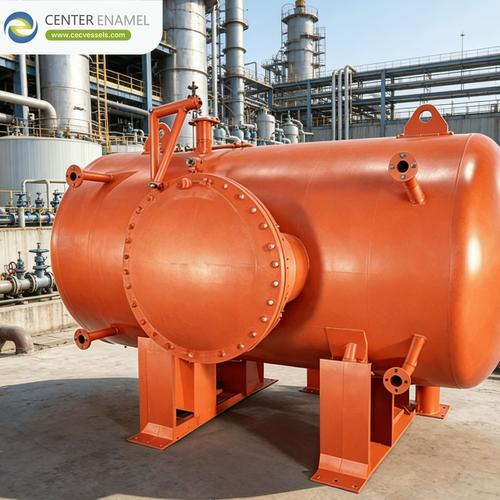
An oil water separator is a process vessel designed to separate free oil, hydrocarbons, and grease from water by using differences in density. Because oil is generally less dense than water, oil droplets rise toward the surface while water remains below. The separated oil can then be collected and removed. Oil water separators are commonly used in industrial wastewater treatment, refineries, manufacturing facilities, transportation facilities, and process-water systems.
How Does an Oil Water Separator Work?
An oil water separator works primarily by reducing the velocity of an oil-contaminated water stream so that oil droplets have enough residence time to separate from water. The separation process is mainly based on the difference in density between oil and water.
When the incoming mixture enters the separator, the flow is distributed through the vessel to reduce turbulence. Larger and lighter oil droplets rise toward the upper part of the vessel, while water moves downward or continues through the separation chamber. The accumulated oil layer can then be removed from the surface.
The effectiveness of oil water separation depends on factors such as oil droplet size, density difference, temperature, flow rate, residence time, and the physical configuration of the separator.
What Is the Basic Principle of Oil Water Separation?
The basic principle of an oil water separator is gravity separation based on density differences. Oil generally has a lower density than water, so free oil tends to rise when the mixture is allowed to remain relatively undisturbed.
The separation process can be described in three basic stages:
1. Flow Distribution: Oil-contaminated water enters the separator and is distributed across the separation zone.
2. Gravity Separation: The flow velocity is reduced, allowing oil droplets to move upward and water to remain in the lower portion of the vessel.
3. Oil Collection: The separated oil accumulates at the surface and is removed through an oil collection or skimming system.
This simple principle makes gravity-based separation suitable for removing relatively large free-oil droplets from water.
What Are the Main Types of Oil Water Separators?
The main types of oil water separators include gravity separators, coalescing plate separators, and flotation-based separation systems. Each type uses a different mechanism to improve the separation of oil from water.
1. Conventional Gravity Oil Water Separator
A gravity oil water separator uses the density difference between oil and water as its primary separation mechanism. The vessel provides sufficient retention time for larger oil droplets to rise naturally to the surface.
This type of separator typically includes an inlet section, separation chamber, oil collection area, water outlet, and sludge collection zone.
Gravity separators are commonly used where the wastewater contains relatively large quantities of free oil and the oil droplets are sufficiently large for gravitational separation.
2. Coalescing Plate Oil Water Separator
A coalescing plate oil water separator uses inclined plates or other coalescing media to improve the separation of smaller oil droplets.
As contaminated water flows through the plate pack, small oil droplets contact the surfaces of the plates and combine into larger droplets. The larger droplets then rise more easily because of their lower density relative to water.
The main advantage of a coalescing plate separator is that it can improve oil removal compared with a conventional gravity separator when smaller oil droplets are present.
3. Dissolved Air Flotation Separator
A dissolved air flotation separator, commonly called a DAF system, separates fine oil droplets and suspended particles by using small air bubbles.
In a DAF system, air is dissolved into a portion of the water stream. When the pressure is reduced, small bubbles are released. These bubbles attach to oil droplets and suspended particles, increasing their effective buoyancy and carrying them toward the water surface.
The floating material can then be removed from the surface.
DAF separation is an enhanced flotation-based separation method and is particularly useful when wastewater contains fine oil droplets or suspended solids that are not readily removed by gravity alone.
What Is the Difference Between Gravity and Coalescing Oil Water Separators?
A gravity oil water separator mainly relies on density differences and sufficient residence time, while a coalescing separator uses additional internal media to encourage small oil droplets to combine into larger droplets.
Gravity separation is generally suited to relatively large free-oil droplets. Coalescing systems can improve the removal of smaller dispersed oil droplets by increasing the effective droplet size before gravity separation occurs.
Therefore, the appropriate configuration depends on the characteristics of the incoming wastewater, including oil concentration, droplet size, water flow rate, and required separation performance.
What Is an API Oil Water Separator?
An API oil water separator is a gravity-based oil-water separation system associated with the design principles developed by the American Petroleum Institute for separating free oil from wastewater.
An API-type separator typically provides a controlled flow path and sufficient residence time for oil droplets to rise toward the surface. The separated oil is collected from the upper layer, while treated water exits through the downstream section.
API separators are commonly associated with petroleum refining, petrochemical operations, and other industrial wastewater applications where free oil separation is required.
What Components Does an Oil Water Separator Have?
An industrial oil water separator may contain several components designed to control flow, improve separation, and collect separated materials.
Common components include:
Inlet Section: Distributes incoming wastewater and reduces excessive turbulence.
Separation Chamber: Provides the required volume and residence time for oil droplets to separate from water.
Coalescing Media: Provides surfaces that encourage smaller oil droplets to combine into larger droplets.
Oil Collection System: Collects the oil layer that accumulates at the surface.
Water Outlet: Allows separated water to leave the vessel while limiting the carryover of floating oil.
Sludge Collection Area: Provides space for heavier suspended solids and settled material.
The exact configuration depends on the wastewater characteristics and the required treatment process.
What Factors Affect Oil Water Separation?
Several operating and physical factors influence the performance of an oil water separator.
Oil Droplet Size: Larger oil droplets generally separate more easily by gravity than very small droplets.
Density Difference: A greater difference between the density of oil and water generally supports faster gravitational separation.
Flow Rate: Higher flow rates can reduce effective residence time and affect separation efficiency.
Residence Time: Adequate residence time allows oil droplets more opportunity to rise to the surface.
Temperature: Temperature can influence oil viscosity and droplet behavior, which may affect separation.
Turbulence: Excessive turbulence can keep oil droplets dispersed in water and reduce the effectiveness of gravity separation.
Internal Configuration: Baffles, plates, coalescing media, and flow-distribution components can influence the movement of oil and water through the vessel.
Where Are Oil Water Separators Used?
Oil water separators are used in many industrial and commercial applications where free oil needs to be separated from water.
Typical applications include:
Petroleum refineries
Petrochemical plants
Oil and gas facilities
Industrial wastewater treatment
Metal processing facilities
Manufacturing plants
Vehicle maintenance and washing facilities
Marine and transportation facilities
Process-water treatment systems
The specific separator design should be selected according to the composition of the wastewater, flow conditions, oil characteristics, and downstream treatment requirements.
What Is the Difference Between an Oil Water Separator and a Water Treatment System?
An oil water separator is a specific separation unit, while a complete water treatment system may contain multiple treatment stages.
An oil water separator primarily targets free oil and hydrocarbons that can be separated through gravity, coalescence, or flotation. A broader industrial wastewater treatment system may additionally include filtration, chemical treatment, biological treatment, dissolved air flotation, sludge handling, or other process units.
Therefore, an oil water separator can function as one stage within a larger wastewater treatment process rather than representing the entire treatment system.
How Do You Select an Oil Water Separator?
Selecting an oil water separator requires an evaluation of the incoming water characteristics and the intended treatment process.
Important selection factors include:
Flow Capacity: The separator should accommodate the expected wastewater flow rate without creating excessive turbulence.
Oil Characteristics: Oil density, viscosity, concentration, and droplet size affect the appropriate separation method.
Water Quality: Suspended solids and other contaminants may influence the internal configuration and pretreatment requirements.
Separation Method: Gravity, coalescing, and flotation systems provide different approaches for separating oil from water.
Residence Time: The vessel should provide sufficient separation volume for the intended process conditions.
Material Selection: Construction materials should be compatible with the wastewater and operating environment.
Maintenance Requirements: The design should provide practical access for oil removal, sludge removal, inspection, and cleaning.
A properly selected oil water separator should match the actual wastewater conditions rather than relying on vessel size alone.
Why Is Residence Time Important in an Oil Water Separator?
Residence time is important because oil droplets need sufficient time to move upward through the water under gravitational forces.
If wastewater passes through the separator too quickly, smaller oil droplets may not have enough time to rise before reaching the outlet. Increasing the effective separation volume or improving internal flow distribution can provide more favorable conditions for oil-water separation.
For this reason, flow rate, vessel dimensions, inlet design, outlet configuration, and internal separation components should be considered together when designing an oil water separator.
Oil Water Separator for Industrial Applications
An industrial oil water separator provides a dedicated process stage for separating free oil and hydrocarbons from water. Depending on the application, the equipment may use gravity separation, coalescing technology, or flotation-based separation.
For industrial applications, equipment configuration can be adapted to factors such as wastewater flow rate, oil concentration, droplet size, suspended solids content, material compatibility, and integration with upstream and downstream treatment equipment.
Center Enamel provides industrial process equipment solutions that can be configured according to specific separation and wastewater treatment requirements. The appropriate oil water separator design depends on the characteristics of the process stream and the required treatment objectives.
Key Points About Oil Water Separators
An oil water separator is a process vessel that separates free oil and hydrocarbons from water primarily by exploiting differences in density.
The main points are:
Gravity separation allows larger oil droplets to rise naturally.
Coalescing separators help smaller oil droplets combine into larger droplets.
DAF systems use fine air bubbles to enhance the flotation of fine oil droplets and suspended solids.
API separators are gravity-based systems commonly associated with petroleum and industrial wastewater applications.
Flow rate, residence time, oil droplet size, density, temperature, and vessel configuration all affect separation performance.
An oil water separator can be used as an individual separation unit or as part of a larger industrial wastewater treatment system.
Choosing the Right Oil Water Separation Method
The appropriate oil water separation method depends on the physical characteristics of the wastewater and the required treatment process. Gravity separators are suitable for free oil with relatively large droplets, while coalescing systems can improve the separation of smaller dispersed oil droplets. Flotation-based systems such as DAF can provide enhanced separation when fine oil droplets and suspended solids are present.
Understanding the difference between these technologies helps engineers select an oil water separator that matches the actual process conditions, flow requirements, and downstream treatment system.


