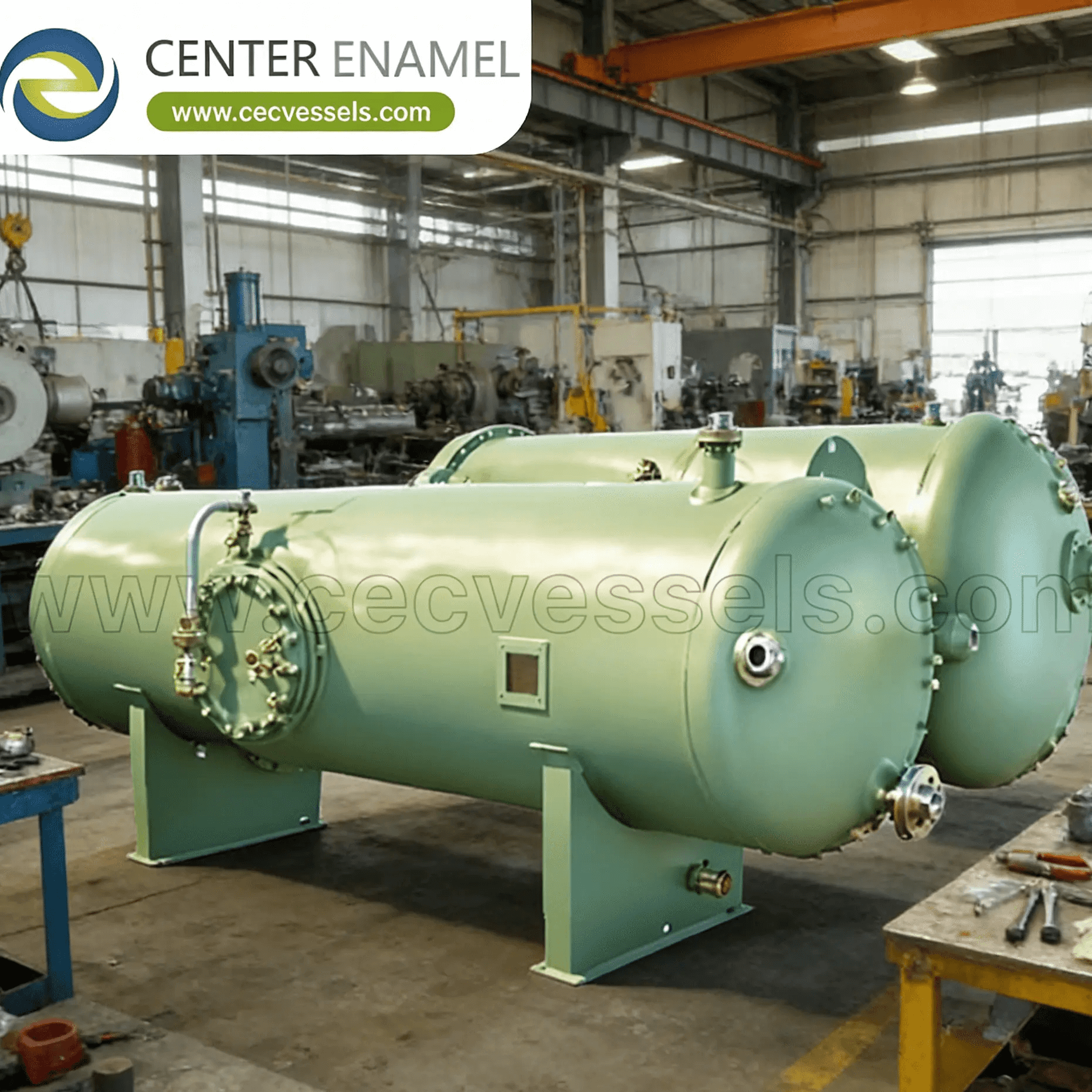
What Is The Purpose Of A Steam Separator?
In industrial steam systems, the presence of moisture can significantly reduce thermal efficiency and cause mechanical issues in downstream equipment. A steam separator is a specialized pressure vessel designed to remove entrained water droplets from steam flow, ensuring that only high-quality "dry" steam reaches the production process. As a professional Steam Separator Manufacturer, Center Enamel develops these essential components to optimize energy transfer and maintain the operational stability of refineries, chemical plants, and food processing facilities worldwide. The Fundamental Function of Steam Separation
Steam is used as a primary energy carrier because of its high latent heat. However, as steam travels through pipelines, it naturally loses heat, causing some of the vapor to condense into liquid water droplets. This "wet steam" is less efficient because the liquid water does not contribute to the heating process and occupies space within the pipes.
As a leading China Steam Separator Manufacturer, Center Enamel engineering focuses on the mechanical separation of these phases. By utilizing internal baffles or centrifugal force, the separator forces the heavier water droplets to drop out of the steam cloud, allowing the lighter dry steam to continue toward the heat exchangers or turbines. This process is vital for any facility relying on boiler pressure vessels for their utility needs. Primary Purposes of Installing a Steam Separator
The integration of a steam separator into a steam distribution network serves several critical industrial purposes:
1. Improving Heat Transfer EfficiencyDry steam has a higher heat transfer coefficient than wet steam. When water droplets coat the internal surfaces of a heat exchanger or a tube heat exchanger, they act as an insulating layer, slowing down the transfer of thermal energy. By removing this moisture, a steam separator ensures that the steam can release its latent heat rapidly and uniformly.
2. Protecting Downstream EquipmentLiquid water moving at high velocities can be destructive. In steam systems, this is known as "water hammer." Additionally, water droplets can cause erosion on turbine blades and valve seats. By functioning as a protective pressure vessel, the steam separator removes the liquid phase before it can cause mechanical wear on expensive system components.
3. Ensuring Process Product QualityIn industries like food processing, textile manufacturing, or chemical synthesis, steam often comes into direct contact with the product. If the steam contains moisture or impurities, it can spoil the batch or cause inconsistent results. Center Enamel designs separators to provide the high-purity steam required for sensitive industrial applications.
4. Accurate Metering and ControlFlow meters and control valves are calibrated for gas-phase fluids. The presence of liquid droplets can lead to inaccurate readings and erratic valve behavior. A steam separator provides a consistent gas-phase medium, allowing for precise control of the refinery utility system. Structural Design and Operating Mechanisms
To achieve high separation efficiency, Center Enamel utilizes various internal configurations tailored to the flow rate and pressure requirements of the facility.
1. Baffle Type SeparatorsThese vessels contain a series of internal plates (baffles) that force the steam to change direction multiple times. Because water is much denser than steam, the droplets cannot change direction as quickly and collide with the baffles, eventually trickling down to the collection sump at the bottom of the vessel.
2. Centrifugal (Cyclone) SeparatorsIn this design, the steam enters the vessel at an angle, creating a high-velocity swirl. Centrifugal force throws the heavier water droplets against the outer wall of the shell, where they lose momentum and drain away. This type is particularly effective for high-velocity steam lines.
3. Coalescing SeparatorsThese units use a wire mesh or specialized internal media to catch even the smallest microscopic droplets. As the droplets gather on the mesh, they "coalesce" into larger drops that are heavy enough to fall into the drainage area. This technology is often paired with coalescing oil separators in integrated refinery projects.
Technical Specifications and Material Selection
Center Enamel provides customizable technical specifications to ensure that every steam separator is perfectly matched to its intended industrial environment:
Vessel Configurations: Available in vertical and horizontal cylindrical layouts to fit specific pipeline orientations.
Material Grades: High-quality 304 and 316 Stainless Steel for superior corrosion resistance in clean-steam applications, and high-strength Carbon Steel for general refinery utility and boiler systems.
Pressure Ranges: Expertly designed for Low Pressure and Medium Pressure industrial applications.
Volume and Scale: Customizable solutions starting from above 1 cubic meter, with nozzle sizes engineered to match the existing steam distribution network.
Integration with Other Industrial Pressure Vessels
A steam separator is a key component in a wider network of fluid management. Center Enamel provides a comprehensive range of equipment that works in tandem with these units:
Steam Distribution Cylinders: Acting as the primary header that receives dry steam from the separator before distributing it to different processing units.
Condensate Tanks: Collecting the water removed by the steam separator so it can be treated and recycled back into the boiler, improving the facility's water and energy efficiency.
Tube Heat Exchangers: Utilizing the high-quality dry steam provided by the separator to achieve maximum thermal efficiency.
Resin Tanks and Fiber Adsorption Tanks: Specialized units in chemical plants that require precise steam heating for material purification.
Boiler Pressure Vessels: The original source of the steam, which relies on downstream separators to maintain the integrity of the entire steam loop.
Engineering Design Standards and Global Compliance
The reliability of a steam separator as a pressure vessel is guaranteed by strict adherence to international fabrication codes. Center Enamel ensures that every shell, head, and nozzle is built to the highest safety and performance benchmarks.
ASME Boiler and Pressure Vessel Code (BPVC)The ASME code is the international benchmark for pressure equipment. Section VIII provides the rules for design, material selection, and fabrication. As a certified Steam Separator Manufacturer, Center Enamel ensures that its vessels are designed with the necessary safety margins for continuous 24-hour operation in demanding refinery environments.
GB/T 150.1-150.4-2024The GB/T 150 series is the national standard for metal pressure vessels in China. The 2024 update represents the latest advancements in welding technology and material testing. Adhering to these standards ensures that our separators are optimized for modern industrial performance and are compatible with international infrastructure requirements.
BS EN 13445For the European market, BS EN 13445 provides harmonized rules for unfired pressure vessels. It places a heavy emphasis on material fatigue and stress analysis, ensuring the equipment remains reliable even under frequent thermal cycling.
Our high-performance pressure vessels serve a vast industrial landscape, from petroleum refining and chemical processing to food, dairy, and brewing. We deliver precision-engineered solutions for pharmaceuticals, power generation, and wastewater treatment, ensuring compliance with the world’s most stringent safety codes. Our systems are designed for peak efficiency and longevity, empowering global partners to excel in even the most challenging environments.
1. Chemical Industry Project l Project Location: Hubei, China l Pressure Vessels: Resin tanks, Coalescing oil separators, Fiber adsorption tanks, Compressed air storage tanks, Condensate tanks, and Steam distribution cylinders l Material: Stainless Steel and Carbon Steel. l Design Standards: GB/T 150 (Pressure Vessels) l Application: Integrated chemical fluid processing, separation, and steam distribution for chemical plants
2. Seawater Desalination Project l Project Location: Malta l Pressure Vessels: Concentrated Sulfuric Acid Storage Tanks (Vertical layout) l Material: Carbon Steel l Design Standards: EN 13445 l Application: Storage of 98% concentrated sulfuric acid.
3. Waste-to-Energy Incineration Project l Project Location: Hebei, China l Pressure Vessels: Large-scale Landfill Leachate Storage and Treatment Tanks (2 Sets) l Material: Carbon Steel l Design Standards: GB 50341-2003 and GB 50128-2005. l Application: Wastewater Treatment
4. Aquaculture Wastewater Treatment Project l Project Location: Sichuan, China l Pressure Vessels: Vertical Wastewater Treatment Vessels (Φ 6×16.5 m (h) 1 set; Φ 7.6×16.5 m (h) 1 set) l Material: Carbon Steel l Design Standards: National standard for vertical cylindrical storage tanks. l Application: Aquaculture Wastewater Treatment
Maintenance and Structural Integrity
To ensure a steam separator continues to operate efficiently, regular maintenance is essential. For ASME-certified vessels, requirements typically include:
Periodic Inspections: Regular visual and non-destructive testing (NDT), such as ultrasonic thickness checks, to monitor for corrosion or erosion in the shell and internal baffles caused by high-velocity steam.
Steam Trap Inspection: The separator relies on a steam trap to discharge the collected water. If the trap fails, the separator will flood and stop working. Regular testing of the trap mechanism is vital.
Internal Cleaning: Removing mineral deposits or scale that may have been carried over from the boiler, ensuring that the internal flow paths remain clear.
Safety Valve Calibration: Verifying that pressure relief valves are functional and correctly set to protect the structural integrity of the vessel during unexpected process variations.
The Center Enamel Manufacturing Advantage
Choosing Center Enamel as your China Steam Separator Manufacturer means partnering with a leader in technical innovation and quality fabrication.
Integrated Design and EngineeringOur team utilizes Finite Element Analysis (FEA) to simulate how pressure, fluid velocity, and thermal loads will affect the vessel shell and internal baffles. This allows us to optimize the design for both performance and efficiency before manufacturing begins.
Advanced Fabrication TechnologyWe utilize automated welding systems and CNC machining for nozzle attachments and internal supports to ensure that every connection is perfect. This commitment to precision ensures that our vessels meet the strict inspection criteria of GB/T 150-2024 and ASME.
Comprehensive Quality AssuranceEvery steam separator produced by Center Enamel undergoes a battery of tests, including hydrostatic pressure testing and helium leak testing, to verify its structural integrity and leak-proof performance. Summary of Steam Separator Excellence
In conclusion, the purpose of a steam separator is to safeguard the efficiency and longevity of an industrial steam system. By removing moisture and ensuring the delivery of dry, high-quality steam, these vessels prevent mechanical damage and optimize heat transfer for refineries and chemical plants. By adhering to international design standards like ASME BPVC and the updated GB/T 150.1-150.4-2024, Center Enamel delivers high-performance solutions that offer both efficiency and long-term durability. As a dedicated China Steam Separator Manufacturer, our focus on quality materials, advanced engineering, and rigorous testing ensures that our products support the long-term success of our global partners.
Let’s build a safer, more efficient future together. If you have an upcoming project that demands high-durability pressure vessels, we are here to help. Please send your requirements to our team, and our technical experts will connect with you promptly to ensure your project meets the highest industrial standards.
|